

IoT HVAC Automation: 7 Powerful Ways It Cuts Cooling Costs in Commercial Buildings
IoT HVAC automation is the single most impactful upgrade a commercial building can make in 2026. HVAC systems account for 40 to 60 percent of total electricity consumption in most facilities — yet the majority still operate on fixed schedules, manual overrides, and static setpoints with no connection to actual occupancy or real-time load data.
The result is predictable: cooling runs in empty spaces, compressors cycle unnecessarily, and electricity bills arrive with no clear explanation for why costs keep rising month after month.
IoT HVAC automation changes all of this. This blog covers 7 specific, measurable ways it does so — and why facilities across India are treating it as a foundational infrastructure investment, not an optional upgrade.
1. IoT HVAC Automation Aligns Cooling With Actual Occupancy
The biggest source of HVAC waste in commercial buildings is straightforward: cooling runs when no one is there.
Conference rooms cool down an hour before meetings start. Office wings stay at full temperature on public holidays. Retail floors run at identical setpoints at 10 AM and 9 PM, regardless of footfall.
IoT HVAC automation connects cooling schedules directly to real occupancy data — from access control systems, motion sensors, or booking calendars. When a zone is unoccupied, cooling reduces automatically. When occupancy increases, the system responds in real time. This single capability alone typically delivers 12 to 18 percent reduction in HVAC electricity consumption — without any compromise on occupant comfort.
2. IoT HVAC Automation Eliminates After-Hours Energy Waste
One of the most consistent findings when a new SIOTA client goes live is after-hours HVAC running completely undetected. ACs left on after office closure. Cooling continuing through the night in unoccupied areas. Systems that were never properly shut down at end of day.
IoT HVAC automation enforces operating schedules automatically. Systems switch off at defined times, with override capabilities available to authorised users only. Exceptions are logged and flagged — so a 3 AM air conditioning alert is visible to the facility manager the next morning, not discovered on the electricity bill. For the full picture on why manual processes fail at scale, read our blog on Why Manual AC Switching Breaks Down Beyond 20 Units.
3. IoT HVAC Automation Enables Centralised Multi-Location Control
For organisations managing multiple facilities — retail chains, co-working networks, bank branches, hospital campuses — the traditional approach requires either on-site staff at every location, or accepting that HVAC at remote sites is largely unmanaged.
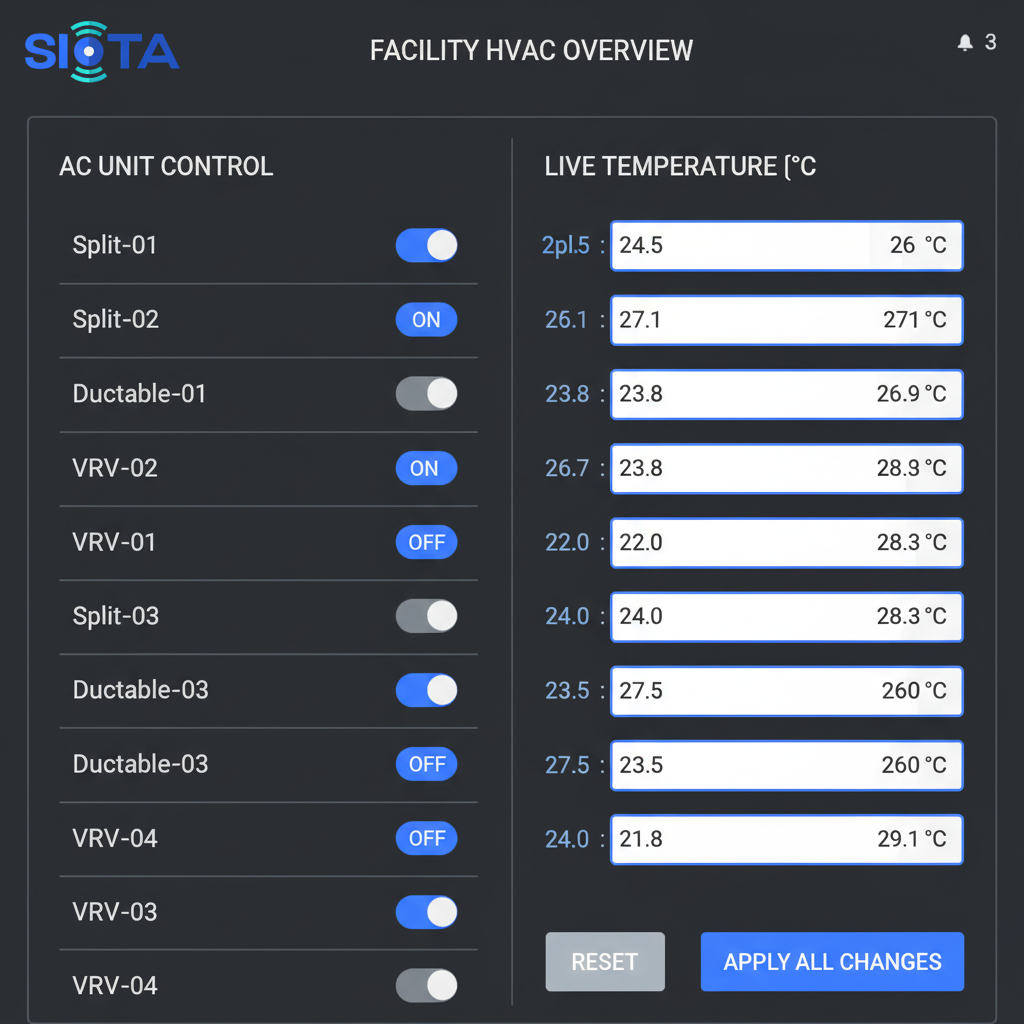
IoT HVAC automation changes this entirely. A single dashboard gives facility teams live visibility and control across all sites from one interface. Temperature setpoints, operating schedules, and override permissions can be managed centrally. One facility manager can effectively oversee HVAC across 20, 50, or 200 locations. Our post on Why Centralized HVAC Control Is the Missing Layer in Co-Working Operations explores this in detail for co-working operators specifically.
| 🔍 Free HVAC Energy Audit — Find Out Exactly What You’re Losing
If your facility is still managing HVAC manually, you’re likely spending 15–25% more on cooling than necessary. Our team will assess your current setup and show you — in numbers — what IoT automation would save you. No obligation, no sales pitch. |
4. IoT HVAC Automation Enables Dynamic Temperature Bands
Most HVAC systems operate on fixed setpoints — a target temperature the system maintains regardless of conditions. This is inherently inefficient because conditions are never static.
IoT HVAC automation replaces fixed setpoints with dynamic temperature bands. Instead of maintaining exactly 22°C at all times, the system allows a comfort band of 22°C to 24°C and operates the compressor only when temperature moves outside that range.
What Dynamic Bands Achieve
- Reduced compressor cycling — fewer on/off cycles means significantly extended equipment life
- Lower electricity consumption — compressors run less frequently and for shorter durations
- Maintained occupant comfort — bands are set within accepted comfort parameters
- Time-of-day adjustment — tighter bands during peak occupancy, wider bands during off-peak hours
5. IoT HVAC Automation Reduces Unnecessary Compressor Operation
Compressor operation is the primary driver of HVAC electricity consumption. Every unnecessary compressor start is wasted energy and accelerated wear.
IoT HVAC automation reduces compressor operation through three mechanisms: demand-based control that prevents cooling beyond actual requirements, pre-cooling strategies that bring spaces to target temperature efficiently before peak occupancy, and intelligent restart management that prevents short cycling after power interruptions.
Facilities implementing IoT HVAC automation consistently report extended equipment life alongside reduced energy consumption — the two outcomes facility teams care most about.
6. IoT HVAC Automation Provides Data for Predictive Maintenance
HVAC systems fail expensively. A compressor failure during peak summer in a data centre, hospital, or food storage facility is not just inconvenient — it is a business-critical event.
IoT HVAC automation continuously monitors performance parameters — temperature differentials, run times, current draw, and airflow. Deviations from baseline performance are flagged before they become failures. A compressor drawing 15 percent more current than normal for its load condition is showing early signs of degradation — an IoT system flags this for preventive maintenance.
This connects directly to SIOTA’s broader approach to IoT-Based Predictive Maintenance — where continuous monitoring across all building systems enables maintenance planning based on actual equipment condition, not just age or scheduled intervals.
7. IoT HVAC Automation Integrates With Energy Monitoring for Full Visibility
HVAC automation is most powerful when it operates as part of an integrated energy intelligence system — not as a standalone tool.
When IoT HVAC automation is connected to real-time energy monitoring, facility teams can see the direct relationship between cooling decisions and electricity consumption. They can identify which zones contribute most to peak demand, correlate HVAC load with production schedules or occupancy patterns, and make operational decisions based on both comfort and cost data simultaneously.
This integration is central to how SIOTA approaches facility intelligence. Our Unified Energy and HVAC Intelligence Dashboard brings HVAC automation, energy monitoring, and DG management into a single view — so facility teams and leadership always work from the same operational reality.
Which Buildings Benefit Most From IoT HVAC Automation?
IoT HVAC automation delivers the strongest return in buildings where:
- HVAC is the dominant energy cost — typically 40 to 60 percent of total electricity consumption
- Multiple zones or floors have significantly different occupancy patterns throughout the day
- Operations span multiple shifts or the building is occupied at irregular hours
- Multi-location management requires central oversight without on-site staffing at every branch
- Sustainability targets require documented, measurable reductions in cooling-related energy use
SIOTA’s IoT HVAC automation solutions serve commercial offices, co-working spaces, retail chains, hospitals, educational institutions, and manufacturing facilities across India. Explore how it applies to your sector on our Industries We Serve page.
How SIOTA’s IoT HVAC Automation Works
SIOTA’s IoT HVAC automation system is wireless, plug-and-play, and non-intrusive. It works with existing HVAC equipment from any manufacturer — no replacement required. Installation typically takes less than a day and does not require shutdowns.
The system connects individual indoor units and central plant equipment to the SIOTA cloud platform, enabling remote monitoring, control, and automation from any device. Schedules, setpoints, and override rules are configured through a simple dashboard interface.
To see what this looks like for your facility, visit our IoT-Based HVAC Automation page or schedule a demo directly.
The Bottom Line on IoT HVAC Automation
IoT HVAC automation is not about replacing your equipment. It is about making your existing equipment work intelligently — responding to actual conditions, operating only when needed, and providing the data you need to manage both comfort and cost effectively.
Facilities that implement IoT HVAC automation consistently report 15 to 25 percent reduction in HVAC electricity costs, extended equipment life, and a facility team that spends less time firefighting and more time managing proactively. For a facility spending ₹5 lakh per month on electricity, that is ₹75,000 to ₹1.25 lakh saved — every single month.
If your building’s HVAC is still running on fixed schedules and manual overrides, the cost of not automating is already showing up in your electricity bills — you just may not have a number for it yet.
| 📞 Ready to See What IoT HVAC Automation Saves Your Facility?
Book a free 30-minute demo with SIOTA. We’ll show you exactly how our system works for your building type — with real numbers, not estimates. |
