

BRSR compliance energy data is no longer a back-office reporting exercise. Since SEBI made it mandatory for India’s top 1,000 listed companies by market capitalization, it has landed squarely on the CFO’s desk — and the data gap it has exposed is significant.
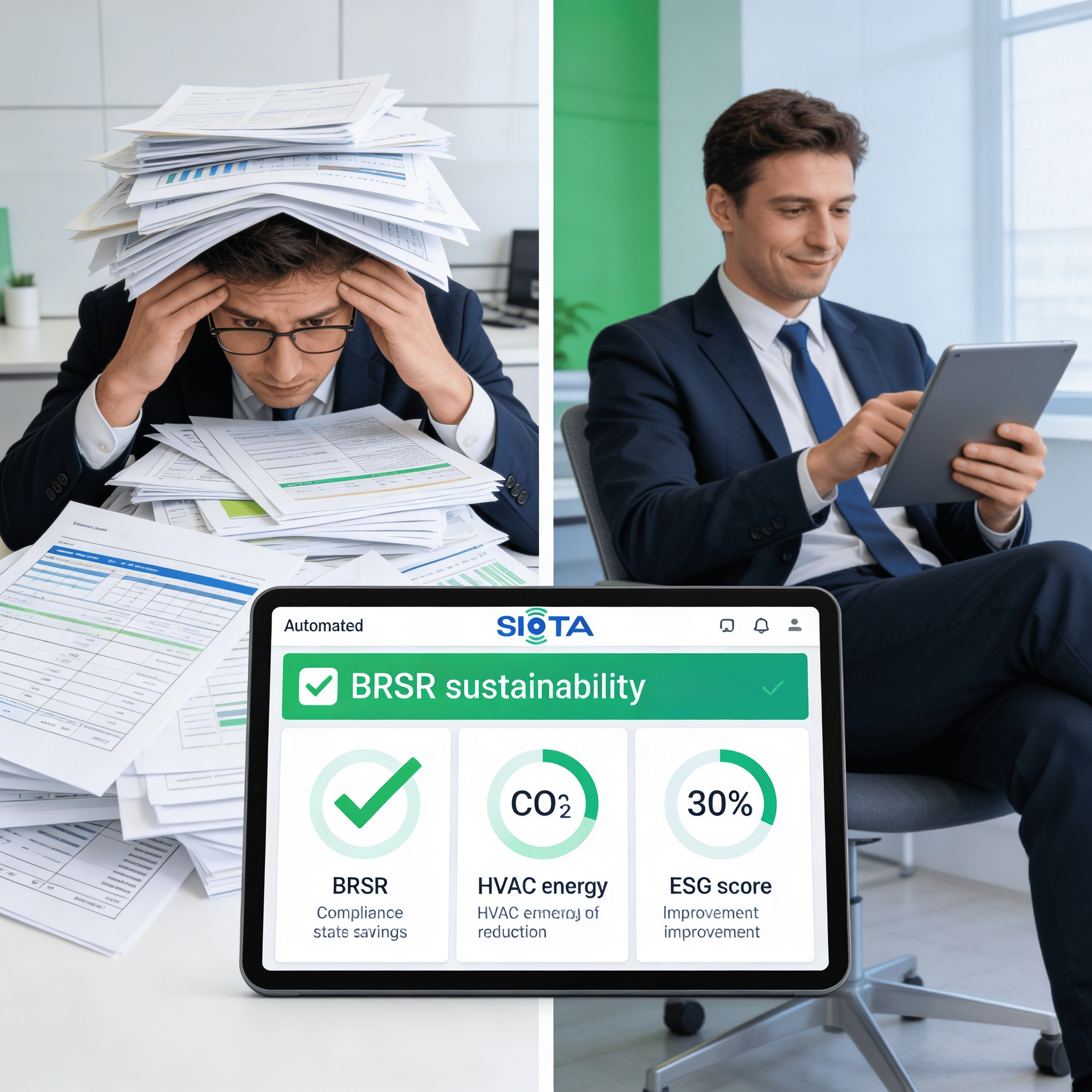
There’s a better way to handle BRSR — replace manual reports and paper logs with SIOTA’s automated sustainability platform. Less stress, more compliance.
Most listed companies can report their revenue, headcount, and capex to the rupee. But ask them how much electricity their Noida office consumed in Q2, or what percentage of their energy came from renewable sources last year, and the answer is usually a spreadsheet stitched together from estimated bills, manual meter readings, and facility staff’s best guesses.
SEBI does not accept estimates. BRSR does not accept “approximately.”
This blog explains exactly what energy data BRSR requires, why most companies are currently unable to produce it accurately, and how SIOTA’s IoT-based Energy Management System gives CFOs and ESG officers verified, real-time data they can submit with confidence.
What BRSR Actually Requires on Energy — and Why It Is Harder Than It Looks
The Business Responsibility and Sustainability Report mandates disclosure under Principle 6 (Environment). Listed companies must report:
- Total energy consumed (in gigajoules), broken down by fuel type and electricity
- Energy intensity per rupee of turnover and per unit of product or service
- Reduction in energy consumption versus the previous year
- Steps taken to use renewable or alternate energy sources
These are not qualitative statements. They are quantified disclosures that go into your annual report and are reviewed by auditors, institutional investors, and ESG rating agencies.
The problem: most companies have no real-time energy monitoring infrastructure. They rely on DISCOM bills — which arrive 4–6 weeks late, cover an entire facility as one number, and cannot be broken down by floor, equipment, or time of use. You cannot calculate energy intensity from a consolidated monthly bill.
Why the CFO Is Now the Most Accountable Person in the Room
Until 2022, BRSR was largely a sustainability officer’s compliance exercise. That changed when SEBI mandated it and linked it to the annual report — a document the CFO signs off on.
ESG ratings now affect institutional investment decisions. MSCI, Sustainalytics, and domestic rating agencies score listed companies on environmental data quality. A vague or unverified energy disclosure pulls your score down. A low ESG score affects whether certain FIIs and ESG funds include you in their portfolios.
The CFO’s concern is no longer just the electricity bill. It is the accuracy, auditability, and year-on-year comparability of every energy number that goes into the BRSR.
SIOTA makes those numbers real.
| 🔍 Free Energy Audit — BRSR Energy Data Readiness Check
We will review your current energy data infrastructure and tell you exactly what gaps exist before your next annual report cycle. No obligation. No sales pitch. 👉 Book your free 30-minute energy audit → siota.in/contact-us |
BRSR Compliance Energy Data: The 5 Metrics SIOTA Delivers Automatically
SIOTA’s IoT-based Energy Management System places wireless smart meters and sensors at every major consumption point in your facility — HVAC systems, DG sets, lighting circuits, common areas, production equipment. Data streams in real time to a unified cloud dashboard. Here are the five BRSR energy disclosures the platform handles automatically.
1. Total Electricity Consumed (kWh and Gigajoules)
SIOTA’s smart meters capture consumption at circuit level, 24/7. The dashboard auto-converts kWh to gigajoules for direct BRSR entry. No manual conversion, no approximation. Every data point carries a timestamp and a sensor ID — exactly what an auditor needs.
2. Energy Breakdown by Source
The platform distinguishes between grid electricity, diesel generator consumption (via DG Monitoring), and on-site solar or renewable generation. BRSR requires this breakdown. Most companies currently cannot produce it without IoT monitoring.
3. Energy Intensity Per Rupee of Turnover
Once total energy consumption is captured, your finance team divides it by revenue figures from your ERP. SIOTA’s dashboard can integrate this calculation with a simple data feed — giving you energy intensity per ₹ crore of turnover as a live metric, updated every quarter.
4. Year-on-Year Reduction vs Previous Period
Because SIOTA stores historical data from day of installation, year-on-year comparison is automatic. If you installed in FY2024–25, your FY2025–26 BRSR already has the baseline. No manual data retrieval, no estimation.
5. Scope 1 and Scope 2 Emissions Estimates
SIOTA’s platform applies standard emission factors — CEA grid emission factors for India, IPCC factors for diesel — to your consumption data and generates Scope 1 and Scope 2 estimates automatically. These are the two categories most listed companies must now begin tracking under BRSR’s extended environmental disclosures. Explore SIOTA’s full sustainability compliance capabilities.
How SIOTA Solves BRSR Data Collection in Real Facilities
Here is what changes after SIOTA is deployed across your facilities:
- Week 1: Smart meters and IoT sensors installed across all facilities — no civil work, no equipment shutdown. SIOTA is live in under 48 hours.
- Week 2 onwards: Real-time energy data flows into the dashboard. Your ESG officer gets login access. They can view consumption by facility, asset, and time period — instantly.
- Quarter end: One-click report export gives the ESG team timestamped, sensor-verified consumption data for the period. Auditors get data with sensor IDs — not estimates from spreadsheets.
- Annual report cycle: Year-on-year comparison, energy intensity calculations, and Scope 1/2 emission estimates are generated from the same dashboard. Your CFO reviews one source of truth.
Predictive maintenance alerts from the same platform also flag equipment anomalies before they cause energy spikes — keeping your consumption data consistent and your equipment running efficiently through the reporting year. See how this applies to your sector on our Industries We Serve page.
SIOTA’s integrated HVAC Automation module also reduces HVAC energy consumption by 15–25% — so the system that generates your compliance data simultaneously cuts the bill you are reporting on.
Which Listed Companies Need BRSR Compliance Energy Data Most Urgently
BRSR is mandatory for India’s top 1,000 listed companies. SEBI has indicated the requirement will widen. The companies with the most urgent data gap:
- Manufacturing plants: High energy intensity, complex equipment mix, multiple fuel types. A single plant may have 15–20 energy input streams. Manual tracking is essentially impossible.
- IT parks and commercial offices: Large HVAC loads, multi-floor, multi-tenant facilities. Energy is the second-largest operating cost but cannot be broken down beyond the utility bill.
- Hospitals and healthcare companies: 24/7 operations, critical backup power, complex lighting and HVAC loads across multiple buildings.
- Banks and PSUs: Hundreds of branch locations mean energy data is genuinely dispersed. Aggregating it without IoT monitoring takes months of manual effort every cycle.
- Hotels and hospitality groups: Energy intensity disclosures are particularly scrutinised. ESG ratings for listed hotel groups are increasingly tied to energy management maturity.
The Bottom Line on BRSR Compliance Energy Data
BRSR energy compliance is a data infrastructure problem, not a sustainability communication problem. Listed companies compiling energy data manually are producing disclosures that are inaccurate, non-auditable, and increasingly scrutinized by institutional investors and ESG rating agencies.
SIOTA’s IoT platform eliminates the data gap. Smart meters and sensors generate verified, granular, real-time energy data across all facilities — automatically structured for the disclosures BRSR requires.
For a listed company spending ₹20 lakh per month on electricity across facilities, SIOTA typically identifies 15–25% reduction opportunities — that is ₹3 lakh to ₹5 lakh saved every month. The BRSR compliance infrastructure pays for itself. The system that generates your compliance data also cuts the bill it is reporting on.
Your ESG officer gets the data. Your CFO gets the numbers. Your auditors get the timestamps.
SEBI’s reporting cycle does not wait. Your energy data infrastructure should be ready before it asks.
| 📞 Ready to See What SIOTA Does for Your BRSR Energy Disclosures?
Book a free 30-minute demo with SIOTA. We will show you exactly what your BRSR energy data would look like — using your facility type, your consumption profile, and real numbers, not estimates.
👉 Schedule your free demo → siota.in/contact-us |
Internal Links Quick Reference
| Anchor Text | URL |
| Energy Management System | siota.in/energy-monitoring-energy-management/ |
| Real-Time Energy Monitoring | siota.in/real-time-energy-monitoring/ |
| DG Monitoring | siota.in/iot-based-dg-monitoring-solutions/ |
| HVAC Automation | siota.in/iot-based-hvac-automation/ |
| Industries We Serve | siota.in/industries-we-serve/ |
| Sustainability / ESG | siota.in/sustainability/ |
| Contact Us (CTA Box 1 + 2) | siota.in/contact-us/ |
