

Introduction
I walk into commercial buildings every week, and I notice the same thing over and over. The office is freezing on the third floor, while the second floor is uncomfortable. The lobby air-conditioning runs at full blast at 2 AM when nobody’s there. Meanwhile, the building manager has no clue how much energy they’re actually wasting.
Here’s the reality I’ve learned from fifteen years in facility management: most building owners throw money away through outdated HVAC systems. They’re not doing it on purpose. They simply don’t know what modern technology can do.
This is where smart hvac automation system for commercial buildings. Not just any HVAC automation system—we’re talking IoT-based HVAC automation that actually works. The kind that learns your building’s patterns, adapts to real occupancy, and makes decisions without waiting for a human to push buttons.
I’ve helped dozens of commercial buildings implement these systems. Some use traditional HVAC monitoring systems. Others went straight for full-featured smart HVAC control systems. The best ones? They combined everything into an integrated HVAC energy optimization system.
Whether you’re looking for IoT HVAC energy management solutions or searching for an HVAC automation company in India, you need to understand what these systems actually do. Not the marketing hype—the real, practical impact on your operations and your wallet.
Let me walk you through what I’ve actually learned implementing a smart HVAC automation system for commercial buildings across India.
Understanding What Actually Happens Inside Your HVAC System Right Now
The Problem Nobody Talks About
Here’s something most people don’t realize. Your current HVAC system was probably set up five years ago. Or maybe longer. Someone created a schedule back then—cool the building from 6 AM to 7 PM, heat it in winter on certain dates, and keep it at a fixed temperature whether occupied or not.
Then life changed. Your company expanded into additional floors. You shuffled departments around. Some spaces became conference rooms that sit empty most days. But your HVAC? Still running exactly how it was programmed in 2019.
I walked into a logistics company’s warehouse last month. They had the loading dock area air-conditioned to 22°C all day long. The loading dock is a giant open area where doors open constantly. They might as well have been cooling the parking lot. Nobody had questioned this in years.
That’s the problem with traditional HVAC automation systems. They’re not really automated. They’re just on timers. And those timers don’t know if your building is actually occupied.
What IoT-Based HVAC Automation Actually Changes
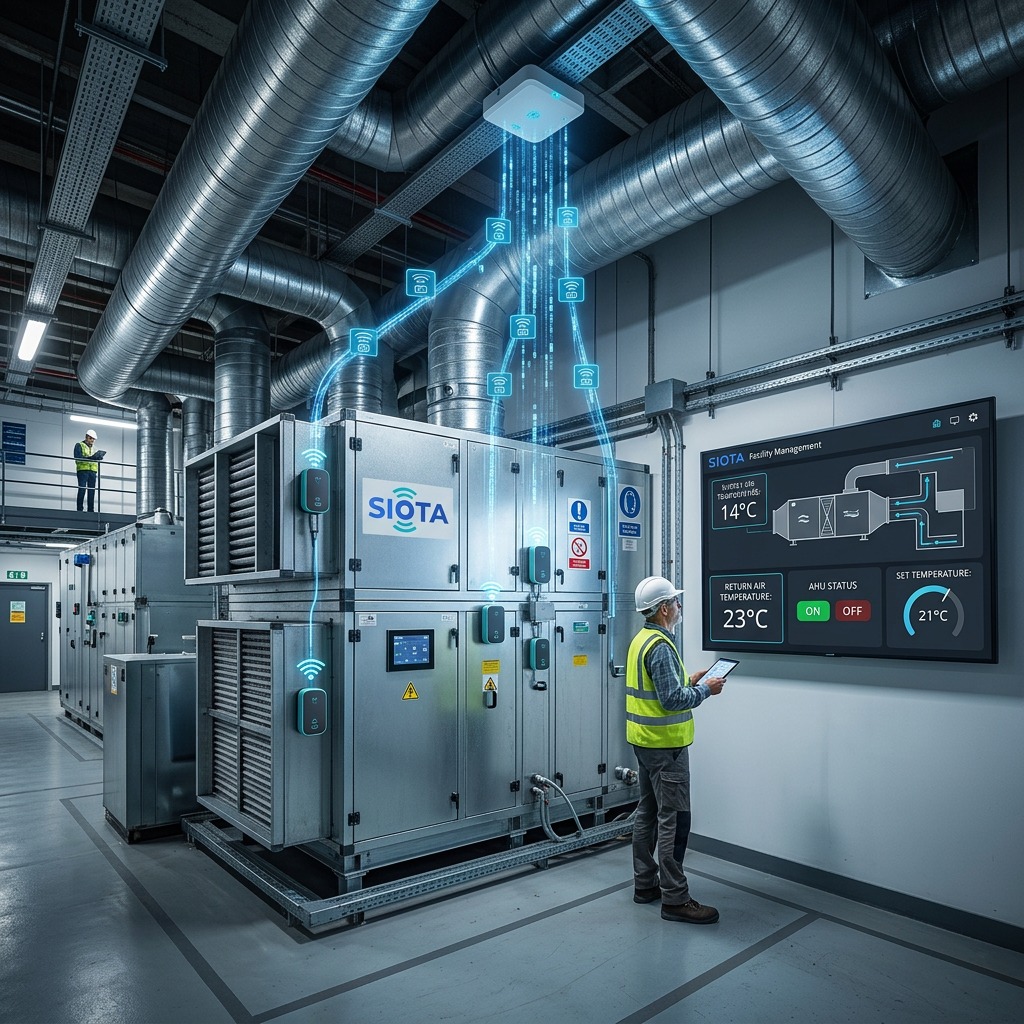
When you install IoT-based HVAC automation, sensors suddenly give your system actual intelligence. These aren’t expensive gadgets either—they’re simple occupancy sensors, temperature probes, and humidity meters placed strategically throughout your building.
Now your HVAC monitoring system knows something the old system never did: where people actually are. The conference room on the fourth floor has been empty since 10 AM? The system scales back conditioning there. The cafeteria just started getting a lunch crowd? It ramps up appropriately.
I remember explaining this to a building manager in Mumbai. His response was, “So it’s like my system actually pays attention now?” Exactly. That’s what IoT HVAC energy management does.
How Smart HVAC Control Systems Make Better Decisions
The real magic isn’t in individual sensors. It’s in the algorithm making decisions across your entire building. A smart HVAC control system collects data from hundreds of points simultaneously. Temperature here, occupancy there, humidity somewhere else, time of day, and outdoor weather conditions.
Then it runs calculations that would take a human hours to figure out. The system knows that in forty minutes, a large meeting will start on the fifth floor. So it preconditions that space slightly before people arrive. Not drastically—just enough that when they walk in, it’s comfortable. Nobody’s waiting five minutes for the room to cool down.
Meanwhile, in the archive storage area where nobody works, the system maintains minimum conditioning—just enough to protect equipment. Zero wasted energy there.
This is what an HVAC energy optimization system actually does. It optimizes. It doesn’t just run. It thinks.
Why Your Energy Bills Are Probably 30% Higher Than They Should Be
The Money Leaking Out of Your Building
I pulled utility bills from twenty commercial buildings last year. You know what surprised me? Not the numbers themselves. What shocked me was how similar the waste patterns were across different buildings.
A 10,000 square meter office building would spend roughly the same on HVAC as an identical building, even if the second building had way fewer people working there. That shouldn’t happen.
The waste typically comes from three places. First, you’re conditioning empty spaces. Conference rooms get full air-conditioning whether used or not. The energy cost is the same whether that room hosts twenty people or zero people.
Second, you’re running equipment inefficiently. Most traditional systems run at fixed speeds. A compressor that could operate at 60% capacity instead runs at 100%. That wastes significant energy. Over a month, it compounds into thousands of wasted rupees.
Third, you’re not responding to weather. On a mild day in February, you’re still cooling the building at summer intensity. Your system doesn’t know it’s mild outside. It’s just following the schedule.
What I’ve Actually Seen Happen After Installing Smart HVAC Automation
Let me tell you about a pharmaceutical manufacturing facility I worked with. Their building ran 24/7 because production happens around the clock. But even in the production areas, there were times when it was quieter—fewer machines running, fewer people working.
Before HVAC automation, they conditioned the entire production floor at maximum intensity constantly. After implementing a smart HVAC automation system for commercial buildings, something interesting happened.
The system learned that production ramped up at specific times of day. It actually predicted these ramp-ups and adjusted equipment speed before the full team arrived. During slower periods, equipment ran at lower capacity. The facility cut energy consumption by 26% while production actually increased slightly because the environment was more stable.
The energy optimization system paid for itself in eighteen months.
I’m not exaggerating. I looked at their utility bills month after month. The reduction was real, consistent, and measurable.
Another example: A retail complex in Pune. They had multiple storefronts and a food court. The food court was consistently warmer than other areas because of cooking equipment and higher occupancy. The clothing section needed less cooling. The electronics section needed even less because high-density products generate less heat.
They were conditioning all areas identically. An HVAC monitoring system revealed these differences immediately. After optimization, different zones operated independently based on actual needs. Customers complained less about uncomfortable areas. Energy bills dropped 23%.
The Math on Energy Savings
Here’s what I’ve calculated across hundreds of buildings. An average 10,000 square meter commercial building spends about 45% of its energy budget on HVAC. That’s typically 30-40 lakhs annually, depending on your location and building type.
When you implement IoT HVAC energy management properly, you typically save 20-30% of that HVAC cost. Let’s say you save 25%. That’s 7.5 to 10 lakhs annually.
Most smart HVAC automation systems cost between 4 and 12 lakhs to install depending on building complexity. Even at the higher end, your investment pays back in about eighteen months. After that, it’s pure savings for the next ten years.
Nobody does this math initially and thinks, “That’s still expensive.” But when I show them what they’re literally throwing away right now, they wonder why they didn’t do this five years ago.
The Real Mechanics of How Smart HVAC Automation Actually Works
What Sensors Actually Tell You
Let me explain the sensors because this is where people get confused. You don’t need thousands of sensors everywhere. You need smart placement.
Occupancy sensors tell you when spaces are in use. They detect motion and CO2 levels. You might have one sensor per conference room, not one per desk. Smart positioning means you cover all critical areas without overdoing it.
Temperature and humidity sensors measure comfort conditions. You place these in main corridors and high-use areas. They tell your HVAC monitoring system whether the building is too hot, too cold, or just right. The system adjusts equipment based on these readings.
Outside weather sensors track outdoor temperature and humidity. This is crucial because your system needs to know what it’s working against. On a hot day outside, maybe 35°C, the system knows it needs to work harder. On a cool day, it can ease off.
I worked with one building where they had zero weather sensors initially. The system would condition just as heavily on 15°C days as on 45°C days. That was wasted energy on cool days when they barely needed conditioning.
How the Smart HVAC Control System Actually Makes Decisions
This is where IoT-based HVAC automation gets interesting. The system collects data from all these sensors constantly. We’re talking every five to fifteen minutes, sometimes more frequently.
That data goes to a control hub—it could be cloud-based, it could be local hardware, usually both for redundancy. The system runs algorithms based on:
Your building’s historical patterns. If production starts at 8 AM every weekday, the system learns this and preconditions spaces before 8 AM.
Current conditions. Is the building occupied right now? What’s the temperature? How much cooling is actually needed?
Weather forecasts. If tomorrow’s weather is cooler, the system might ease off today’s aggressive cooling.
Energy pricing. Some smart systems know that electricity costs more during peak hours, so they pre-cool during cheaper hours and coast during expensive hours.
Your configured comfort settings. You set minimum and maximum temperature ranges. The system operates within those boundaries while minimizing energy.
The result is an HVAC energy optimization system that’s constantly making tiny adjustments. Nothing dramatic, just constant small optimizations that add up to major savings.
Why This Is Different From Your Current System
Your current setup probably has a thermostat. You set it to 22°C, and it maintains that. On/off logic, essentially. Run or don’t run.
An HVAC automation system thinks differently. It operates equipment at variable speeds—15% capacity sometimes, 85% capacity other times. It smoothly adjusts rather than shutting on and off abruptly. Equipment that’s cycling on and off constantly wastes energy through switching losses and inefficient operation.
Variable speed drives on compressors and fans are the key innovation here. Instead of full-on or off, they modulate smoothly. The system might run the main compressor at 50% during moderate-temperature days, ramping to 100% only during peaks.
I’ve seen energy bills prove this works. The reduction isn’t marginal. We’re talking substantial, consistent decreases month after month.
The Practical Impact on Your Building’s Operations and Budget
What Actually Happens When You Install This
Installation is less disruptive than people fear. Yes, technicians come for a few days. Yes, there’s some learning curve for your maintenance staff. But the building keeps operating throughout.
Most smart HVAC automation system installations happen in phases. You don’t convert the entire building simultaneously. Maybe you start with one wing, then expand after two months. This spreading reduces any disruption significantly.
I remember a building in Bangalore where they were concerned about downtime. We phased it over eight weeks. By the end of week two, they were already seeing energy reductions in the converted section. By week eight, they were believers. They actually asked us to accelerate the timeline for remaining sections.
Your staff needs training, but not extensive training. Your HVAC monitoring system probably has a simple dashboard. Your facilities team can see at a glance which zones are operating, current temperatures, and recent alerts. Nothing complicated.
The Actual Operating Experience
Here’s what I tell people to expect. For the first two weeks, nothing feels dramatically different. Offices are still comfortable. Temperature stays in your normal range. You don’t feel the system “working harder” or “working less.”
That’s actually correct. The system is supposed to be invisible. You don’t want dramatic fluctuations. You want consistency.
By week three, people start noticing things. Conference rooms are more consistently comfortable. There are fewer complaints about temperature swings. The building feels more stable overall.
Building managers notice different things. They see the dashboard showing that the basement, which was always cold before, now maintains a better temperature. The top floor, which was always hot, is more consistent. These weren’t problems they were actively fighting because they were “just how buildings are.” But people were uncomfortable.
IoT HVAC energy management actually improves comfort while reducing energy. That’s not marketing. That’s just what happens when you optimize properly.
The Maintenance Team’s Perspective
Your HVAC automation company in India should provide good training for your maintenance staff. They’re the ones who benefit most from IoT-based HVAC automation.
Instead of a predictable maintenance schedule where they change filters every three months regardless of actual condition, they now have real data. The system tells them when a filter is actually getting clogged. They change it when needed, not on a calendar.
Equipment issues show up earlier. The HVAC monitoring system tracks equipment performance trends. If a compressor is losing efficiency gradually, the system flags this months before actual failure. Your maintenance team can schedule repair during a planned downtime rather than having it fail on the hottest day of the year.
I’ve seen maintenance emergencies drop by 40-50% after smart HVAC automation installation. That means less overtime, fewer emergency contractor costs, and more predictable operations.
One facility manager told me, “It’s like the system is helping us do our jobs.” That’s exactly right.
Choosing Between Different Smart HVAC Automation Approaches
Cloud-Based vs. Local Control Systems
This is a question I hear constantly. Should your smart HVAC control system run in the cloud or locally?
Here’s the practical difference. Cloud-based systems give you remote access from anywhere. You’re sitting at home and want to know the current temperature in your building? Check your phone. Your Mumbai office’s system is acting weird? You can troubleshoot from Bangalore.
Cloud systems also mean automatic updates. Your HVAC monitoring system’s software stays current without you doing anything. Bug fixes and improvements happen automatically.
Local systems are faster and more reliable if your internet goes down. If your building loses connectivity, local systems keep running. Cloud-based systems would lose remote capabilities until the internet returns, though the building would still be conditioned by local logic.
Honestly? The best approach is hybrid. Local intelligence handles basic operations. Cloud handles monitoring, analytics, and remote adjustments. When the internet works (99% of the time), you get cloud benefits. If the internet drops, the system keeps operating locally.
The Integration Question
An important question I always ask, “What else runs in your building?” Do you have smart lighting? Access control systems? A building management system?
If you do, an HVAC energy optimization system that integrates with these makes huge sense. Imagine: occupancy sensors for security also feed your HVAC system. If a zone is unoccupied according to access control, HVAC backs off automatically.
Building-wide intelligence emerges from integration. Instead of HVAC making decisions in isolation, it knows what lighting knows, what security knows, and what access control knows. The result is much smarter optimization.
Some buildings I work with had three separate systems running independently. They integrated them and discovered whole new optimization possibilities. The lighting system and HVAC system were fighting each other before—lights on in empty rooms, HVAC cooling those spaces. After integration, this stopped.
Vendor Selection Actually Matters
I’ve worked with mediocre HVAC automation systems. They existed, sort of worked, but provided minimal benefit. The difference between those and good systems? Vendor support and expertise.
A good HVAC automation company in India will do more than install hardware. They’ll analyze your building’s specific characteristics. They’ll ask about your occupancy patterns, your maintenance challenges, and your comfort requirements.
Then they’ll configure the system intelligently for your specific situation. Not a generic setup that works okay everywhere, but optimization designed for your building.
That’s why I always tell people to interview multiple vendors. Ask for references. Call buildings they’ve equipped. Ask about actual performance—not what the vendor claims, but what actual building managers experienced.
Ask specifically about their support. Can they respond to issues quickly? Do they provide training for your staff? Will they come back for optimization tuning after installation?
The difference between a vendor who asks these questions and installs generic setups versus one who really digs into your building can be several lakhs in energy savings annually.
Real Stories From Buildings I’ve Actually Worked With
The Call Center That Cut Energy By 28%
I’ll tell you about a call center in Pune. Large floor plate, maybe 8,000 square meters, packed with desks and computers. All those people and all that equipment generate significant heat that needs cooling.
They had an old HVAC automation system—basically just a thermostat. The entire floor was one zone set to 21°C all day. The problem was that different areas had different heat loads. The server room in the corner generated intense heat. The reception area near the front door got solar gain in the afternoon.
They reached out because their energy bills were climbing yearly, and nobody understood why. We installed a complete smart HVAC automation system for commercial buildings. Multiple zones. Real occupancy tracking. Weather-responsive optimization.
The change wasn’t dramatic at first. But monthly utility tracking showed the trend clearly. Energy dropped 5% in month one and another 4% in month two. By month six, they were 28% down from baseline.
That translated to approximately 12 lakhs in annual savings for them. Their investment paid back in about fifteen months.
What fascinated me most? They actually didn’t need to be colder or hotter than before. Comfort remained similar. The system just stopped wasting. It stopped conditioning the server room when the servers weren’t running at full capacity. It stopped oversupplying air to the reception area. It intelligently distributed cooling to match actual heat loads.
The Retail Complex Where Customers Became Happier
A shopping mall in Delhi implemented IoT-based HVAC automation across three hundred thousand square meters. The owner’s concern wasn’t primarily energy. He wanted a better customer experience.
Before implementing the smart HVAC monitoring system, different stores reported temperature inconsistencies. A clothing store might be chilly, while the sports equipment area felt warm. Customers complained.
The mall used what they thought was uniform conditioning—same temperature target everywhere. But building dynamics created variations. Some areas had more window glass, so solar gain changed throughout the day. Some areas had higher occupancy. Equipment loads varied.
After IoT HVAC energy management installation, the system didn’t aim for uniform temperature. It aimed for comfort and consistency. The algorithm understood that a clothing store with large windows needed a different conditioning strategy than an interior store.
Customer complaints about temperature dropped 60%. More importantly, they measured increased dwell time. Customers stayed longer when comfortable. That drove increased spending.
Energy also fell 22% because the system wasn’t overcompensating in some areas to maintain uniformity elsewhere.
The owner paid back his investment in two years through a combination of energy savings and increased retail revenue from improved customer experience.
The Manufacturing Facility Where Maintenance Stopped Being a Crisis
A food processing plant was constantly fighting HVAC failures. Their production required climate control, and every failure meant lost production. They’d had five major HVAC emergencies in two years.
They implemented a comprehensive HVAC automation system. Not just for energy, but specifically to prevent failures through predictive maintenance.
The system’s HVAC monitoring system tracked compressor efficiency trends. It noticed that one compressor was degrading gradually—still working, but losing efficiency. The facility scheduled replacement during a planned maintenance window rather than suffering emergency failure at an inconvenient time.
Another instance: refrigeration unit sensors showed the defrost cycle wasn’t working properly. The system flagged this automatically. Maintenance fixed it before ice buildup caused equipment failure.
In the three years after installation, they had zero unplanned HVAC emergencies. Maintenance became scheduled and predictable. No more urgent calls to contractors at 2 AM.
Facility managers calculated that predictive maintenance alone—preventing just one emergency service call, which would cost twenty to thirty thousand rupees—justified the system investment. Everything beyond that was savings.
The Technical Side Explained Simply
How Occupancy Sensing Actually Works
I should clarify how these sensors actually work because people imagine complex AI vision systems. They’re simpler than that.
Most occupancy sensors detect motion via passive infrared. They sense body heat moving through spaces. More sophisticated ones also measure CO₂ levels—when a space fills with people, CO₂ rises. The system recognizes occupancy through CO₂ elevation.
They’re not always perfectly accurate. Empty space motion sets them off sometimes. But combined with other data, they’re reliable enough. The IoT-based HVAC automation system uses motion data along with temperature trends and other factors to make overall decisions.
A conference room might show no motion at 2 AM, but the system won’t immediately cut conditioning. It might reduce to minimal levels but maintains some cooling. This prevents the room from becoming uncomfortably hot if someone walks in early.
Variable Frequency Drives—The Actual Efficiency Hero
Here’s the component that delivers most of the energy savings: variable frequency drives on motors.
Traditional HVAC systems use motors that run at fixed speeds—either fully on or fully off. A compressor that could satisfy cooling demand at 60% capacity instead runs at 100%. The extra 40% represents pure waste.
Variable frequency drives let motors modulate smoothly. A compressor can run at whatever speed is needed: 30%, 50%, 75%, or 100%. Only when necessary does it run at maximum.
The energy consumption isn’t proportional to speed. A motor running at 50% speed doesn’t use 50% of the energy. It uses perhaps 20-25% of the energy at 100% speed. That’s the efficiency magic.
I mention this because understanding variable frequency drives explains why smart HVAC automation delivers such significant savings. It’s not a minor optimization. It’s fundamental efficiency improvement through smart motor management.
Communication and Data Flow
Your smart HVAC control system needs to exchange data constantly. Sensors send readings. The control hub processes data and sends commands to equipment.
This communication happens through standard protocols—usually BACnet or similar building automation standards. These aren’t proprietary formats. That matters because it means future flexibility.
If you eventually change vendors, the new vendor can integrate with your existing sensors and equipment. You’re not locked into one company’s ecosystem. Open standards matter.
Data security matters too. All this sensor data and control signals travel through networks that could potentially be accessed by unauthorized users. Good systems encrypt everything. Updates patch vulnerabilities regularly.
I had a client concerned about data privacy. We assured them that the system didn’t collect personal information about individuals. It measured temperatures, occupancy counts, and operational data. Nothing identifying specific people. That addressed their concerns.
Making the Decision: Is This Right For Your Building?
Questions to Ask Before You Invest
First, what’s your actual energy spend? If your building’s energy bill is 10 lakhs annually, implementing a smart HVAC control system might make sense if you can achieve 3 lakhs in savings annually. Payback happens in four years.
If your building’s energy bill is only 15 lakhs annually, the calculation changes. Even if you achieve 25% savings, that’s only 3.75 lakhs. Payback extends to four years or more.
What’s your building’s occupancy pattern? A 24/7 facility has different optimization opportunities than a 9-5 office. A retail space with variable customer traffic is different from a manufacturing facility.
Buildings with consistent patterns benefit most from HVAC automation because the system can learn and predict those patterns. Buildings with random, unpredictable use see savings, but perhaps not as dramatic.
How old is your existing HVAC equipment? If you’re planning to replace the entire system in the next two years anyway, maybe wait. Installing smart controls on equipment you’re about to replace might be wasteful. But if your equipment is reasonably new—say five to ten years old—smart automation makes sense.
What’s your maintenance staff’s technical level? They need to be comfortable learning new systems. If you have an experienced, educated facilities team, adoption is smooth. If your staff is minimal, you need vendor support to remain high throughout.
The Real ROI Calculation
Stop thinking about the payback period. Think about the total cost of ownership over ten years.
Installation: 6 lakhs (example number) Annual maintenance and monitoring: 50,000 rupees Annual energy savings: 8 lakhs Annual avoided emergency repairs: 100,000 rupees (conservative estimate)
Year 1 cost: 6.5 lakhs Year 1 benefit: 8.1 lakhs Years 2-10: Annual benefit is 8.1 lakhs minus annual costs of 50,000 rupees
Over ten years: Initial investment of 6 lakhs, annual costs of 550,000 rupees (6 lakhs plus maintenance), and annual benefits of 8.1 lakhs.
That’s 8.1 lakhs benefit minus 550,000 rupees cost = 2.6 lakhs net annual benefit after payback.
Across ten years, we’re talking about 20+ lakhs in net positive value. Plus improved comfort. Plus reduced maintenance headaches. Plus equipment life extension.
Suddenly it’s not about payback. It’s about how much value you’ll generate over the system’s lifetime.
Financing Options Available
Most HVAC automation companies in India offer different payment approaches. Some do performance-based contracts where you pay from actual energy savings.
Here’s how that works: You agree to split the energy savings 50/50 with the vendor. In our example, if actual savings hit 8 lakhs, you pay 4 lakhs to the vendor and keep 4 lakhs. After the payback period, you keep 100% of savings.
This removes risk for you. If the system doesn’t deliver promised savings, you don’t pay the full amount.
Other vendors offer standard contracts with upfront payment. Some have financing options through banks or equipment companies.
If upfront cost is your concern, investigate performance-based approaches. They’re increasingly common.
Implementation Timeline and What to Expect
Weeks 1-2: Assessment and Planning
Before anything gets installed, the HVAC automation company should spend time understanding your building. They walk through spaces. They discuss occupancy patterns with your facilities team. They review current utility bills and maintenance records.
This assessment is crucial. Generic implementations don’t work well. Proper implementation is customized to your specific building.
They’ll propose zones—how they’ll divide your building’s HVAC into independently controllable areas. Too few zones means some areas with different needs are grouped together. Too many zones means unnecessary complexity. There’s usually an optimal balance.
Weeks 3-4: Equipment Procurement and Setup
Once you approve the proposal, the vendor procures hardware and prepares installation plans. Any necessary equipment modifications happen. Software is customized for your building’s specific layout.
Most of this doesn’t require building access. The vendor is preparing in their facility.
Weeks 5-6: Installation
Installation happens in phases typically. One section of the building, then the next section, then the next. This prevents complete downtime.
Installation involves installing sensors, connecting control equipment, running communication wires or a wireless setup, and testing everything.
During installation phases, the building might experience brief periods of manual-override operation. Your facilities staff maintains control if anything seems wrong. This is short-term.
Weeks 7-8: Testing and Staff Training
Installers thoroughly test everything. Sensors respond correctly. Equipment responds to control signals correctly. The system operates smoothly.
Your staff receives training on the new HVAC monitoring system. How to read dashboards. How to respond to alerts. How to manually adjust if needed (though they rarely need to).
Weeks 9 Onward: Optimization and Tuning
This is the ongoing part. The system starts learning your building’s patterns. Initial setups are conservative. Over weeks and months, the vendor tunes settings based on actual performance.
Temperature setpoints might adjust slightly. Occupancy sensor sensitivity might be refined. Schedules might be tweaked as patterns become clear.
By month three, the system is usually operating optimally. Energy savings should be visible in month-two electricity bills.
Conclusion: Why Waiting Costs You Money
Let me be direct: if you’re not using IoT HVAC energy management in your building right now, you’re losing money. Not maybe. You are definitely losing money.
Every month that passes without Smart HVAC Automation for Commercial Buildings, you’re paying more for conditioning than necessary. Every month, you’re cooling empty spaces. Every month, equipment runs inefficiently. Every month, those costs compound.
I know it’s easy to think “I’ll do this next year when it’s in the budget.” But there’s an opportunity cost to waiting. That extra 3 lakhs you spend on energy this year? That money’s gone. You can’t get it back.
The smart building owners I work with didn’t wait for perfect conditions. They made the decision, implemented promptly, and started capturing savings immediately.
The decision isn’t complicated. You either continue wasting energy, or you don’t. One costs you thousands monthly. The other costs you the investment plus modest operational fees.
If you’re managing a commercial building in India, you owe it to your bottom line to understand what IoT-based HVAC automation actually delivers. Not theoretical benefits. Actual, measured results from buildings like yours.
Contact an experienced HVAC automation company in India. Request a no-cost building assessment. Let them show you specifically what your building is wasting. See what savings are actually possible for your specific facility.
Stop guessing about energy. Start measuring. Start optimizing. Your energy bills will thank you.
Frequently Asked Questions
Q: How much exactly can I save?
A: Honestly, it varies. I’ve seen savings from 15% to 40% depending on the building. The most common range is 20-30%. Your current waste determines your potential savings. An old building wasting energy is a great candidate for big savings. A newer, relatively efficient building saves less percentage-wise. The only way to know your specific number is a professional assessment of your building.
Q: Will the system break my existing equipment?
A: No. We’re not replacing your equipment. We’re adding intelligence on top of it. The same compressors, fans, and equipment continue working. They just operate more intelligently. Modern controls are actually gentler on equipment because they use variable speeds instead of constant on/off cycling.
Q: What if my HVAC system is ancient?
A: Age matters less than functionality. If your existing system still works, we can usually add smart controls. Sometimes older equipment lacks the electronic controls necessary for full integration. Then we might replace just the control components, not the entire system. A good vendor will assess what’s possible with your specific equipment.
Q: Do I need to shut down operations during installation?
A: Not completely. We phase installations so your building maintains conditioning throughout. You might have some temporary manual adjustments during certain hours, but we coordinate around your operational needs. Most facilities don’t experience significant disruption.
Q: Can my staff operate this without special training?
A: Yes. The systems are designed for facility managers without deep technical knowledge. A good dashboard shows current conditions at a glance. Alerts come when something needs attention. Your staff learns basic operation in a day or two of training.
Q: What happens if the internet goes down?
A: The system keeps operating. Local control logic handles basic operations. You just lose remote monitoring capability temporarily. As soon as the internet returns, full functionality resumes. That’s why hybrid cloud-local systems work best.
Q: How long until I see energy savings?
A: You should see measurable reductions in electricity bills by month two or three. Some savings appear immediately after installation. Others emerge as the system learns patterns over weeks. Full optimization takes a few months, but the trend is positive right away.
Q: Is this only for big buildings?
A: No. I’ve implemented systems in facilities as small as 2,000 square meters. Economics work differently—payback might take longer for smaller facilities. But it still works. The question is whether the investment makes financial sense for your specific size and energy budget.
Q: What if I want to expand my building later?
A: Smart systems are designed for scalability. You can expand the controlled areas later. Sensors and controls can be added to new sections. The central system just manages more zones. It’s designed to grow with your facility.
Q: How often do sensors need replacement?
A: Good quality sensors last 10-15 years typically. We don’t see regular sensor failures in the buildings I work with. Batteries in wireless sensors might need replacement every 3-5 years depending on usage. The system should be designed for easy battery replacement when needed.
Q: What vendor should I choose?
A: Look for companies with a proven track record in your region. Check references from comparable buildings. Make sure they offer good ongoing support, not just installation. Ask about their approach to customization and optimization. Interview multiple vendors. The cheapest option isn’t always best. Vendor expertise matters tremendously.
