

Introduction
Let me tell you something that happens more often than people admit.
A pharma warehouse in Pune runs fine for three years. No complaints, no incidents. Then one summer night, the compressor in cold room B quietly starts struggling. Nobody notices. By morning, ₹40 lakh worth of vaccines sits outside the approved temperature range. The paperwork is there. The refrigeration log — filled in manually every four hours — shows nothing unusual. Because it was filled at 10 PM, and the compressor started failing at 11.
That is the exact problem a real time temperature monitoring system solves. Not the paperwork. Not the periodic checks. The gap between the checks — which, in a temperature-sensitive environment, is where everything actually goes wrong.
This guide is written for people who are either already dealing with temperature-sensitive inventory or are about to invest in monitoring infrastructure. We will cover how these systems actually work, what matters when you are buying one, and which industries see the fastest payback. And if you want to skip straight to exploring a solution built specifically for Indian compliance requirements, SIoTA is worth a serious look.
What “Real Time” Actually Means — and Why It Changes Everything
The phrase gets used loosely. Some vendors call 15-minute polling intervals “real time.” That is not real time — that is periodic logging with a dashboard in front of it.
A genuine real time temperature monitoring system captures data continuously (or at intervals short enough to catch fast-moving excursions — typically 30 seconds to 2 minutes) and delivers alerts within 60 seconds or less of a breach.
That distinction matters enormously in practice.
The Math Is Simple
Say your cold room door is accidentally left open after a delivery. Ambient temperature starts rising. For most vaccine products, you have a 15-to-30-minute window before the temperature exceeds the acceptable range. If your “monitoring” checks every 15 minutes and your alert takes another 5 minutes to reach someone — and that person needs 10 minutes to get to the cold room — you are already in excursion territory before anyone takes action.
With sub-60-second alerting, the same scenario plays out differently. The door is left open. Two minutes later, the temperature starts rising. At minute 3, an SMS and a WhatsApp message go to the cold room supervisor and the quality manager simultaneously. The door is closed at minute 5. No excursion. No paperwork. No loss.
Real Time Also Means Trend Detection
Good systems do not just alert on breaches — they alert on trends. If a refrigeration unit has a slow refrigerant leak, the temperature will not spike suddenly. It will drift. 5°C to 5.8°C over six hours. A rule-based breach alert will not catch that until it hits the threshold — but a trend-aware system flags the drift pattern early, giving maintenance time to act before any product is at risk.
This is the difference between reactive monitoring and genuinely predictive monitoring. It is not a marketing term. It is a meaningful technical distinction.
How the System Actually Works: A Non-Technical Explanation
You do not need to understand the engineering in depth. But knowing the four layers helps you ask better questions when evaluating vendors.
Layer 1: The Sensors
Sensors are the starting point. They sit inside your cold room, freezer, oven, reactor, or server rack and measure temperature at regular intervals.
The type of sensor matters:
- RTD sensors are the gold standard for pharmaceutical and food storage. Accurate to ±0.1°C to ±0.3°C. Slightly more expensive, but worth it when regulatory compliance is involved.
- Thermocouples handle extreme ranges — up to 1800°C — so they show up in furnaces, kilns, and industrial ovens.
- Wireless NTC sensors are popular for quick-deploy retrofits in warehouses and retail. Battery-powered, easy to install, reasonably accurate.
- Infrared sensors measure surface temperature without contact — useful for conveyor lines and spot-checking.
Most facilities use a mix. A pharma company might use RTDs in stability chambers and wireless NTCs in the general warehouse. A food processing plant might have thermocouples near cooking equipment and RTDs in finished goods cold storage.
Layer 2: Connectivity
The sensor data has to get somewhere. How it travels depends on your facility.
Wi-Fi works well in most office buildings and modern warehouses. LoRaWAN is the right call for large outdoor facilities, remote tanks, or situations where running network cable is impractical — it can cover several kilometres on a single gateway. Cellular (NB-IoT or LTE-M) is ideal for transport monitoring and sites without existing network infrastructure. For older industrial environments with existing wired infrastructure, Modbus or RS485 integration is often the most practical route.
The honest answer is that most real deployments use more than one protocol. A good vendor designs for that upfront, rather than selling you a single-protocol system and leaving you to figure out the gaps later.
Layer 3: The Platform
This is where the intelligence lives. The platform receives sensor data, applies your threshold rules, stores historical records, generates compliance reports, and sends alerts.
The things that separate a good platform from a mediocre one are less obvious than the feature list suggests. Data buffering — the ability to store readings locally when internet connectivity drops and sync them once it returns — sounds like a minor feature until your auditor asks why there are 45-minute gaps in your temperature log. Audit trail integrity — timestamped, tamper-evident records — is the difference between a log that satisfies an FDA inspector and one that raises questions.
Layer 4: Alerts and the Dashboard
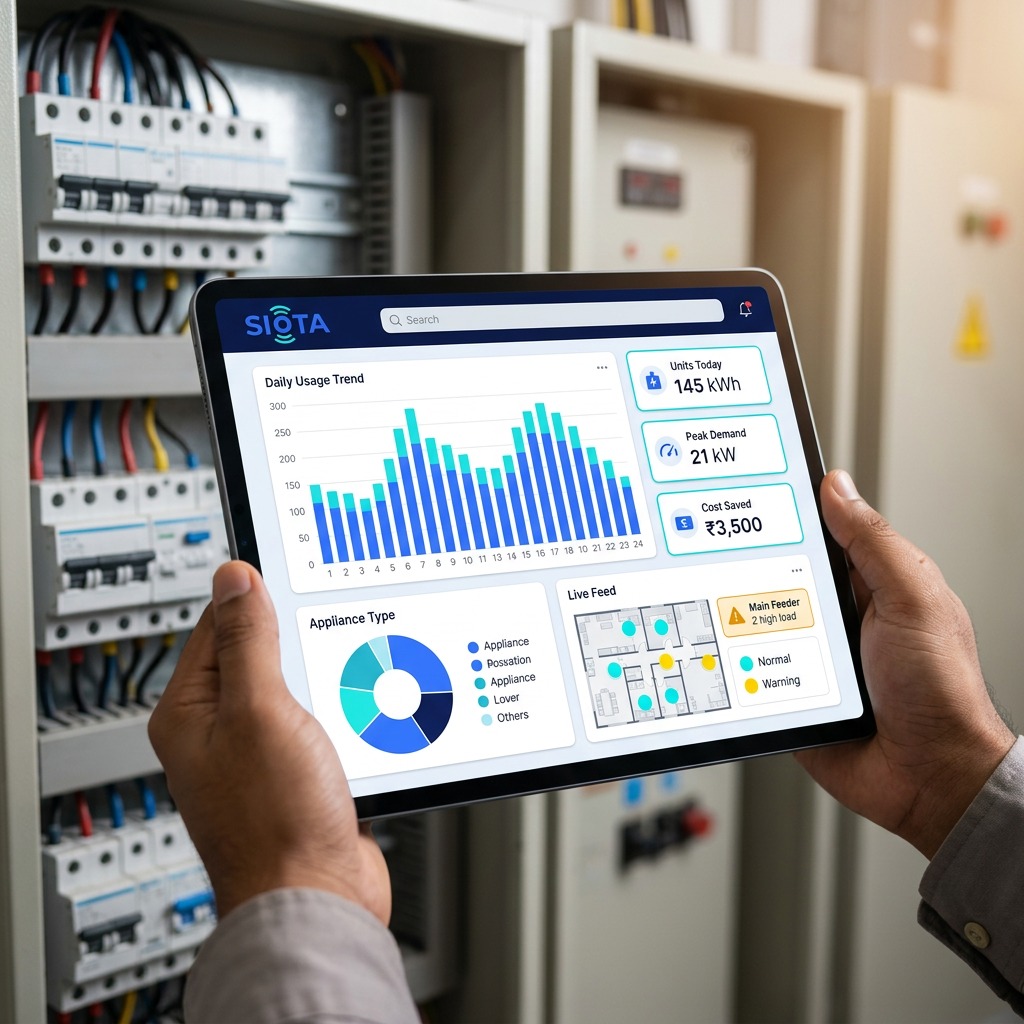
The dashboard is what your team sees every day. It should show live readings, historical trends, and alert status in a way that does not require training to interpret.
Alerts should reach people through multiple channels — SMS, email, push notification, WhatsApp, and phone call escalation for critical situations. The escalation logic matters: if the primary contact does not acknowledge an alert within 5 minutes, the system should automatically escalate to the backup contact. This is not a nice-to-have for regulated facilities. It is expected.
Who Needs This Most — and What They’re Actually Protecting
Pharmaceuticals and Healthcare
This is the most demanding application, and rightly so. A temperature excursion in a vaccine cold chain does not just mean financial loss — it can mean ineffective vaccines reaching patients. The regulatory framework is correspondingly strict.
In India, Schedule M (revised 2023) mandates continuous temperature monitoring for pharmaceutical manufacturing facilities. WHO prequalification audits and CDSCO inspections now routinely ask for automated temperature records. Inspectors are specifically looking for systems that cannot be manually edited — a key requirement that rules out paper logs and basic data loggers.
For biologics stored at -20°C to -80°C, the stakes are even higher. A single excursion in an ultra-low temperature freezer can destroy material worth crores. These applications need redundant sensors, backup alert contacts, and automated escalation to a 24-hour response team.
Food and Cold Chain
India’s cold chain infrastructure has improved significantly over the past decade, but temperature monitoring adoption still lags behind the investment in physical infrastructure. Walk-in coolers get built. Refrigerated trucks get purchased. The monitoring often remains manual — someone checking a thermometer twice a shift and writing it down.
FSSAI’s Food Safety Management System requirements have tightened. For large food businesses and exporters, automated temperature records are increasingly being requested during inspections. For exporters to EU or US markets, they are essentially mandatory.
The ROI calculation here is direct. If automated monitoring prevents even one batch rejection per year, it typically pays for itself many times over.
Data Centres and Server Rooms
A data centre is not an obvious use case, but it is one of the most cost-justified ones. Cooling accounts for 30–40% of a data centre’s total energy cost. Most facilities run their cooling harder than necessary because they do not have granular enough data to optimise it.
Real time temperature monitoring — combined with airflow mapping — allows facilities to identify hot spots, right-size cooling deployment, and reduce energy costs by 15–25%. For a mid-sized data centre, that is a meaningful number. The payback period on a monitoring system is often under 12 months purely on energy savings, before even accounting for the avoided cost of hardware failure.
Manufacturing
Process industries — chemicals, plastics, food processing, textiles — depend on temperature control at multiple production stages. Out-of-spec temperatures mean rejected batches, equipment damage, and in some cases, serious safety incidents.
The monitoring requirements here are different from cold chain. Instead of maintaining a narrow cold range, you are often tracking temperature across a wide operational range and watching for deviations from process setpoints. Integration with SCADA or PLC systems is often required. This is a more complex technical environment, and vendor selection needs to account for it.
What to Look for When Choosing a Vendor
The market in India has grown considerably. There are now dozens of vendors offering IoT temperature monitoring. Most of them will show you an impressive dashboard demo. The differences that matter are mostly invisible in a demo.
Ask About Alert Latency — With Evidence
“Real time alerts” is in every vendor’s pitch deck. Ask them to demonstrate it. Ask what the 99th percentile alert latency is — not the average. An average of 30 seconds is not reassuring if 1% of alerts take 15 minutes. For regulated environments, ask whether alert delivery is logged and auditable.
Data Ownership and Portability
Your sensor data is your data. Some vendors make it surprisingly difficult to export historical data — especially if you decide to switch platforms. Ask explicitly: “Can I export all of my historical temperature data in a standard format? What does that process look like?” If the answer is vague, treat it as a red flag.
Calibration Support
Sensors drift. Annual calibration against a NABL-accredited reference is standard practice, and in regulated industries, it is a regulatory requirement. Does the vendor offer calibration services? Does the platform track calibration certificates and alert you when they are due? A system with no calibration management will create compliance gaps within a year of deployment.
Local Support
Remote support is fine for software issues. For sensor failures, network problems, or anything requiring physical access to your facility, you need someone who can show up. Ask specifically: “If a sensor fails at my site, what is your on-site response time?” Get it in writing if the application is critical.
Compliance Documentation
For pharma and food customers, ask whether the vendor provides IQ/OQ/PQ documentation. Validation is a regulatory requirement for many facilities, and having to commission a third party to write validation documentation because your vendor cannot support it adds significant cost and time to implementation.
SIoTA addresses all of these directly. They have built their platform specifically for Indian compliance requirements — Schedule M, WHO GDP, FSSAI — and their team has direct experience supporting customers through regulatory inspections. That background shows in how the product is designed, not just how it is marketed.
How Long Does Implementation Actually Take?
People consistently underestimate this, then get frustrated when timelines slip.
For a straightforward deployment — say, 10–20 wireless sensors in a single warehouse with no integration requirements — allow 3–5 days. Two for installation and configuration, one for testing, one buffer for the unexpected.
For a multi-site pharma deployment with validation requirements, 6–10 weeks is realistic. The physical installation might take a week. Validation — IQ, OQ, PQ — takes longer, particularly if your QA team has specific documentation requirements.
Integration with existing ERP or quality management systems adds time that is hard to estimate without knowing your specific setup. Budget for it explicitly rather than assuming it will be straightforward.
The most common implementation failure is rushing commissioning. Take the time to run a proper soak test — at least 48 hours of normal operation with the full alert chain verified — before signing off. Problems that surface during commissioning are cheap to fix. Problems that surface during an audit are not.
FAQ
Why do manual temperature logs fail regulatory audits? Auditors — particularly WHO and FDA inspectors — are trained to look for signs of data falsification in manual logs. Entries that are too regular, handwriting that is too consistent, readings that never vary — these are red flags. Automated systems produce data that looks like what actually happened, because it is what actually happened. Beyond the audit question, manual logs simply cannot catch events that happen between checks.
What happens to my data if there is a power cut or internet outage? A professionally designed system buffers data locally on the gateway device. When connectivity is restored, the buffered data syncs to the cloud automatically. From a compliance perspective, there should be no gaps in your temperature record. If a vendor’s system cannot do this, walk away.
Can I monitor a refrigerated truck with the same platform as my warehouse? Yes, with the right system. Transport monitoring uses cellular connectivity (SIM-based) rather than Wi-Fi or LoRa. Most enterprise platforms support multiple connectivity types on a single dashboard. Confirm this explicitly — not all systems that offer transport monitoring do it on the same platform as fixed installations.
How accurate does my monitoring need to be for pharmaceutical storage? For standard 2–8°C storage, ±0.5°C accuracy is the typical requirement. For ultra-low temperature storage (-20°C to -80°C), tighter accuracy is often specified in product storage requirements. Your QA team should define the accuracy requirement before you specify sensors — do not let the vendor define it for you.
What is the difference between a data logger and a real time monitoring system? A data logger records temperature at intervals and stores the data locally. You retrieve it manually — often by physically collecting the device — and review it after the fact. It tells you what happened. A real time monitoring system transmits data continuously, alerts you when something goes wrong while it is happening, and stores records in the cloud for immediate remote access. The distinction matters enormously for large facilities and critical applications.
Is cloud-hosted monitoring safe for sensitive pharma data? It depends on the vendor’s infrastructure and your organisation’s data policy. Ask specifically where data is hosted (ideally India, for data residency requirements), what encryption is used in transit and at rest, and whether the platform has undergone a security audit. SIoTA’s platform is hosted in India and meets the data security requirements of its pharma and healthcare customers.
How often do sensors need replacing? Wired sensors, if properly maintained, can last 10+ years. Wireless battery-powered sensors typically need battery replacement every 2–5 years depending on polling frequency and transmission power. The sensors themselves generally outlast the batteries significantly. Calibration is an annual requirement regardless of battery status.
What does SIoTA offer that other vendors do not? The honest answer is that SIoTA has built their product with Indian regulatory requirements as a first-class concern — not as an afterthought. Schedule M, FSSAI, WHO GDP, NABL — these are built into how reports are generated and how the audit trail works, not bolted on as PDF exports. Their local engineering team also means you are not relying on remote support for a system that is protecting critical inventory.
Conclusion
There is a version of this conversation where we talk about IoT trends and digital transformation and Industry 4.0. That is fine. But the more honest version is this: a real time temperature monitoring system is about not losing things you cannot afford to lose.
Vaccines. Biologics. Food inventory. Server hardware. Process batches. These are real assets with real replacement costs — and most of the losses that happen are entirely preventable with visibility that the technology can absolutely deliver today.
The systems exist. The connectivity exists. The platforms are mature. The cost has come down significantly. The only thing left is the decision to implement.
If your facility is still relying on manual temperature logs, or on a basic data logger that you retrieve once a week, you are carrying a risk that does not need to be there.
SIoTA offers a free site assessment — an hour with their team to map your monitoring requirements, identify compliance gaps, and give you a realistic picture of what implementation looks like for your specific facility. No pressure, no generic demo. Just a practical conversation.
It is worth the hour.
