

Introduction
Let me ask you something.
When was the last time someone physically walked into your cold room at 2 AM to check the temperature? Probably never. And that’s exactly where businesses quietly lose money — in the hours nobody is watching.
An IoT temperature monitoring system solves this problem in a way that no manual process ever could. It watches your equipment constantly. It alerts you the second something goes wrong. And it keeps records that satisfy even the strictest regulatory auditor.
In India especially, where power fluctuations are common and supply chains stretch across wildly different climates, having real-time visibility into your temperature-controlled environments isn’t just smart — it’s survival.
This guide covers everything: how these systems work, what benefits they actually deliver, which industries need them most, and what to look for when you’re ready to invest. We’ve also answered the ten questions we hear most often from businesses exploring this for the first time.
Whether you run a pharmaceutical cold chain, a food processing plant, or a chain of restaurants—by the end of this article, you’ll know exactly what an IoT temperature monitoring system can do for you.
What Is an IoT Temperature Monitoring System, Really?
Strip away the technical jargon, and the concept is simple.
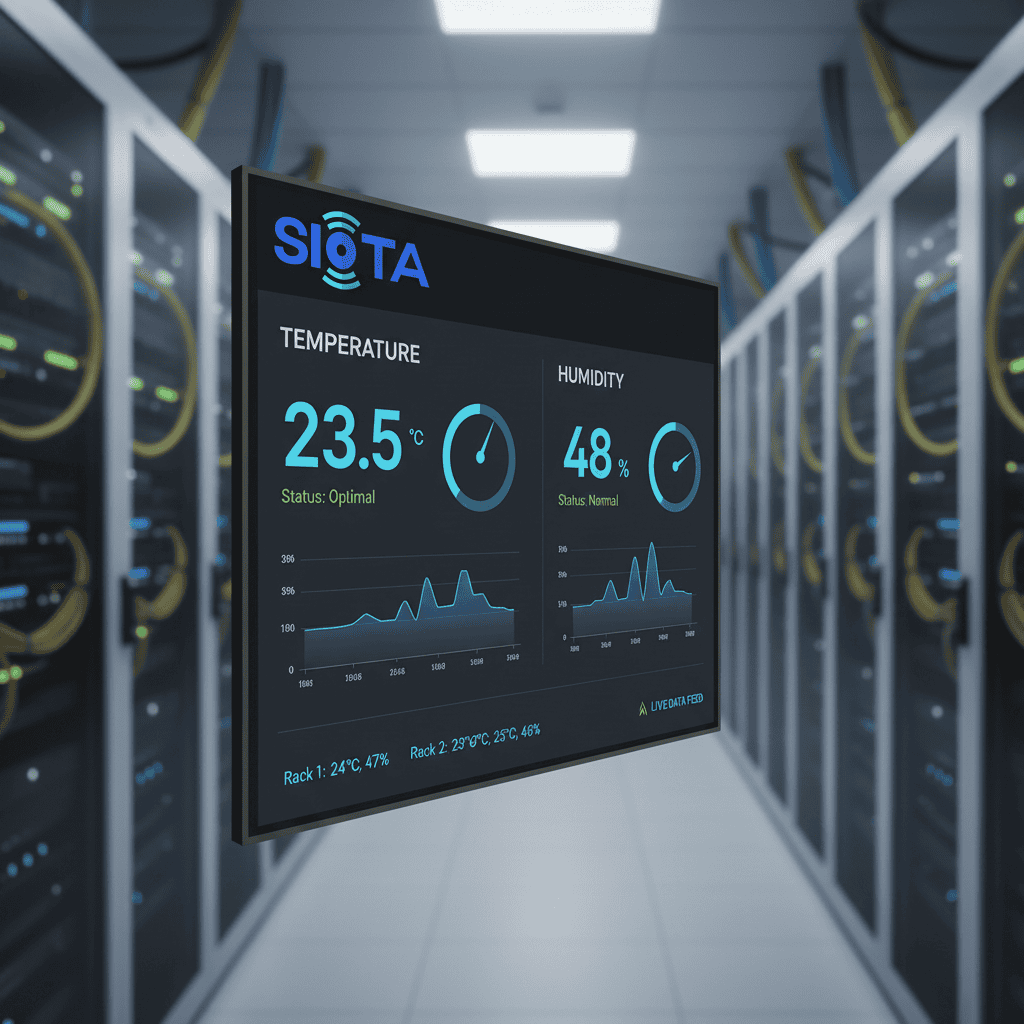
You place small wireless sensors in your cold rooms, freezers, incubators, server racks, or wherever temperature matters. Those sensors constantly measure and transmit readings to a cloud platform. You — or your team — can check those readings from any phone or laptop, at any time.
If the temperature drifts outside your accepted range, you get an alert immediately. Not after the next manual check. Not the following morning. Right now.
That’s the core of it. Everything else — the dashboards, the reports, the integrations — is built around that fundamental promise of knowing before it’s too late.
How the Data Actually Flows
Think of it in three steps.
First, the sensor measures temperature every few minutes (or every few seconds if precision matters). Second, a small gateway device collects readings from all nearby sensors and pushes the data to the cloud—using Wi-Fi, cellular, or LoRa depending on your setup. Third, the cloud platform stores the data, checks it against your thresholds, sends alerts if needed, and makes everything visible on a dashboard.
Each step is automated. There’s no human in the middle unless an alert fires.
Choosing the Right Sensor for Your Environment
Not all sensors are the same, and picking the wrong one costs you later.
Thermocouples handle extreme temperatures—think industrial furnaces or very deep freeze storage. RTD sensors are more precise and better suited for pharmaceutical environments where a fraction of a degree matters. NTC thermistors are affordable and reliable for standard cold storage or HVAC monitoring. Infrared sensors work without physical contact, useful for monitoring products on a moving conveyor.
Your vendor should help you match sensor types to your specific environment. If they don’t ask about your use case before recommending a sensor, that’s a red flag.
7 Benefits That Go Beyond the Brochure
A lot of vendors list benefits that sound impressive but feel abstract. Here’s what these systems actually do for real businesses.
1. You Stop Discovering Problems After the Damage Is Done
This is the big one. A refrigerator compressor fails at midnight. By the time your team arrives in the morning, eight hours have passed. The medication, or the meat, or the samples—all of it is compromised.
With an IoT temperature monitoring system, the alert goes out within minutes of the failure. Your on-call technician can respond, reroute the product, or at least document the excursion before it becomes a total loss.
2. Compliance Stops Being a Headache
If you operate in pharma, food, or healthcare, you’re used to auditors asking for temperature logs. Before IoT monitoring, producing those logs meant hoping your team had diligently updated spreadsheets. Often, they hadn’t.
An IoT system captures every reading automatically. When an auditor asks for six months of data from cold room B, you export a report in two minutes. Clean, timestamped, tamper-evident. FSSAI, WHO-GMP, CDSCO — the records are always ready.
3. You Can Monitor Everything from One Screen
One manager at a company with 12 warehouses across three states once said he used to spend more time traveling to check temperatures than actually managing his operations.
With remote monitoring, he watches all 12 locations on a single dashboard from his office. If a site in Pune shows a problem, he sees it at the same moment his team there does. Distance stops being a limitation.
4. Energy Bills Drop When You Know What’s Happening
Cold storage equipment that runs inefficiently costs money every hour. IoT monitoring reveals patterns—a compressor that cycles too frequently, a cold room door that’s left open too long, and a refrigeration unit that struggles during afternoon heat peaks.
Once you can see these patterns, you can act on them. Businesses that optimize based on this data regularly see 20–30% reductions in energy costs. That adds up fast.
5. Equipment Failures Stop Being Surprises
Healthy refrigeration equipment has recognizable temperature patterns. When those patterns start changing—gradual drift, slower recovery after door openings, unusual cycling—it’s often a sign that something is wearing out.
IoT systems can flag these changes long before the equipment fails completely. You schedule maintenance proactively instead of scrambling during a crisis. Your downtime drops. Your repair costs drop too, because you’re catching problems early.
6. Your Product Quality Becomes Consistent
Temperature excursions don’t always cause obvious spoilage. Sometimes the damage is subtle—a slight reduction in a vaccine’s efficacy, a change in a food product’s texture, or degradation of a chemical compound’s stability.
Consistent monitoring means consistent conditions. And consistent conditions mean your quality control team isn’t chasing mystery problems that turn out to be cold chain failures nobody caught.
7. You Can Grow Without Rebuilding Everything
A good IoT temperature monitoring system grows with you. You start with five sensors in your first facility. Two years later, you have 200 sensors across six cities. The platform handles it. You’re not starting over or managing multiple disconnected systems.
This scalability is something traditional loggers simply can’t offer.
Which Industries Need This Most
Every industry that depends on temperature-sensitive products or processes benefits. But some have more urgent needs than others.
Pharmaceuticals and Healthcare
This is probably the highest-stakes application. Vaccines must stay between 2°C and 8°C throughout their journey from manufacturer to patient. A single undetected excursion can render a batch ineffective—and worse, dangerous.
Hospitals, blood banks, diagnostic labs, and pharma manufacturers in India operate under guidelines from CDSCO and WHO-GMP that essentially require documented, continuous temperature monitoring. An IoT system doesn’t just make compliance easier — it protects patients.
Food Processing and Cold Storage
FSSAI mandates proper temperature control across the food supply chain. Beyond compliance, the commercial stakes are obvious. A cold storage unit failure that ruins a day’s inventory is a significant loss. One that goes undetected over a weekend can be devastating.
Automated monitoring with instant alerts is the only way to truly protect perishable inventory at scale.
Logistics and Cold Chain Distribution
India’s cold chain is growing rapidly, and the challenges are real. Refrigerated trucks travel long distances through variable climates. Power backup at smaller warehouses isn’t always reliable. Cellular connectivity in remote areas is improving but still inconsistent.
Modern IoT systems address all of this. Battery-powered sensors, cellular gateways, and local data buffering ensure that even a truck moving through a low-coverage area never loses its monitoring record.
Data Centers and IT Infrastructure
Servers generate a lot of heat. When cooling systems underperform, temperatures rise — and above certain thresholds, hardware fails. Downtime in a data center is expensive by the minute.
IoT temperature monitoring gives data center managers early warning of cooling failures and helps optimize airflow across hot and cold aisles.
Manufacturing and Chemical Plants
Industrial processes often require tight thermal windows. A reaction that runs too hot or too cool produces an off-spec product. Storage of raw materials outside temperature ranges degrades quality before production even begins.
Zone-by-zone monitoring in manufacturing environments gives quality teams the data they need to maintain process consistency.
What to Actually Look for When Buying
The market has no shortage of options. Here’s how to cut through the noise.
Real-Time Alerts That Actually Reach You
Test this during your evaluation. Set a threshold, trigger a breach, and see how fast the alert arrives and through which channels. SMS, email, and app notifications should all work. Some systems also support phone calls for critical alerts.
Data That’s Easy to Access and Export
If generating a compliance report requires calling customer support or wrestling with an unintuitive interface, that system will become a burden. The dashboard should be clean. Reports should be downloadable in formats your auditors accept — typically PDF or CSV.
Sensors That Fit Your Environment
Ask about ingress protection ratings, operating temperature ranges, and calibration certificates. A sensor rated for -40°C to +85°C is very different from one designed for standard office environments. Get the spec sheet, not just the sales pitch.
Connectivity That Matches Your Reality
If your facility has solid Wi-Fi coverage, a Wi-Fi gateway setup works fine. If you’re monitoring remote warehouses or vehicles, you need cellular backup. Ask specifically how the system behaves during network outages — buffering and catch-up sync are critical features.
A Vendor Who Understands the Indian Market
Global platforms are often built for Western infrastructure and regulatory environments. Indian businesses face different realities—power outages, tropical heat, and specific FSSAI and CDSCO requirements.
A vendor like Siota. It understands these realities and builds solutions around them. Local support matters too. When something needs fixing, you want someone who can actually show up.
Making It Work After You Buy
Buying the system is the easy part. Getting full value from it requires some discipline on implementation.
Place sensors where they matter most, not where it’s most convenient. In a cold room, that means near the door; at the warmest and coldest corners; and at product level—not just near the thermostat on the wall.
Write down what happens when an alert fires. Who gets called? What do they do? Who documents the response? Without a clear SOP, alerts get acknowledged but not acted on.
Calibrate your sensors regularly. All sensors drift over time. Annual calibration using NABL-certified equipment keeps your data trustworthy. Your platform should track calibration dates and warn you when a sensor is due.
Look at the data proactively, not just reactively. Weekly trend reviews often reveal gradual problems—a cold room that’s consistently hitting the upper edge of its range, a freezer that takes longer and longer to recover after door openings. Catching these early is worth far more than responding to alarms after the fact.
Conclusion
Here’s the honest truth: most temperature-related losses in business are preventable. Not through better manual processes or more frequent checks — those approaches have a ceiling. The only real answer is continuous, automated monitoring with instant alerts.
An IoT temperature monitoring system gives you that. It protects your inventory, keeps your regulators satisfied, reduces your energy bills, and extends the life of your equipment. Over a reasonable payback period, it doesn’t cost money — it saves it.
If you’re ready to move from reactive to proactive, from manual logs to automated records, from guessing to knowing —
Visit Siota.in and talk to an expert who understands your industry.
The right system is closer and more affordable than you might think.
Frequently Asked Questions
Q1. What exactly does an IoT temperature monitoring system do?
In simple terms, it watches your temperature-controlled environments 24/7 and tells you immediately if something goes wrong. Wireless sensors send data to a cloud platform, which stores historical records, shows live readings on a dashboard, and sends alerts when temperatures go outside your set limits.
Q2. How accurate are these sensors?
Accuracy depends on the sensor type. Standard NTC thermistors are typically accurate to ±0.5°C—fine for general cold storage. Pharmaceutical and laboratory applications usually require RTD sensors with ±0.1°C to ±0.2°C accuracy, paired with NABL-traceable calibration certificates.
Q3. Does it work in places with unreliable internet or power?
Yes, with the right setup. Good systems buffer data locally when connectivity drops and sync everything to the cloud once it’s restored. For locations with frequent power issues, battery-powered sensors and cellular gateways provide independence from local infrastructure.
Q4. Is automated temperature monitoring actually required by Indian regulators?
For pharmaceutical companies, yes — CDSCO’s Schedule M and WHO-GMP guidelines effectively require it for manufacturing and storage. FSSAI regulations require temperature documentation throughout the food supply chain. Even where it isn’t technically mandated, automated records are far more defensible during audits than manual logs.
Q5. How long does installation take?
A single facility with a handful of sensors can be operational in one or two days. A large multi-site enterprise rollout typically takes two to six weeks, depending on infrastructure complexity, sensor count, and any custom integrations required.
Q6. What happens to my data if the internet goes down?
Quality IoT systems store readings locally on the gateway device during outages. When connectivity returns, all buffered data uploads automatically, so your records have no gaps, even during extended outages.
Q7. What does it cost?
Pricing depends on the number of sensors, connectivity requirements, cloud subscription plan, and support level. Entry-level deployments in India can start at a few thousand rupees per month. For an accurate quote based on your specific situation, Siota.in offers free consultations without any obligation.
Q8. Can it connect with our existing ERP or quality management software?
Most modern platforms support API integration with popular ERP systems, SCADA platforms, and quality management tools. This means temperature data flows directly into your existing workflows without duplicate data entry.
Q9. How is the data secured?
Reputable vendors use encrypted data transmission and encrypted cloud storage with role-based access controls. Ask specifically about ISO 27001 compliance and where data is physically stored. For businesses with data sovereignty concerns, some vendors offer private cloud or on-premise options.
Q10. Why consider Siota.in specifically?
Siota.in builds IoT monitoring solutions for Indian operating conditions — accounting for local power infrastructure, climate zones, and regulatory frameworks like FSSAI and CDSCO. Beyond the technology, they provide on-ground installation support, calibration services, and responsive customer support that global platforms rarely match.
