

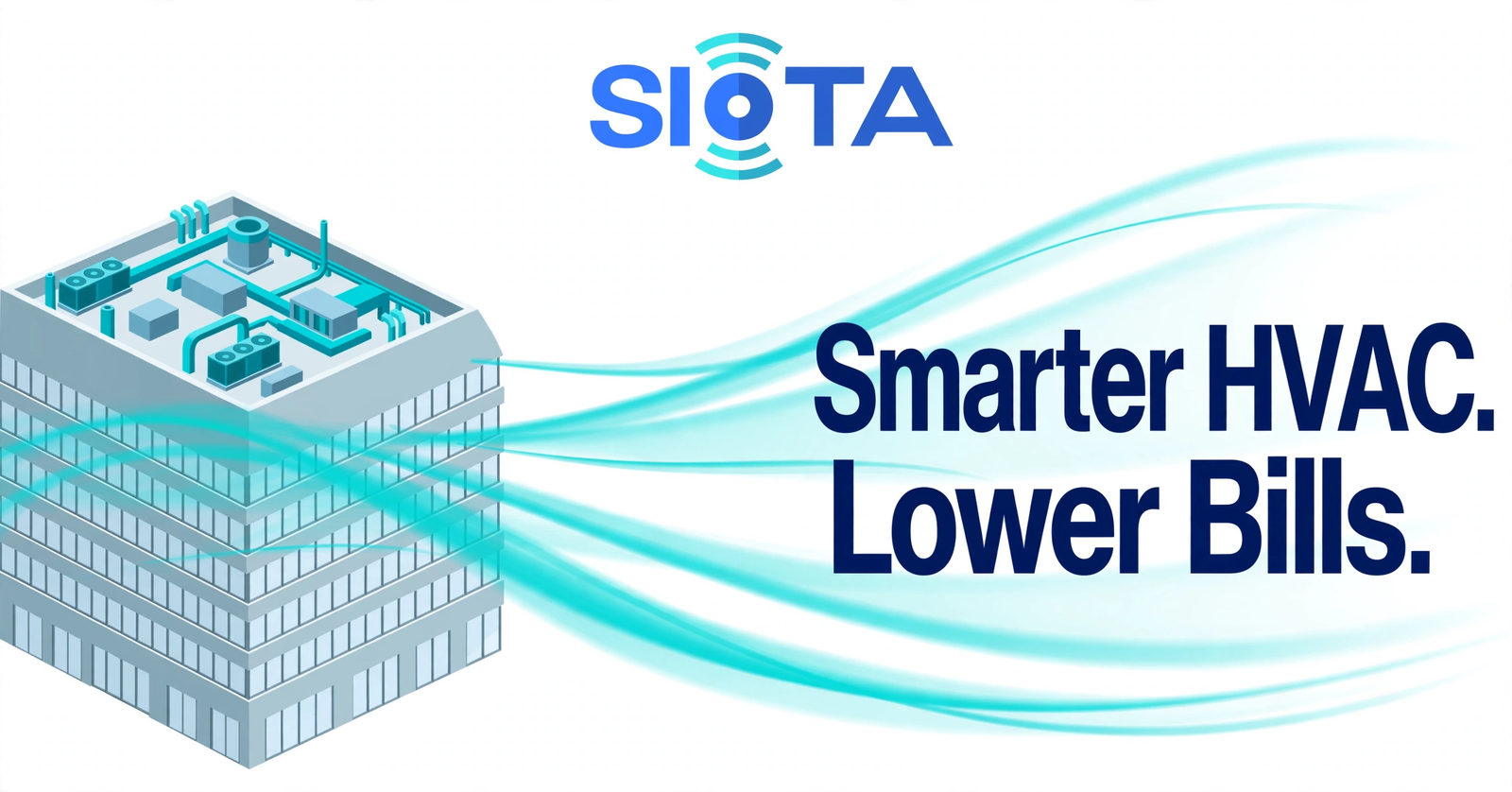
Walk into any office building in India at 8 in the morning and you’ll hear it before you see anyone: the low hum of the air-conditioning already running at full tilt, cooling empty floors for people who arrive an hour later. By most estimates, HVAC — heating, ventilation, and air-conditioning — eats up 40 to 60 percent of a commercial building’s electricity. Not lighting, not computers, not the elevators. Cooling the air. Which is exactly why hvac automation for commercial buildings has become the single highest-leverage energy project a facility team can take on: it attacks the biggest line on the bill, and it does it without asking anyone to sweat through a Delhi May.
Here’s the uncomfortable part. Most commercial buildings in India run their HVAC the way they did fifteen years ago: somebody flips the plant on in the morning, somebody flips it off at night, and in between, the system cools whatever it cools at whatever setting it was left at. Meeting rooms sit at 21 degrees with nobody inside. The chiller runs at full load on a pleasant February afternoon. An AHU pushes conditioned air into a floor that’s half-empty because half the team works from home on Fridays now. None of this is anyone’s fault, exactly — it’s just what happens when a complex system is operated by habit and a wall-mounted thermostat from 2009.
Automation changes the operating model. Instead of fixed schedules and fixed setpoints, the system responds to what’s actually happening: occupancy, outdoor temperature, time of day, tariff slabs. It trims the waste that manual operation can’t see and can’t react to fast enough. And unlike a chiller replacement — which is a crore-plus decision that needs board approval — automation is usually a controls-and-sensors layer on top of equipment you already own. This article breaks down what it includes, what it costs in Indian conditions, and how the payback math actually works, with a worked example you can adapt to your own building.
What hvac automation for commercial buildings actually includes (and what it doesn’t)
The phrase gets thrown around loosely, so let’s pin it down. HVAC automation means giving your heating, ventilation, and cooling equipment a brain — sensors that report conditions, controllers that make decisions, and software that ties it together. It does not mean ripping out your chillers. Your existing plant usually stays; what changes is how intelligently it runs.
At the equipment level, it starts with the basics done properly. Temperature and humidity sensors in zones that matter, not just one thermostat in the corridor. Occupancy sensors — or better, integration with access control and meeting-room booking data — so the system knows which spaces are actually in use. Variable frequency drives (VFDs) on AHU fans and pumps, so motors slow down when full speed isn’t needed instead of burning full power against a damper. Chiller sequencing logic, so a second chiller only starts when the first genuinely can’t cope, rather than both running because “that’s how we’ve always done it.”
Above that sits the scheduling and optimisation layer. Start-stop schedules tied to real occupancy patterns instead of a guard’s memory. Setpoint management that nudges temperatures sensibly — every degree you raise the cooling setpoint in summer cuts compressor energy noticeably, and 24 degrees is perfectly comfortable for most office work, whatever the old 21-degree habit says. Night purging in suitable climates, free cooling when outdoor air is cooler than return air, and demand-controlled ventilation that dials back fresh air intake when CO2 levels show a space is empty.
What it doesn’t include, and what you should be wary of when a vendor’s proposal gets ambitious: it doesn’t replace good maintenance, it doesn’t fix an oversized or dying chiller, and it doesn’t eliminate the need for someone who understands the building. Automation is a force multiplier for a competent facility team, not a substitute for one. The best projects pair the technology with operator training, so the people running the building trust the system instead of bypassing it the first week.
Why HVAC is the biggest line on your electricity bill
India is a cooling-dominated country for commercial buildings. In most climate zones — composite like Delhi, warm-humid like Chennai and Mumbai, hot-dry like Ahmedabad — the cooling season runs eight to ten months a year, and even the “winter” months need dehumidification and ventilation energy. The ECBC code exists precisely because cooling loads dominate Indian commercial energy use, and anyone who’s seen a mall’s or hospital’s electricity bill knows the shape of it: a mountain from March to October and a smaller hill the rest of the year.
The reason HVAC dominates isn’t just the climate, though. It’s part-load operation. Commercial cooling equipment is sized for the worst hour of the worst week of the year — that brutal May afternoon when it’s 45 degrees outside and the building is full. But the system spends most of its life nowhere near that peak. A chiller running at 40% load with fixed-speed pumps and fans is grotesquely inefficient compared to what it could do with variable-speed control responding to actual demand. Manual operation has no way to chase that efficiency; it just runs everything, all the time, “to be safe.”
Then there’s the human factor, which is the quiet killer. Setpoints get lowered during a heatwave and never raised back. A tenant complains once, and the whole floor gets overcooled for a year. The banquet hall’s AHU runs all weekend because nobody told the operator the event was cancelled. Each of these is small; together, in a 2-lakh-square-foot building, they’re lakhs of rupees a month. Automation doesn’t get tired, doesn’t forget, and doesn’t cool empty rooms out of habit — which is exactly why hvac automation for commercial buildings pays back faster than most facility upgrades.
What it costs in an Indian commercial building
The honest answer is “it depends,” but you deserve better than that, so here’s the shape of it. There are broadly two routes, and they cost very different money.
Route one is an IoT-based retrofit: wireless sensors, smart controllers on your existing AHUs and FCUs, VFDs where the motors justify them, and a cloud dashboard with scheduling and analytics. For a mid-sized office building, this typically lands in the lakhs — the exact figure moves with the number of zones, how many motors need drives, and how deep you go on analytics. No civil work, no ripping out the BMS if you have one, and installation happens floor by floor without shutting the building down. This is the route most existing buildings take for hvac automation for commercial buildings, and it’s the one where payback is usually fastest because the capex stays modest.
Route two is a full BMS overhaul or a new-building BMS with HVAC automation designed in from the start. That’s a different budget conversation — tens of lakhs into crores for large buildings — and it makes sense when the existing controls are truly end-of-life or when you’re building new and can design the whole system around efficiency from day one. If a vendor quotes you route-two money for a route-one job, by the way, that’s your cue to get a second quote.
A few cost drivers to keep in mind while comparing proposals. VFDs are the single most cost-effective hardware in most retrofits — if your AHU fans and chilled water pumps are fixed-speed, drives usually pay for themselves embarrassingly fast. Sensor density matters less than sensor placement: a dozen well-placed sensors beat fifty decorative ones. And software licensing is the recurring cost nobody puts on the first slide — ask what the annual subscription covers, what happens to your historical data if you stop paying, and who owns the system configuration. The cheapest proposal with a punishing lock-in is rarely the cheapest system.
The payback math, worked through with an example
Let’s make this concrete with an illustrative example — round numbers, a typical mid-sized office, and assumptions you should replace with your own building’s figures. Take a 1.5-lakh-square-foot office in Gurugram with a monthly electricity bill of around ₹30 lakh. HVAC at roughly half of that is ₹15 lakh a month going to cooling, ventilation, and associated pumping.
Now apply automation. A well-executed project — scheduling tied to occupancy, setpoint optimisation, VFDs on major fans and pumps, chiller sequencing — commonly trims HVAC energy by 15 to 25 percent. Take the conservative end: 15 percent of ₹15 lakh is ₹2.25 lakh saved every month, or ₹27 lakh a year. Against a retrofit capex in the low tens of lakhs, the simple payback lands in the one-to-three-year band, and every year after that is pure saving. Push the savings to 20 percent with disciplined setpoint management and you’re looking at ₹36 lakh a year.
Two things make the hvac automation for commercial buildings math better than it looks on paper. First, several savings don’t show up in the kWh column: lower maximum demand (fewer MD charge spikes), deferred chiller replacement because the plant runs gentler part-load hours, and fewer comfort complaints because temperatures stop swinging. Second, electricity tariffs only move one direction over time in most Indian states, so a saving measured today is worth more every year you keep it. When finance asks why this project and not something else, the answer is that few capex items in a building pay back in two to three years and then keep paying for a decade.
The caveat, stated plainly: the math only works if someone measures the baseline first. When you’re evaluating hvac automation for commercial buildings as a vendor category, insist on a measurement plan — a few weeks of metered baseline before the retrofit, and metered verification after. Without a baseline, “savings” is a story. With one, it’s an audit trail your CFO can sign off on.
Where HVAC automation projects go wrong
Most failed projects don’t fail on technology; they fail on the boring stuff. The most common failure is installing automation and never commissioning it — sensors mounted, controllers wired, and then the system runs on factory defaults because nobody tuned the sequences to the actual building. An uncommissioned automation system is just expensive manual control with extra steps.
The second failure is the bypass. Operators who don’t trust the system — or were never trained on it — switch everything to manual “just for today,” and today becomes permanent. This is a people problem, not a controls problem, and the fix is involving the facility team from the design stage, not unveiling the system at handover. If the operators helped set the schedules, they’ll defend them.
The third is sensor neglect. A temperature sensor drifting two degrees over a year will quietly wreck every optimisation built on top of it. Calibration and periodic checks need to be somebody’s actual job, with a schedule, not a line in a manual. And the fourth is scope creep disguised as ambition: automating lighting, access, and the kitchen exhaust in phase one, running out of budget, and finishing nothing properly. Start with HVAC — it’s the biggest load — prove the savings, then expand the hvac automation for commercial buildings scope with the credibility you’ve earned.
Frequently asked questions
Can HVAC automation work with my existing AC units, or do I need new equipment?
In most cases your existing equipment stays. Automation adds sensing, control, and intelligence on top of chillers, AHUs, and FCUs you already own — VFDs on motors, smart controllers, and scheduling software. Full equipment replacement is only needed when the plant itself is failing, which is a different project entirely.
How much can HVAC automation realistically save?
For a typical Indian commercial building, 15–25% of HVAC energy is a realistic band for a well-executed retrofit, with the exact figure depending on how wasteful the current operation is — the more manual the building, the bigger the prize. Insist on a metered baseline before the project so the savings are measured, not claimed.
Do I need a full BMS for this?
No. A full building management system is one route, but an IoT-based retrofit achieves most of the HVAC savings at a fraction of the cost and without replacing existing controls. Many buildings start with the retrofit, prove the payback, and integrate with or upgrade to a fuller BMS later.
What happens during a power cut? Does the system handle DG changeover?
A properly designed system rides through changeovers and resumes its schedules automatically when power returns — no 2 am phone calls to restart the plant. DG-period operation can also be tuned separately, since running full cooling on diesel is brutally expensive and worth managing deliberately.
What maintenance does the automation itself need?
Mostly sensor calibration, periodic checks on controllers and network gateways, and a review of schedules when occupancy patterns change — say, when a tenant moves out or hybrid-work policies shift. Budget a small annual maintenance arrangement rather than treating commissioning as a one-time event.
The bottom line
Your HVAC system is the largest electricity consumer in your building, it runs hardest exactly when tariffs and tempers are highest, and right now it’s probably operating on habit. Automation replaces habit with measurement and response — cooling the spaces that are occupied, easing off when they’re not, and running every motor at the speed the moment actually needs. The technology is proven, the retrofit doesn’t shut your building down, and the payback math survives contact with a sceptical CFO. If you’re shortlisting hvac automation for commercial buildings, start with a walkthrough of your own plant: Siota’s engineers will map your HVAC loads, meter a proper baseline, and show you where the savings are hiding in your building specifically — then automate exactly that. Talk to Siota and turn your biggest electricity line item into your best energy project. You can also find SIOTA Technologies Private Limited on Google for directions, working hours and customer reviews.
