

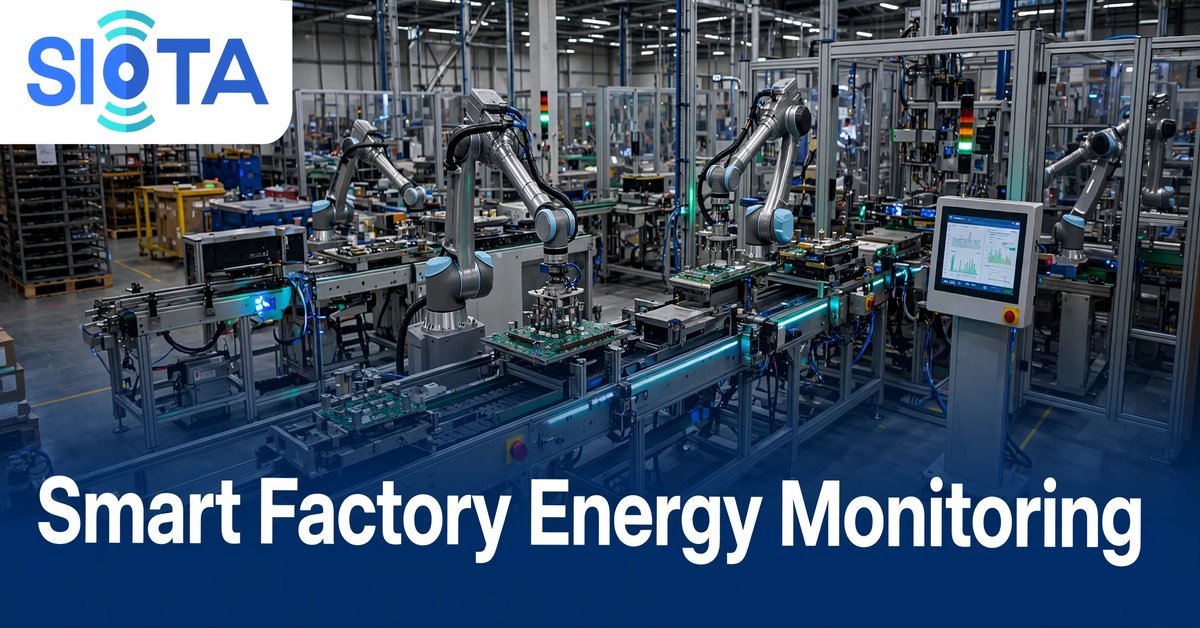
Walk into any Indian factory at month end and you will find the same scene: the accounts team staring at a power bill nobody can explain, maintenance insisting the machines are fine, and the owner watching margin vanish into the meter. Nobody is lying — they cannot see where the power went. That blind spot is why smart factory energy management is becoming the line between factories that control costs and ones that simply pay up. The fix usually starts with a cloud based energy monitoring system for factories fitted to your existing plant, with no shutdown needed.
This article is a practical walkthrough for factory owners, plant heads and maintenance teams: what smart factory energy management actually means on an Indian shop floor, which machines to watch first, how cloud dashboards change daily decisions, and how to pick a partner without getting lost in sales talk. No theory for its own sake — just the working view from plants that have done it.
Smart factory energy management starts with knowing where the power goes
Most Indian factories meet their electricity in exactly one place: the monthly bill. One number, thirty days of activity crushed into a single line, and a due date. That number tells you what you paid, but nothing about what you paid for. Was it the furnace running an extra shift? The compressor leaking air all weekend? The old motor on line three drawing more current than it should? The bill keeps all of that to itself.
So decisions get made on guesswork. The owner asks maintenance to reduce consumption, maintenance tightens a few belts and hopes, and next month’s bill decides whether the hope worked. Without machine-wise, shift-wise data, energy management is really energy wishing — sincere, but not a strategy.
A connected monitoring setup breaks the bill open. Power meters go on the main incomer and on key feeders, current sensors sit on individual machines, and everything feeds a cloud dashboard that updates every few seconds. Suddenly the factory’s electricity has a shape: you can see the morning start-up spike, the lunch-hour dip that never quite dips, and the night shift’s steady hum through the small hours.
That shape is where every saving begins. You cannot fix what you cannot see, and learning to read that shape is the core skill of smart factory energy management. For most factories the first month of visibility alone changes how the team talks about power. The conversation moves from “the bill is high” to “line two’s idle load is high between 2 and 4 pm” — and that is a problem someone can actually solve.
Why Indian factories burn more power than their owners think
Indian factories have a particular mix of conditions that quietly inflates consumption. Voltage fluctuations push plants to run equipment in safe-but-wasteful ways. Old machinery, bought second-hand or simply run for decades, draws more current than its nameplate suggests. And the working culture in many plants treats electricity as a fixed cost — something that arrives, not something you manage.
Then there is the waste nobody watches. Compressed air is the classic example: compressors run, air leaks out of joints and hoses across the plant, and the compressor works harder to keep pressure up. Nobody sees an air leak the way they would see a water leak, so it goes unrepaired for months. The same invisibility applies to idle machines left running between jobs, oversized motors running at a fraction of their load, and cooling systems fighting the afternoon heat.
The first principle of smart factory energy management is that most of this waste is not anyone’s fault — it is nobody’s job. When no single person owns the electricity data, the waste has no owner either. A monitoring system fixes that by giving every leak and idle hour a name, a number and a time stamp.
None of this needs new machines, and that is the part many owners miss. The factory you already have can usually run noticeably leaner once its energy habits are visible. Monitoring does not replace maintenance or good engineering — it tells maintenance exactly where to look, instead of asking them to look everywhere.
What a cloud-based system actually changes on the shop floor
The word “cloud” puts some plant heads off — it sounds like something for IT companies, not factories. In practice, a smart factory energy management setup on the cloud simply means the data lives somewhere your team can reach it from anywhere: the plant head’s phone, the owner’s laptop at home, a consultant’s desk in another city. No server room, no software to maintain, no IT department required.
On the shop floor itself, the change is small and practical. Meters and sensors get fitted to incomers, feeders and machines — usually without stopping production. A gateway box collects the readings and sends them to the cloud every few seconds. From that moment, the factory’s electricity is live data, not last month’s bill.
What changes fastest is the morning routine. Instead of waiting for month end, the maintenance head opens the dashboard and sees yesterday: which line consumed what, whether the night shift behaved, whether any machine drew unusual current. Problems that used to hide for thirty days now surface within hours, while they are still cheap to fix.
The cloud part also matters for owners running more than one unit. Two or three plants in different industrial estates can be compared side by side — same machines, different shifts, different numbers. That comparison alone often reveals which plant manager runs the tighter ship, and the others get a concrete example to copy instead of a lecture.
The machines that repay monitoring fastest
Not every machine deserves a sensor on day one. The smart move is to start where the power — and the waste — concentrates. In practice, smart factory energy management is less about the sensors and more about this targeting: watching the few loads that dominate the bill before worrying about the rest. In most factories that means a short list: air compressors, furnaces and ovens, large motors and pumps, process cooling, and the main incomer itself as the reference point everything gets measured against.
Compressors earn their meters first because their waste is both large and invisible. Furnaces and ovens matter because heating loads are heavy and small inefficiencies multiply across long cycles. Big motors on conveyors, crushers and mixers draw steady current that drifts upward as bearings wear and belts loosen — a trend the dashboard shows weeks before the motor itself complains.
This is exactly the kind of targeting that good commercial energy monitoring solutions are built for: start with the heavy, wasteful loads, prove the value in the first quarter, then extend meters to the rest of the plant as the savings fund the rollout. Nobody needs to instrument everything on day one.
One more candidate people forget: the machines that run when nobody is working. Weekend baseload — the plant’s consumption with zero production happening — is often a shock the first time an owner sees it. Pumps, compressors, exhaust fans and office air-conditioning quietly running through Sunday add up to a number that is pure waste, and pure saving once someone starts switching them off.
From data to discipline: making the savings stick
Here is the honest part most vendors skip: the dashboard alone saves nothing. Smart factory energy management only works when the data changes what people do every day. The factories that win treat the first month of data as the start of a routine, not the end of a project.
That routine is simple. Someone owns the numbers — usually the maintenance head or a designated energy champion on the team. Every morning they spend ten minutes on the dashboard: yesterday’s consumption against target, any alerts overnight, any machine behaving oddly. Once a week, a short review with the plant head: what did we catch, what did we fix, what is still open.
Targets matter more than technology. A factory that sets one simple goal — bringing weekend baseload down, or cutting one line’s idle hours — and tracks it openly will outperform a factory with fancier sensors and no targets. People respond to a visible score, and a dashboard gives the whole team the same scoreboard.
The best part is that the system keeps everyone honest without blame games. When a cloud based energy monitoring system for factories shows that line three’s consumption jumped the week a new operator joined, the conversation becomes about training, not accusations. Data takes the argument out of energy management, and that is worth as much as the units saved.
Choosing a commercial energy monitoring partner without the sales fog
The market is full of vendors and the brochures all look the same, so a few practical filters help. First, ask whether the system installs on your existing plant without shutdowns. If the answer involves stopping production for days, walk away — retrofit-friendly hardware that clamps on and wires in during normal working hours is the whole point of this approach.
Second, ask to see a live dashboard from a real factory, not a demo with perfect data. Real factory data is messy: spikes, gaps, odd patterns at shift change. A vendor confident in their smart factory energy management system will show you the mess and explain what it means. A vendor who only shows slides is selling you a dream.
Third, check the after-sales reality. Sensors fail, gateways lose connectivity, and sites need attention from time to time. You want support from people in your time zone who pick up the phone — not a ticket queue in another country. Ask who services your industrial estate and how quickly they reach site when something goes wrong.
Fourth, make sure the data stays yours: exportable, timestamped, and accessible even if you change vendors later. A monitoring platform you cannot leave is a trap, not a tool. And finally, favour vendors who ask about your machines before their technology — the ones who ask what you manufacture are usually the ones who know where your waste hides.
FAQs
Will sensors and meters force us to stop production during installation?
No. Retrofit installations are designed to fit around running plants. Clamp-on current sensors and meters wire into panels during normal working hours, usually feeder by feeder, so production never stops. Most factories are fully instrumented within days, not weeks, and the team barely notices the work happening.
We already have an energy meter at the main incomer. Isn’t that enough?
The incomer meter tells you the factory’s total, which is exactly what the bill tells you. Smart factory energy management needs the breakdown behind that total: which feeder, which machine, which shift. Without that split, you know you spent too much but not where — and “where” is the only part you can fix.
How soon will we see the first useful insight?
Usually within the first week of live data. Weekend baseload, idle machines, compressors running against leaks — the obvious waste shows up almost immediately because nobody was watching it before. The deeper insights, like slow motor degradation or shift-wise comparisons, build up over the first month or two.
Can the system handle our mix of old and new machines?
Yes, and that is the normal case in Indian factories. Monitoring sits at the electrical level — meters and sensors on feeders and machines — so it does not care how old the machine is or who made it. A thirty-year-old lathe and a brand-new CNC both draw current, and both can be watched the same way.
Who in our team actually needs to look at the dashboard?
Three people, realistically: the maintenance head for daily checks, the plant head for the weekly review, and the owner for the monthly picture. Operators do not need logins — they need the one or two targets that come out of the data, like switching off idle machines between jobs. Keep the audience small and the actions clear.
What happens to our data if we change vendors later?
That depends on the vendor you choose now, so ask before signing. Your readings should be exportable in standard formats and remain accessible to you regardless of the contract. If a vendor hesitates on data ownership or export, treat that as a warning sign and keep looking.
If the monthly bill still lands as a surprise, the factory is flying blind — and the fix is simpler than most owners expect. Start with a smart factory energy management assessment of your heaviest loads, watch your first month of live data, and let the numbers show you where the waste lives. You can also find SIOTA on Google — check the listing and get in touch — to talk through what your plant actually needs before spending a rupee on hardware.
