

Running a business in Delhi means living with some of the country’s most punishing power conditions: steep commercial tariffs, brutal summer peaks, voltage swings and the odd outage that resets everything. Most offices, factories and campuses here still manage all of that with a monthly DISCOM bill — one number, thirty days late. This is the gap that energy monitoring solutions in Delhi are built to close. A real time energy monitoring system watches your building’s electricity live, feeder by feeder, so the team sees waste the day it happens instead of the month after.
This guide is for Delhi’s facility managers, business owners and admin heads who are done guessing. It covers what energy monitoring solutions in Delhi actually include, how they handle the city’s specific power problems, what the dashboard should show, and how to choose a vendor you can actually reach when something goes wrong.
Energy monitoring solutions in Delhi: what you are actually buying
Strip away the brochures and what you are buying is simple: meters and sensors on your electrical panels, a small gateway that collects their readings, and a cloud dashboard where your team watches it all. The hardware clamps onto your existing panels without shutting anything down. The software turns raw current and voltage readings into something a non-engineer can read.
The best energy monitoring solutions in Delhi start with a site walk, not a quotation. A good vendor walks your building or plant, looks at your panels, your heavy loads and your shift patterns, and then tells you where the meters should go. Anyone who quotes a system without seeing your site is guessing — and you will pay for their guess.
What comes out of it is a live picture of your power: how much the whole site draws right now, which floors or machines draw the most, how today’s consumption compares with yesterday’s, and whether anything is behaving oddly. That picture updates every few seconds, from anywhere, on a phone or a laptop.
One thing to be clear about: this is monitoring, not magic. The system does not reduce your bill by itself. It shows you, precisely and continuously, where your electricity goes — and then your team makes the decisions that cut the waste. Think of it as finally getting headlights for a road you have been driving in the dark.
Delhi’s power realities: what a monitor has to survive here
Delhi is not a gentle place for electrical equipment or for energy data. Summer afternoons push air-conditioning loads to extremes that would look like faults anywhere else. Voltage fluctuates, outages interrupt both supply and data, and commercial tariffs punish peak demand in ways residential users never see. Any monitoring setup here has to be built for these conditions, not for a brochure.
That is why energy monitoring solutions in Delhi need to be tougher than average. Meters must ride through voltage swings without losing calibration. Gateways must buffer readings locally when the internet drops — and it will drop — then backfill the gaps automatically when connectivity returns. If a system loses data every time the broadband has a bad afternoon, its reports will be full of holes exactly when you need them most.
Peak demand is the other Delhi-specific story. Commercial tariffs here make your highest fifteen or thirty minutes of the month disproportionately expensive. A live system watches demand as it builds and warns the team before a new peak gets set — say, when too many chillers and lifts run together on a May afternoon. One avoided peak can matter more than weeks of small savings.
Then there is the multi-site reality. Plenty of Delhi businesses run an office in the city and a warehouse or plant in Bawana, Narela or Greater Noida. A cloud dashboard puts all of them on one screen, so the owner compares sites instead of collecting separate bills and wondering. That comparison discipline is why energy monitoring solutions in Delhi pay off fastest for multi-site owners.
The energy monitoring dashboard your team will actually open
Here is an uncomfortable truth about dashboards: most of them get opened enthusiastically for two weeks and then ignored forever. The difference between a dashboard that lives and one that dies is whether it answers the three questions a busy facility manager actually asks: how are we doing today, is anything wrong right now, and what needs my attention this week.
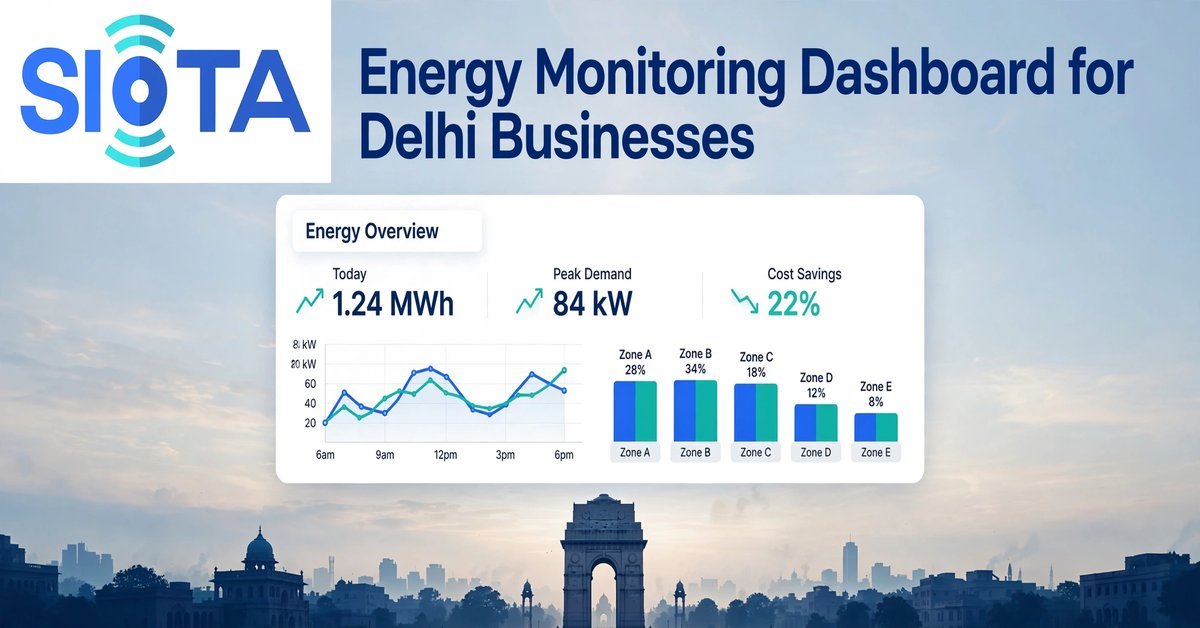
A good energy monitoring dashboard puts today’s consumption front and centre, against yesterday and against the monthly target. Below that, the big consumers — floors, machines, feeders — ranked so the eye goes straight to the heavyweights. And off to the side, alerts: plain-language flags like “chiller 2 drawing 20% above normal” instead of cryptic codes.
The dashboard also needs to respect its audience. The security guard in the control room needs a simple green-amber-red view. The facility manager needs trends and comparisons. The owner needs a monthly summary that fits on one screen. One login with role-based views beats three separate systems every time.
Ask any vendor for a live demo login before you sign, and open it on your phone. If you cannot understand your own building’s power in two minutes on a mobile screen, your team will not use it either. The prettiest dashboard in the sales presentation is worthless if the daily-use version confuses people.
What real-time monitoring catches that monthly bills never will
The monthly bill is a post-mortem. It tells you, thirty days late, that something was wrong — never what, never when, never which machine. A real time energy monitoring system works the other way: it catches the problem while it is still cheap to fix.
The classic catches are almost boring in how often they repeat. The AHU serving a floor that emptied at 6 pm but ran at full speed till midnight. The compressor cycling against a leak nobody reported. The water pumps running through a Sunday. The office floor where the AC starts at 7 am for a team that arrives at 9:30. Each one is invisible on the bill and obvious on a live graph.
Then there are the slow problems the bill actively hides. A motor whose current creeps upward month after month as bearings wear. A chiller losing efficiency so gradually that each bill looks only slightly worse than the last. Live data turns these into visible trends with dates attached — maintenance gets a warning weeks before the breakdown, instead of a repair bill after it.
And there is the human factor. When the team knows consumption is visible, behaviour changes on its own. Nobody wants to be the shift whose line glows red on the morning report. Energy monitoring solutions in Delhi work partly as measurement and partly as a mirror — and the mirror is often the cheaper half of the saving.
Getting it installed without stopping your operations
The fear that stops most Delhi businesses is downtime: nobody wants electricians shutting panels in a running office or plant. The good news is that modern retrofit hardware is designed exactly for this. Clamp-on current sensors fit around cables without disconnecting them, meters wire into spare ways in the panel, and the work happens feeder by feeder during normal working hours.
A typical commercial building in Delhi — say, an office floor or a mid-size plant — gets fully instrumented in days. The vendor’s team coordinates with your electrician, works around your schedule, and tests each meter as it goes live. Your operations team will barely notice, apart from strangers with toolboxes near the panels for a few days.
What you should insist on is a clean handover. Every meter labelled and mapped to the dashboard, so “Feeder 7” actually means something to your team. Alert thresholds set sensibly from the first week of data, not left at factory defaults that cry wolf. Good energy monitoring solutions in Delhi include this handover as standard — and a walkthrough where your facility manager learns the dashboard on your building’s real data, because training on a demo account teaches nothing.
One practical Delhi note: schedule installation outside the peak summer crunch if you can. Vendors are stretched thin in May and June when every building’s cooling problems surface at once. An installation planned in the milder months gets more attention and a calmer commissioning.
Picking a vendor who is actually reachable in Delhi
This matters more than any feature list. Sensors fail, gateways lose connectivity, SIM cards need attention — and when your dashboard goes dark, you need a human being who answers the phone in your time zone and reaches your site the same day. A vendor with a real Delhi presence beats a cheaper vendor with a support desk three time zones away.
Ask direct questions before signing. Who services my area — do you have engineers in Delhi NCR or do they fly in? What is the response time in the service agreement, in writing? Can I see a live dashboard from another Delhi site you monitor, so I can judge the data quality myself? Vague answers to any of these are a reason to keep looking.
Also check what happens after the sale in the unglamorous details. Who replaces a failed sensor and how fast? Are alert configurations and dashboard changes included, or billed extra each time? Is your data exportable in standard formats if you ever switch vendors? The cheapest quotation often becomes the most expensive relationship.
Finally, favour vendors who talk about your building before their technology. The ones who ask about your shifts, your heavy loads and your pain months — May, June, the wedding season for banquet halls — are the ones who will set up the system to catch your real problems. Energy monitoring solutions in Delhi are only as good as the local understanding behind them.
FAQs
Do we need permission from the DISCOM to install monitoring?
No. Energy monitoring sits on your side of the meter — sensors and meters on your own panels and feeders. It does not touch the DISCOM’s meter or supply, so no permission is needed. Your vendor should still coordinate with your building’s electrical team, but the utility is not involved.
Our building already has a BMS. Do we still need energy monitoring?
Often, yes. A BMS controls equipment; it rarely gives you clean, continuous energy data with proper metering. Many Delhi buildings have a BMS that runs the HVAC but cannot tell you what each feeder consumed yesterday. That missing layer is exactly where energy monitoring solutions in Delhi add value — and a good IoT platform can read data from your existing BMS rather than replacing it.
How does monitoring handle Delhi’s power cuts and voltage swings?
Properly specified meters ride through fluctuations without losing calibration, and gateways buffer readings locally during outages or internet drops, then backfill automatically. Ask the vendor specifically about this — it is the difference between a system built for Delhi and one built for a brochure.
Can one system cover our office in the city and our warehouse outside it?
Yes. That is one of the main advantages of a cloud setup: every site feeds the same dashboard. You can view each location separately or compare them side by side, and alerts from all sites land in one place. Multi-site owners in Delhi NCR commonly run offices, warehouses and plants on a single login.
Who looks at the data — do we need to hire someone?
No new hiring needed. The daily check takes the facility manager about ten minutes each morning; the weekly review is a short sit-down with the business head. Operators do not need dashboard access — they need the two or three action points that come out of the data. Small teams manage this fine.
Is cloud-based monitoring safe for our consumption data?
Your readings travel over encrypted connections to secured cloud servers, the same basic approach banks and email use. More important than the technology is the contract: your data should be yours, exportable in standard formats, and deletable if you leave. Get that in writing before you sign.
If your Delhi facility still runs on a monthly bill and a prayer, it is time to see your power as it happens. Start with energy monitoring solutions in Delhi that put live, feeder-wise data in front of your team, and let the first month of visibility show you what the bill has been hiding. You can also find SIOTA on Google — check the listing and get in touch — to arrange a site walk and talk through what your building actually needs.
