

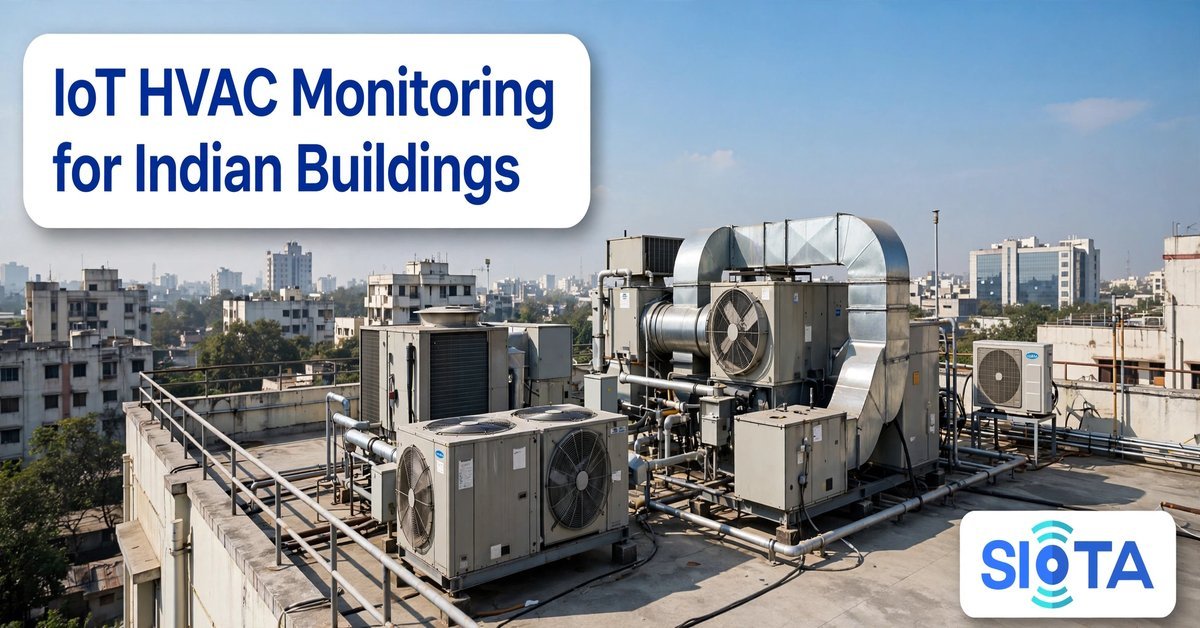
If you manage a commercial building in India, you already know the pattern: every summer the electricity bill climbs, the chillers run flat out, and nobody can say with confidence where all that cooling energy is actually going. Working with an iot based hvac monitoring company in india turns that guesswork into hard evidence. Wireless sensors track energy use, temperatures and run-hours across chillers, pumps and air handling units, and everything lands on a dashboard your operations team can actually read.
Before you speak to any iot based hvac monitoring company in india, it helps to understand what these systems really do, what they cannot do, and where projects usually go wrong. Too many facility teams pay for a dashboard of colourful graphs and end the year with the same power bill. This guide walks through the buying decision the way an energy consultant would explain it over chai, so your budget buys visibility that leads to action.
What an iot based hvac monitoring company in india actually does for your building
At its simplest, an IoT-based HVAC monitoring setup puts small wireless sensors on your cooling equipment and connects them to software that shows what is happening right now. Current sensors measure how much electricity each chiller, pump or air handling unit is drawing. Temperature sensors track supply and return air, chilled water lines and occupied spaces. Some systems also log run-hours, so you can see which machine works the hardest and which one barely runs at all.
The difference between this and your building’s main energy meter is granularity. Your utility bill tells you the whole building consumed a certain number of units last month. That is like knowing your car used a tank of petrol without knowing whether the leak was in the engine or the air-conditioning. Equipment-level monitoring tells you exactly which machine, on which floor, at which hour is pulling more power than it should.
A good iot based hvac monitoring company in india will not just sell you sensors. They will walk your plant room with you, study your single-line diagram, and decide where measurement actually matters. A chiller without a flow meter can still be judged through its electrical signature. An air handling unit can be assessed from its supply and return air temperatures. The aim is maximum insight with minimum hardware, because every sensor you do not need is money saved.
What monitoring will not do on its own is fix anything. The sensors only reveal the waste; turning insight into savings still needs someone to act on setpoints, schedules, dampers and coils. Remember this when vendors promise savings figures. The technology enables savings; your team’s follow-through delivers them.
Why monitoring matters more in Indian commercial buildings
Indian commercial buildings run their cooling systems harder than buildings almost anywhere else. The cooling season is long, the afternoon peak is sharp, and many offices, malls and hospitals run air-conditioning ten to twelve hours a day for most of the year. When HVAC is the largest electrical load in the building, small inefficiencies add up to serious money over a year.
There is another Indian reality: mixed equipment of mixed ages. It is common to find a ten-year-old chiller running next to a new one, pumps replaced piecemeal over the years, and air handling units added floor by floor as tenants changed. A building management system, if one exists at all, often covers only part of this. An iot based hvac monitoring company in india deals with this patchwork every single day, and the retrofit-friendly nature of wireless sensors is exactly why the approach works here.
Dust and maintenance gaps add a third reason. Coils foul faster, filters clog sooner, and outdoor units bake in direct sun through the hottest months. Without measurement, a chiller slowly losing efficiency looks exactly like a chiller doing its job, because the building still feels cool. The extra units only show up on the bill, months later, mixed in with everything else. Continuous monitoring catches that slow drift while there is still time to act on it.
Finally, there is the people factor. In most Indian facilities, the operator who knows the plant best is one job change away from leaving. A monitoring system writes that knowledge down in data: normal pump currents, design chilled water temperatures, holiday behaviour. That record outlasts any single employee.
Monitoring, management or automation: choosing the right scope
Vendors use three words that sound similar but mean different scopes. Monitoring means measuring and reporting: data, alerts and dashboards, with your team deciding what to do. Management means someone actively uses the data to run the plant better through schedules, weekly reviews and anomaly chasing. Automation means the system itself acts, adjusting setpoints and switching equipment by rules.
An iot based hvac management company in india sits in the middle of this ladder. The engagement usually pairs monitoring hardware with an ongoing service: monthly energy reviews, anomaly alerts with suggested actions, and quarterly performance summaries. This suits buildings that want results but do not have a dedicated energy manager on staff. The vendor becomes, in effect, your outsourced energy team for the HVAC plant.
Most consultants recommend climbing the ladder one rung at a time. Start with monitoring, because you cannot manage what you cannot measure. Run it for a few months, fix the obvious problems the data reveals, and build your team’s confidence in the numbers. Only then consider automation, when you know exactly which decisions are repetitive enough to hand over to software. Buildings that jump straight to automation often end up automating their existing bad habits.
Budget follows the same ladder. Monitoring is the lightest investment, mostly hardware and a software subscription. Management adds a service fee for the human expertise. Automation adds control hardware and engineering time. None of these is cheap or expensive in absolute terms; it depends on your connected load and how many points you monitor. Ask every iot based hvac monitoring company in india to quote the three scopes separately so you can compare honestly.
Questions to ask a vendor before you sign anything
The first question is about the hardware: who owns the sensors, and what happens if you stop the subscription? Some vendors install their devices and take them back if you cancel, leaving you with nothing. Others sell you the hardware outright. Neither model is wrong, but you should know which one you are buying into before the first sensor goes up on your chiller.
Ask how the system handles your building’s reality. Can it monitor equipment without shutting the plant down for installation? Wireless clamp-on current sensors usually can, which matters because no facility manager wants to explain a shutdown to tenants. Ask about connectivity too: what happens to data when the internet drops? A serious iot based hvac monitoring company in india will have local buffering on the gateway, so a network outage costs you a delay in the dashboard, not a gap in the record.
Insist on seeing a real dashboard, not a slide deck. Ask the vendor to log into a live site and walk you through it. Can your shift operator understand it at three in the morning? Does it show which air handling unit has a stuck damper, or just pretty charts of total consumption? The best systems translate raw readings into plain-language alerts: this pump is drawing more current than its twin, go and look at it.
Finally, ask about the exit. How do you get your historical data out if you leave? In what format? How long is it retained? Data lock-in is the quiet trap of this industry. A vendor confident in their service will answer these questions easily, because they expect you to stay for the value, not because you cannot leave.
What the installation looks like in a working building
A typical installation starts with a site survey. When an iot based hvac monitoring company in india takes up your project, their engineer walks your plant room, notes every chiller, pump, cooling tower and air handling unit, and marks where sensors will go. This usually takes half a day for a mid-sized commercial building. You will be asked for single-line diagrams and any existing BMS documentation, but experienced teams are used to working without perfect paperwork.
Installation itself is refreshingly non-disruptive. Clamp-on current transformers go around cables without cutting power. Temperature sensors strap onto pipes or sit in ducts. Gateways mount on a wall and connect over your existing Wi-Fi or a cellular connection. For a building with a central plant and a dozen air handling units, the physical work often finishes within a couple of working days, with the plant running normally throughout.
Then comes commissioning, the part vendors talk about less. Each sensor point must be named, mapped to the right equipment and given sensible alert thresholds, which takes a week or two of watching and tuning. A chiller drawing high current on Monday mornings is not faulty; that is the pull-down after a weekend shutdown. Good commissioning teaches the system your building’s normal before it starts crying wolf.
Plan for a learning period of about a month before you judge the system. In the first weeks, your team will get alerts that turn out to be normal behaviour, and the vendor should tune them down. After that, the alerts that remain are the ones worth acting on. Buildings that skip this tuning phase end up with operators who ignore every alert, which is worse than having no system at all.
Signs your building is ready for iot based hvac automation
Not every building needs automation, but some are clearly ready. The first sign is stable monitoring data: you have measured for months and the same manual decisions repeat daily. If your operator switches the same pumps on at eight and off at eight, that decision is a candidate for automation. If every day looks different, keep the human in charge a while longer.
The second sign is scale. A small building can be run well by an attentive operator with good data. A campus with multiple blocks and dozens of air handling units is a different story: no human watches forty machines at once. That is where iot based hvac automation earns its keep, enforcing schedules, staging chillers and resetting setpoints by actual occupancy.
The third sign is that your team already acts on monitoring alerts. If weekly energy reviews happen, if anomalies get investigated, if setpoints get adjusted when the data suggests it, then your organisation has the discipline automation needs. Automation amplifies good operations and bad operations alike. Buildings that ignore their dashboards should fix the culture before they buy the controls.
When these three signs line up, talk to your iot based hvac monitoring company in india about the automation path. Often the same sensor infrastructure can support it, which keeps the incremental cost reasonable. The vendor already knows your plant, your load patterns and your team’s working style. That continuity is worth more than a slightly cheaper quote from a stranger, so give your incumbent the first chance to quote the upgrade.
Frequently asked questions
How is IoT-based HVAC monitoring different from a regular BMS?
A building management system controls equipment and usually comes bundled with the building’s original construction, covering only what the original contractor included. IoT-based monitoring is a retrofit layer: wireless sensors added to existing equipment, independent of the BMS, focused on energy visibility. Many buildings run both, using the BMS for control and the IoT layer for measurement and analytics. An iot based hvac monitoring company in india will typically integrate with your BMS where possible rather than replacing it.
Will installation require shutting down our plant?
In most cases, no. Clamp-on current sensors install on live cables, temperature sensors strap onto pipes without cutting them, and gateways only need a power socket and network access. Your plant keeps running throughout. The only exception is flow or pressure meters that need pipework changes, and even those are scheduled during planned maintenance windows.
How many sensors does a typical commercial building need?
It depends on your plant layout, but a sensible starting point is one energy measurement point per major machine: each chiller, each primary and secondary pump, each cooling tower fan, and each large air handling unit. Temperature points go on chilled water supply and return lines plus a few representative occupied spaces. A mid-sized office building often lands in the range of a few dozen points. Start with the big energy users; you can always add granularity later once the value is proven.
What happens to our data if we cancel the subscription?
This varies by vendor, which is exactly why you should ask before signing. Reputable vendors let you export your historical data in standard formats like CSV, and some retain read-only dashboard access for a transition period. Be wary of contracts where the hardware is taken back and the data simply disappears. Your building’s energy history has real value for future audits and retrofits, so protect it in writing from day one.
Can the system separate our HVAC load from the rest of the building?
Yes. Current sensors on the HVAC feeders separate cooling load from lighting, lifts and plug loads. During power cuts this shows how much diesel is being burned just for cooling, which helps decide which air handling units stay on during generator operation.
How long before we see useful insights?
Basic insights, like equipment running when it should not, often appear within the first week. Deeper insights, like slow chiller efficiency drift or the true cost of an operating schedule, need a month or more of data across varying weather and occupancy. Treat the first month as commissioning. From the second month onward, a well-tuned system produces a steady stream of actionable findings.
Choosing the right partner matters more than choosing the right sensor brand. Look for an iot based hvac monitoring company in india that surveys your plant before quoting, shows you a live dashboard before asking for money, and talks honestly about what monitoring cannot do. If you would like to see how SIOTA approaches this work, have a look at SIOTA’s Google business listing for an overview of their energy monitoring projects with commercial buildings across India, and start the conversation with a site survey of your own plant.
