IoT energy monitoring for BRSR compliance is no longer a choice for India’s listed companies — it is a regulatory requirement with consequences. SEBI mandated Business Responsibility and Sustainability Reporting (BRSR) for the top 1,000 listed companies by market capitalisation from FY 2022–23 onwards. Energy consumption is a core disclosure requirement within that framework. And the question every CFO, sustainability head, and facility manager is now facing is the same: where does this data come from?
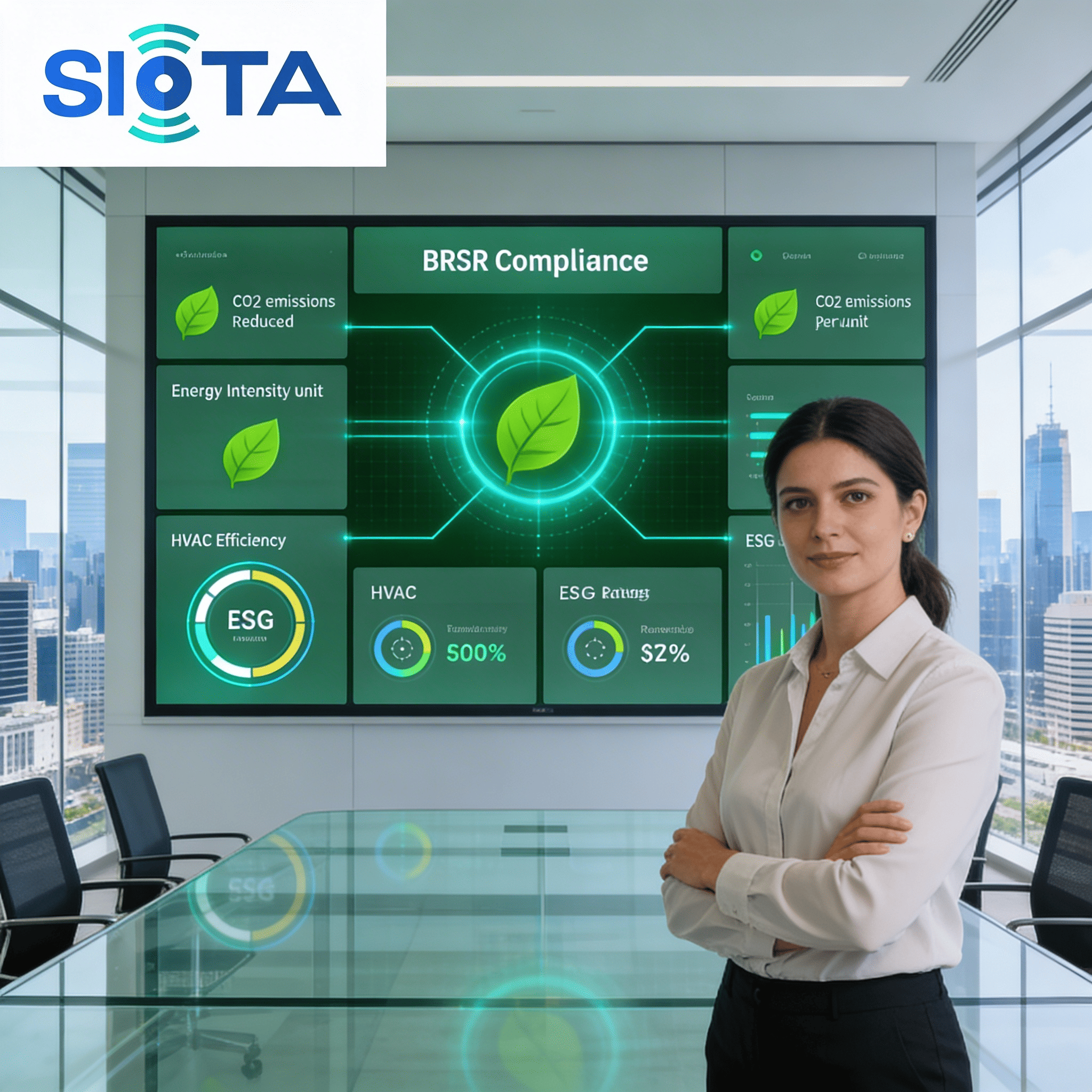
Walk into every BRSR review with confidence — SIOTA turns your IoT energy and HVAC data into a ready-to-present compliance dashboard.
For most facilities, the answer is still: manually. Engineers walk the floors, read sub-meters, compile spreadsheets, cross-reference bills, and hope the numbers reconcile. The result is data that is incomplete, inconsistently formatted, and difficult to audit — exactly the opposite of what BRSR, ESG investors, and green building certification bodies require.
IoT-based energy monitoring solves this at the source. This blog covers 7 specific ways it enables Indian companies to meet BRSR, ESG, and green building requirements — with data that is continuous, granular, and audit-ready from day one.
1. IoT Energy Monitoring for BRSR Compliance Provides the Continuous Data SEBI Now Requires
BRSR disclosures under the SEBI framework require companies to report total energy consumption, energy intensity (per unit of revenue or output), and the proportion of energy from renewable sources — broken down by facility and by type. This is not a summary. It is a granular, verifiable dataset.
Manual meter reading cannot produce this reliably. Readings are periodic, prone to transcription error, and impossible to audit without a continuous chain of evidence. A missed reading or a site visit that didn’t happen creates a gap in the dataset that compliance teams then have to explain.
IoT energy monitoring captures consumption at the circuit, equipment, and zone level — continuously, automatically, and with a timestamp on every reading. The data chain is unbroken. Every figure in the BRSR report has a source. And if an auditor asks how a number was derived, the system produces it in seconds.
SIOTA’s Energy Management System is designed specifically to provide this level of data quality — not periodic snapshots, but live, continuous measurement across every circuit in every facility.
2. IoT Energy Monitoring for BRSR Compliance Automates the ESG Reporting Workflow
For a company managing 5, 15, or 50 or more facilities across India, preparing the energy section of an ESG or BRSR report manually takes weeks. Data has to be requested from each site. It arrives in different formats. It covers different time periods. Someone then has to normalise, validate, and consolidate it into a reportable number.
IoT energy monitoring replaces this entire workflow. Consumption data from every facility flows automatically into a centralised dashboard. It is normalised, timestamped, and organised by location, asset class, and time period. When reporting season arrives, the energy section of the BRSR report is not assembled — it is exported.
Companies that SIOTA has worked with report that their energy reporting timeline compressed from three to four weeks of manual effort to under two days — simply because the data was already there, already structured, already auditable.
| 🔍 Free Energy Audit — Find Out If Your Facility’s Data Is BRSR-Ready
Most facilities that believe their energy data is sufficient for BRSR compliance have significant gaps when the data is stress-tested. Our team will assess your current setup and show you — specifically — what is missing and what it would take to fix it. 👉 Book your free 30-minute energy audit → siota.in/contact-us |
3. IoT Energy Monitoring for BRSR Compliance Supports Green Building Certification (IGBC, GRIHA, LEED)
Green building certifications — whether IGBC (Indian Green Building Council), GRIHA, or LEED — require documented evidence of energy performance. This is not a one-time submission. Certifications require ongoing measurement and verification, particularly for energy efficiency credits.
The measurement and verification (M&V) protocols embedded in IGBC and LEED frameworks require energy baseline establishment, post-installation measurement, and ongoing monitoring of energy savings. IoT energy monitoring is the only practical infrastructure that supports all three requirements simultaneously.
SIOTA’s real-time energy monitoring system provides the metering infrastructure, data logging, and reporting formats that certification bodies require. Facilities using SIOTA have used the system’s data directly in their IGBC credit submissions — without any additional data collection or reformatting.
4. IoT Energy Monitoring for BRSR Compliance Tracks HVAC Energy — the Largest Single Controllable Load
In most commercial buildings, HVAC accounts for 40 to 60 percent of total electricity consumption. It is the single largest contributor to the energy figures that appear in BRSR disclosures — and it is also the most variable, the most difficult to attribute accurately, and the most significant lever for energy intensity improvement.
SIOTA’s HVAC automation system integrates directly with the EMS to provide circuit-level visibility into HVAC energy consumption. This means the BRSR report does not just show total facility consumption — it shows HVAC consumption separately, trend lines over the reporting period, and the measurable impact of any efficiency improvements made during the year.
For companies with net-zero commitments or energy intensity reduction targets, HVAC data at this level of granularity is what makes those targets meaningful. Without it, you cannot demonstrate progress. With it, you can show exactly which operational changes drove the numbers — and by how much.
5. IoT Energy Monitoring for BRSR Compliance Documents DG Fuel Consumption and Emissions
Scope 1 emissions — direct emissions from sources the company controls — include diesel generator consumption. For Indian facilities, particularly those with unreliable grid supply, DG fuel consumption can represent a significant portion of the total carbon footprint. BRSR and ESG frameworks require it to be disclosed accurately.
Manual DG tracking is notoriously unreliable. Logbooks are filled retrospectively. Fuel reconciliation is done monthly at best. The result is DG consumption figures that are estimates rather than measurements — a weakness that sophisticated ESG auditors and credit rating agencies now specifically scrutinise.
SIOTA’s IoT-based DG monitoring solution integrates directly into the EMS, capturing run hours, fuel consumption, and generation output at the sensor level. This data feeds directly into Scope 1 emissions calculations — providing the audit trail that BRSR and voluntary ESG frameworks require.
6. IoT Energy Monitoring for BRSR Compliance Enables Credible ESG Ratings and Investor Reporting
India’s ESG rating landscape is maturing rapidly. CRISIL, ICRA, Sustainalytics, and MSCI ESG all evaluate listed Indian companies on the quality and verifiability of their sustainability data — not just the numbers themselves, but the systems that produced them. Data generated by continuous IoT monitoring is rated qualitatively higher than data derived from manual estimation.
Institutional investors — particularly foreign portfolio investors with ESG mandates — are increasingly asking about the data infrastructure behind sustainability disclosures. A company that can demonstrate a live, sensor-based monitoring system across all its facilities is communicating something very different to its investors than a company submitting estimates reconciled from quarterly meter readings.
This distinction is now showing up in equity research reports, ESG scores, and in some cases, in cost of capital. The data infrastructure decision is no longer just an operational one — it is a capital markets decision.
7. IoT Energy Monitoring for BRSR Compliance Delivers Simultaneous Cost Reduction — Compliance Pays for Itself
The business case for IoT energy monitoring in most facilities does not depend on compliance at all. Facilities implementing SIOTA’s EMS consistently achieve 15 to 30 percent reduction in electricity costs within the first quarter. For a company spending ₹1 crore per month on electricity across its facilities, that represents ₹15 to 30 lakh in monthly savings — with a payback period of 2 to 4 months.
Compliance is the additional return on top of the cost reduction. Companies that deploy IoT monitoring to reduce energy costs discover that they simultaneously acquire the data infrastructure required for BRSR, ESG reporting, and green building certification — without any additional investment in data collection systems.
This dual return profile — operational cost reduction plus compliance infrastructure — is what makes IoT energy monitoring one of the most defensible capital expenditures available to a CFO in 2026. The compliance benefit alone may justify the investment. The cost savings make the conversation straightforward.
Which Companies and Facilities Benefit Most From IoT Energy Monitoring for BRSR Compliance?
IoT energy monitoring for BRSR compliance delivers the strongest ROI in organisations where:
- Listed companies in the top 1,000 by market cap — BRSR is mandatory; data quality affects ESG ratings
- Multi-location operations — manufacturing units, retail chains, hospital networks, commercial campuses — where manual data collection is inherently inconsistent
- Green building portfolios — IGBC, GRIHA, or LEED-certified or targeting-certification buildings where M&V is a certification requirement
- Companies with net-zero or science-based targets — where energy intensity reduction needs to be demonstrated, not estimated
- Facilities with significant DG dependency — where Scope 1 emissions are material and need to be accurately reported
SIOTA serves manufacturing, commercial offices, hospitals, retail, co-working, and educational institutions across India. Explore how our EMS applies to your sector on our Industries We Serve page.
How SIOTA’s Energy Management System Supports BRSR and ESG Compliance
SIOTA’s Energy Management System installs smart meters and IoT sensors at your distribution board — covering main incomer, sub-circuits, HVAC loads, DG systems, and critical equipment. Installation is non-intrusive, typically completed in under a day, with no operational shutdowns.
All data streams to SIOTA’s cloud platform in real time. The dashboard provides live consumption readings, historical trend analysis by time period and location, anomaly alerts, and multi-site benchmarking. For BRSR reporting, the system exports energy data in the formats required for regulatory submission — organised by facility, by asset class, and by time period.
For green building certification, SIOTA’s metering infrastructure can be configured to the specific sub-metering requirements of IGBC, GRIHA, or LEED — providing the M&V data trail that certification audits require.
The Bottom Line on IoT Energy Monitoring for BRSR Compliance
India’s listed companies are operating under a compliance framework that requires energy data they simply cannot produce without the right infrastructure. Manual collection is too slow, too inconsistent, and too difficult to audit. Estimates and approximations will not survive the scrutiny of ESG rating agencies, green building auditors, or institutional investors with genuine ESG mandates.
IoT energy monitoring is the infrastructure answer to this compliance requirement — and it simultaneously reduces the electricity costs that make energy management worth doing in the first place. The dual return on cost reduction and compliance is what makes this a decision that belongs in the boardroom, not just the plant room.
If your company is currently preparing BRSR disclosures from manually collected data, the risk is already present. The question is only how long it takes to show up in your ESG score, your certification audit, or your investor conversations.
| 📞 Ready to See What IoT Energy Monitoring Delivers for Your BRSR and ESG Reporting?
Book a free 30-minute demo with SIOTA. We will show you how our Energy Management System captures, structures, and exports the energy data your BRSR and ESG reports require — with real numbers from your facility type, not estimates. |
Internal Links Quick Reference
| Page | URL |
| EMS Page | siota.in/energy-monitoring-energy-management/ |
| HVAC Automation | siota.in/hvac-automation/ |
| DG Monitoring | siota.in/iot-based-dg-monitoring-solutions/ |
| Real-Time Energy Monitoring | siota.in/real-time-energy-monitoring/ |
| Industries We Serve | siota.in/industries/ |
| Contact Us | siota.in/contact-us |
