

Introduction
I’ve spoken to a lot of facility managers in Delhi. And almost every single one says the same thing — “We only find out about the waste after we get the bill.”
That’s the core problem with how most commercial buildings in Delhi NCR manage energy today. Monthly meter readings. Manual logs. And a very unpleasant surprise at the end of the month.
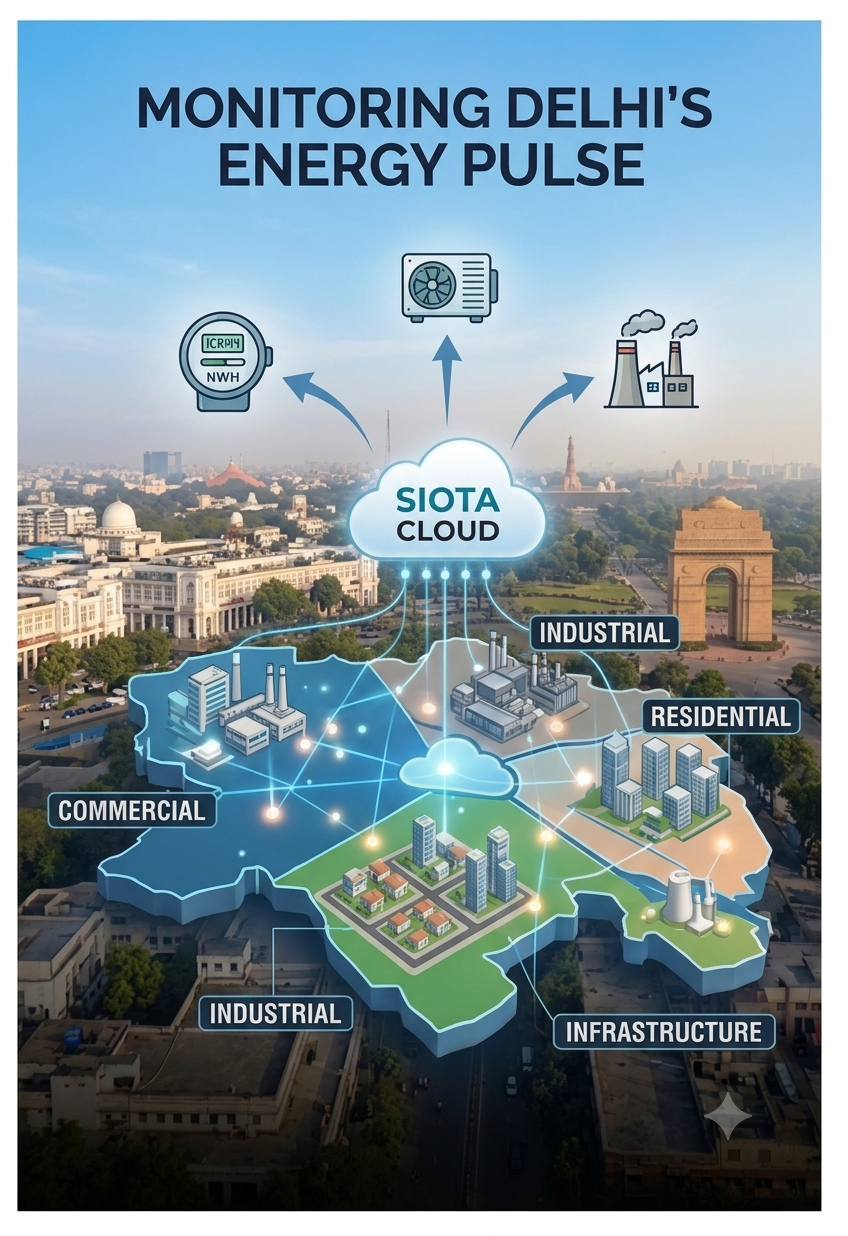
Energy monitoring solutions in Delhi are changing this. Not in a flashy, futuristic way—but in a very practical, measurable way. IoT sensors go on your panels and equipment. Data flows to a dashboard. You can see — in real time — what’s consuming power, what’s being wasted, and what needs attention.
SIOTA has been doing exactly this for commercial facilities across India. Their platform handles energy monitoring, HVAC automation, DG tracking, predictive maintenance, and more. All from one screen.
This article is for anyone running a commercial building, hospital, factory, or hotel in Delhi who’s tired of paying more than they should on electricity—and wants to understand what actually works.
Why Energy Monitoring Solutions in Delhi Have Become Non-Negotiable
Delhi is expensive to run a business in. Commercial electricity tariffs are high. Summers are brutal on HVAC loads. And if you’re running DG sets during power cuts—which most facilities here do—you’re spending serious money on fuel with very little visibility into whether it’s being used efficiently.
The honest truth is most facilities don’t have a power problem. They have a visibility problem.
The Monthly Bill Trap
When your only reference point is a monthly electricity bill, you’re always reacting. You see the number, you call a meeting, someone investigates, and by the time anything changes, another month has passed.
Real-time monitoring flips this. You’re not waiting for the bill — you’re watching consumption as it happens. If an AC unit is running at full load in an empty hall at 11 PM on a Tuesday, you know about it that night. Not three weeks later.
DG Sets Are Where a Lot of Money Gets Lost
This one doesn’t get talked about enough. Delhi NCR facilities run DGs heavily during summer. Without monitoring, fuel consumption is tracked manually — if at all. Pilferage happens. Runtime gets logged inaccurately. Load data is guesswork.
A proper DG monitoring setup gives you fuel levels, runtime, load, and alerts—all automated. The savings here alone often justify the entire system.
How These Systems Actually Work — Without the Jargon
I know “IoT-based platform” sounds like something that requires a full IT team and six months of setup. It doesn’t.
The actual process is pretty straightforward. Smart meters and sensors get installed at your electrical panels and major equipment. They’re mostly wireless. No major civil work, no production shutdown. SIOTA gets most deployments live within 48 hours.
What Gets Installed
Smart energy meters sit at your distribution boards. They read load data every few seconds—far more granular than what your utility meter shows.
IoT gateways connect everything to the cloud. Think of them as the bridge between your physical infrastructure and the dashboard your team uses.
Sensors go on HVAC units, DG sets, temperature-sensitive areas — wherever you need visibility.
What You See on the Dashboard
Once it’s live, you have a real-time view of your entire facility’s energy profile. Consumption by floor, by equipment, by time of day. HVAC performance. DG runtime and fuel. Temperature in server rooms or cold storage. Power factor readings.
You also get alerts. If something goes out of range — an unusual load spike, a temperature deviation, a DG running longer than scheduled — your team gets notified immediately.
Over time, the system learns what “normal” looks like for your facility. Anything that deviates from normal gets flagged automatically.
What the Numbers Actually Look Like for Delhi Businesses
Let’s get concrete, because this is where most people want to understand whether it’s worth it.
The 15–30% Savings Figure
IOTA puts this number out publicly—and it’s not a marketing exaggeration. It comes from actual deployments. The savings typically come from three places:
First, idle load elimination. Equipment running when it shouldn’t be. This is shockingly common in large facilities.
Second, HVAC scheduling optimization. Most buildings have cool spaces that are empty for long stretches. Occupancy-based control fixes this without anyone having to manually switch things off.
Third, DG efficiency. Better load management and fuel tracking reduce both consumption and pilferage.
For a mid-sized Delhi office spending ₹8 lakh a month on electricity, 20% savings is ₹1.6 lakh back every month. The system pays for itself fast.
BRSR Compliance Is Now a Real Pressure
If your company is listed or planning to be, SEBI’s BRSR mandate is something your finance and sustainability teams are already losing sleep over. Energy data is a major component of BRSR reporting.
Collecting that data manually is a nightmare. Automated monitoring gives you clean, auditable energy records with zero extra effort. For companies with ESG commitments or sustainability targets, this isn’t a nice-to-have anymore—it’s essential.
Who in Delhi Is Actually Using These Systems
Not everyone needs the same thing. But here’s where the ROI is clearest.
Hospitals and Healthcare Facilities
Healthcare is unforgiving about two things: uptime and environment control. A temperature deviation in a pharma storage area can destroy an entire batch of medicines. A DG failure during a procedure is catastrophic.
Energy monitoring in hospitals isn’t just about saving money — it’s about risk management. Real-time alerts for temperature, power, and equipment health give admin teams the ability to act before a problem becomes a crisis.
It also helps with accreditation. NABH and similar bodies want documentation. Automated logs make that easy.
Hotels in Delhi NCR
A five-star property running 400 rooms has HVAC running around the clock. Guest comfort is the priority — but so is not burning ₹30 lakh a month on electricity.
Occupancy-based HVAC means unoccupied rooms aren’t being cooled to the same level as occupied ones. That’s a huge lever. Remote monitoring across multiple properties lets one facilities team handle everything from a single screen.
Manufacturing Plants
Factories in Delhi NCR — especially in sectors like auto components, textiles, and pharmaceuticals — have complex energy profiles. Multiple machines, multiple shifts, power factor issues, DG dependency.
Machine-level monitoring shows exactly which equipment is drawing the most power and when. Predictive maintenance means failures get caught before they stop production. For a plant running 24/7, that’s enormous.
Commercial Office Buildings
Tenant expectations have shifted. Green building certifications like IGBC or LEED are increasingly important for attracting premium tenants. Energy monitoring is a core requirement for both.
Building owners in Delhi who deploy monitoring also reduce common-area electricity costs significantly, which directly improves NOI.
What to Actually Look For When Choosing a Vendor
Delhi has no shortage of vendors claiming to offer energy monitoring. Here’s how to cut through the noise.
Go-Live Speed
A serious vendor should be able to get you a lease within days, not months. If the sales pitch involves months of infrastructure changes before you see any data, walk away.
SIOTA’s 48-hour deployment claim is realistic for most commercial setups because the system is wireless and doesn’t require major civil work.
Granularity of Data
There’s a big difference between monitoring total building consumption and monitoring by equipment. Total consumption data is useful but limited. Equipment-level data is where the real insights come from.
Ask this question directly: Can I see consumption for each individual AC unit? If the answer is vague, the system probably isn’t granular enough.
Local Support
This matters more than most buyers realize upfront. IoT systems occasionally need on-ground attention—a sensor recalibration, a gateway connectivity issue, or a firmware update. A vendor with a local presence in Delhi NCR can respond in hours. A vendor with only a Bangalore office cannot.
Compliance-Ready Reports
If BRSR, ESG, or ISO 50001 is on your radar, ask to see exactly what reports the platform generates. They should align with the specific frameworks you need — not just export raw data for your team to manually format.
Conclusion
If your Delhi facility is still running on monthly meter readings and manual DG logs, you’re not managing energy — you’re just paying for it.
The good news is that fixing this doesn’t require a massive overhaul. Modern energy monitoring solutions in Delhi are fast to deploy, non-disruptive, and pay for themselves quickly. The data you get in the first 30 days will almost certainly surprise you.
SIOTA has built a platform specifically for this — real-time monitoring, HVAC automation, DG tracking, predictive maintenance, and BRSR-ready reporting. All in one place. All accessible remotely.
Stop reading the bill after the damage is done. Start watching your energy in real time.
Frequently Asked Questions
Q1. What exactly do energy monitoring solutions do?
They track electricity consumption in real time using IoT sensors and smart meters. Instead of waiting for a monthly bill, you see what’s using power, when, and how much—and get alerts when something looks off.
Q2. How much can I realistically save on my Delhi facility’s power bill?
Most facilities see a 15–30% reduction within the first few months. The bigger your current bill and the less oversight you currently have, the larger the savings tend to be.
Q3. Will installation disrupt my operations?
No. Sensors and meters are installed at electrical panels using mostly wireless tech. Most facilities go live within 48 hours with no production or operational downtime.
Q4. Does this help with BRSR compliance?
Yes, significantly. The platform automatically collects and formats energy data in a way that’s audit-ready for BRSR and ESG reporting — no manual compilation required.
Q5. What if I have multiple locations across Delhi NCR?
That’s actually where centralized monitoring shines. One dashboard covers all your locations—Noida, Gurugram, Faridabad, and central Delhi—so your facilities team doesn’t need to be on-site everywhere.
Q6. Is SIOTA only for large enterprises?
They typically work best with mid-to-large commercial facilities. If your monthly electricity bill is ₹2 lakh or above, the economics usually make strong sense.
Q7. How is this different from our existing BMS?
A BMS controls equipment. IoT energy monitoring adds real-time data visibility, AI-driven anomaly detection, and cloud accessibility on top of that. Most setups integrate with existing BMS infrastructure rather than replacing it.
Q8. What industries benefit most from this in Delhi?
Hospitals, hotels, factories, commercial office buildings, and data centers see the strongest ROI — essentially any facility with heavy HVAC or DG dependency.
