

Here’s something most warehouse managers only discover the hard way.
You walk in on a Monday morning. The HVAC unit that controls your cold storage section tripped overnight. Nobody got an alert. Your team didn’t know until someone physically checked at 8 AM. By then, six hours had passed—and an entire pallet of insulin worth ₹40 lakhs had gone out of range.
This isn’t a hypothetical. It’s a story we hear regularly at SIoTA.
The frustrating part is that it’s completely preventable. An IoT-based temperature and humidity monitoring system for warehouse operations would have triggered an alert within 60 seconds of the temperature rising above the threshold. Someone would have been on the phone with the HVAC technician before the first hour passed.
That’s the core value proposition here — not fancy dashboards or buzzword-heavy technology. Just reliable, continuous visibility into what’s happening inside your warehouse at every hour of the day, including the hours when no one is around.
This guide is written for warehouse managers, quality control heads, and operations teams who want a clear, practical understanding of how these systems work, what to look for, and what real deployment looks like on the ground. We’ll cover everything — from how sensors communicate to what compliance documentation looks like when an auditor walks in.
What an IoT-Based Temperature and Humidity Monitoring System for Warehouse Actually Does
Strip away the marketing language, and the system is straightforward.
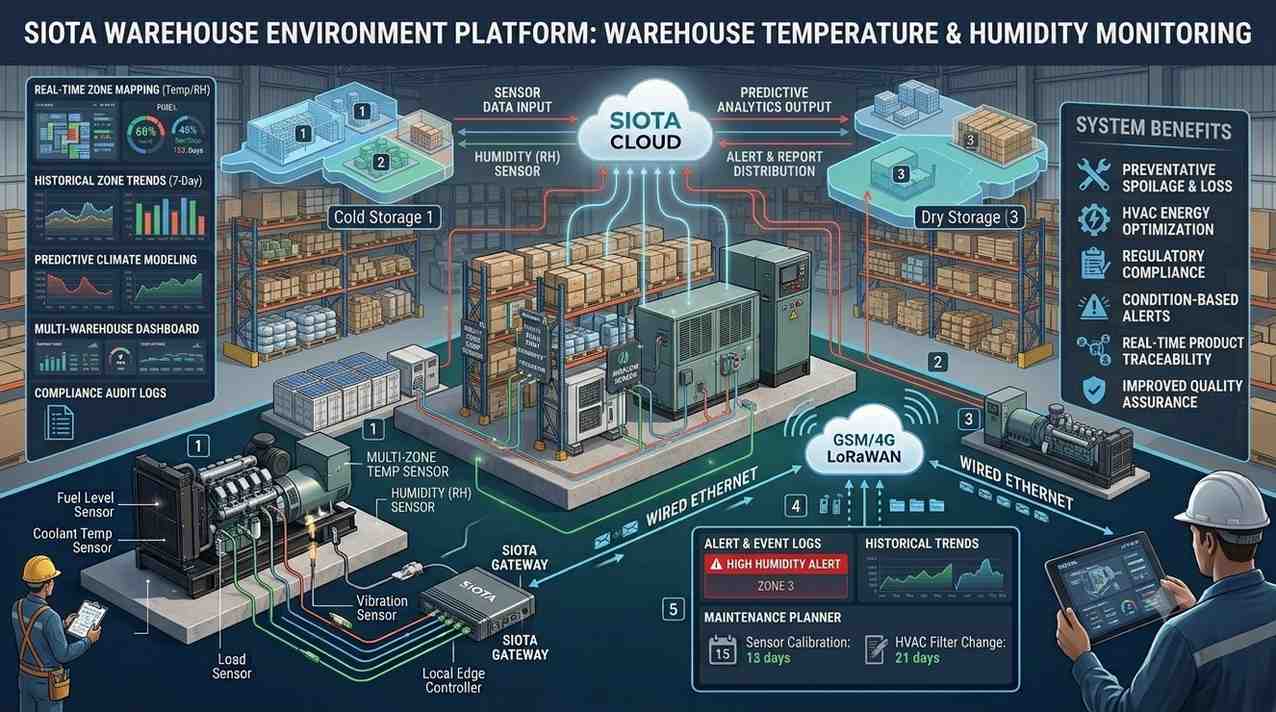
You place wireless sensors at strategic points throughout your warehouse — near cold room doors, along shelving rows, close to loading bays, and around HVAC vents. These sensors measure temperature and humidity every few seconds and send that data to a cloud platform over a wireless network.
That platform gives you a live view of conditions in every zone. When something goes out of range, you get an alert — on your phone, via SMS, or through WhatsApp — within seconds. And every reading is saved automatically, building a detailed historical record that you can pull up any time for internal reviews or regulatory audits.
That’s it, fundamentally. The power is in the continuous nature of it.
The Three Layers That Make It Work
Sensors on the ground
The sensors themselves are small, battery-powered devices that typically mount on walls, shelves, or ceilings with a magnetic clip or adhesive. They measure temperature with ±0.3°C accuracy and humidity within ±2% RH—accurate enough for pharma and food-grade requirements.
SIoTA’s sensors are rated IP67, meaning they’re fully protected against dust and can handle water exposure. They work reliably from -40°C to +85°C, so whether you’re running a blast freezer or a dry goods warehouse in Rajasthan summer heat, the hardware keeps working.
Battery life is over five years under normal conditions, so you’re not running around replacing batteries every few months.
The wireless network
Sensors communicate over NB-IoT, LoRaWAN, or standard Wi-Fi depending on your facility. NB-IoT is particularly good for large warehouses with thick concrete walls — it penetrates structures well and doesn’t need you to build out any new Wi-Fi infrastructure.
LoRaWAN covers large outdoor or semi-covered areas like loading yards. Wi-Fi works well in modern facilities that already have wireless coverage. SIoTA’s team selects the right protocol (or combination of protocols) based on your specific site layout.
The cloud platform
This is where all the data lives. SIoTA’s dashboard gives you live readings from every sensor on a single screen, color-coded by zone. Historical data is stored for as long as you need it — most regulated industries require a minimum of two to five years of records, and SIoTA holds everything in tamper-proof cloud storage.
The platform is accessible from any browser or the SIoTA mobile app. You don’t need to be physically present in the warehouse to know what’s happening inside it.
Why Manual Temperature Checks Are No Longer Good Enough
Manual monitoring was never designed for the scale or precision that modern warehouses require.
Think about what manual checking actually looks like in practice. A staff member walks the floor twice a day, reads a thermometer in the center of the cold room, writes a number in a logbook, and moves on. That’s 22 to 23 hours between checks. A lot can happen in 22 hours.
There’s also the human factor. Readings get misrecorded. Logbooks get misplaced. Staff forget during busy periods. And when an auditor asks for records from 14 months ago, someone has to dig through physical binders trying to find a handwritten entry.
Here’s what the data actually shows.
According to WHO research on pharmaceutical cold chains, around 25% of temperature-sensitive medicines arrive damaged due to cold chain failures. In most cases, those failures happened in storage — not in transit. The monitoring simply wasn’t there to catch the problem early.
For food warehouses, improper humidity is equally dangerous. Moisture above 70% RH creates conditions where mold can develop on packaged goods, wooden pallets absorb moisture and weaken, and cardboard packaging warps and fails. By the time visible damage appears, the product has often already been compromised.
What a Single Excursion Actually Costs
People tend to underestimate the full cost of a temperature event. It’s not just the product you throw away.
If you’re in pharma, a documented excursion triggers a batch deviation investigation. That process alone takes time, involves quality teams and documentation, and can delay distribution. If the batch gets quarantined, you lose not just the product but the production slot.
For food businesses operating under FSSAI, undocumented excursions create compliance exposure. If a recall happens and you can’t produce clean monitoring records, the regulatory conversation becomes much more difficult.
And then there’s insurance. More underwriters now require documented environmental monitoring records as a condition of covering temperature-sensitive goods. Without records, claims can be — and frequently are — denied.
The Features That Actually Matter in a Monitoring System
There’s a lot of noise in the market around features. Some vendors lead with the number of integrations they support or how many chart types their dashboard offers. In practice, the features that protect your business come down to a short list.
Alert Speed and Escalation Logic
An alert that arrives 15 minutes after a breach is almost useless in a critical cold chain situation. The system needs to detect a threshold violation and notify the right person within seconds—not minutes.
SIoTA’s alert engine sends notifications within 30 seconds of a breach via SMS, email, WhatsApp, and in-app push. But the alert itself is only half the picture. What happens if the person who receives the alert is on a call and misses it?
That’s where escalation logic matters. SIoTA lets you configure escalation chains — if the primary contact doesn’t acknowledge an alert within five minutes, the system automatically notifies a backup contact or a supervisor. This removes the single-point-of-failure problem that comes with manual alert handling.
Zone-Level Visibility, Not Just a Single Reading
Temperature is rarely uniform across a warehouse. Near loading dock doors, ambient outdoor temperatures bleed in every time a truck arrives. In the back corners of cold rooms, airflow from the HVAC unit may be weaker. Near the ceiling, heat stratification means temperatures are a few degrees higher than at shelf level.
A single sensor in the middle of your warehouse gives you one data point. It tells you almost nothing about what’s happening at the specific shelf where your most valuable stock sits.
SIoTA maps sensor data onto a floor plan of your facility, giving you a live heat map that shows temperature distribution across every zone simultaneously. This also helps your facilities team identify structural or HVAC issues—cold spots that suggest airflow problems, warm patches near poorly sealed doors—before they cause product damage.
Compliance Reports That Don’t Require Manual Assembly
If you’ve ever had to prepare for a regulatory inspection using manual logbooks, you know how much time goes into assembling the documentation. Pulling data from different sources, reformatting spreadsheets, checking for gaps in records — it’s a day’s work or more.
SIoTA generates compliant temperature logs automatically, in real time. When an inspection comes up, you pull up the date range, select the zones, and download a report in PDF or Excel format. The report includes sensor IDs, calibration dates, all recorded values, any excursions, and timestamps — everything an auditor needs, ready in under a minute.
Long Battery Life and Durable Hardware
In industrial environments, hardware that needs frequent maintenance creates operational friction. SIoTA’s IP67-rated sensors run for five-plus years on a single battery change under normal deployment conditions. In cold storage environments where battery drain is faster, the system proactively alerts you when battery levels drop below a safe threshold.
How Deployment Actually Works: What to Expect
One of the most common hesitations we hear from warehouse teams is that deploying an IoT system sounds complex, disruptive, or expensive. In practice, a standard installation is simpler than most people expect.
Before Installation: The Site Survey
SIoTA’s engineering team (or your own team using SIoTA’s planning tools) starts with a site survey. The goal is to map the facility, identify critical monitoring zones, assess existing connectivity, and determine optimal sensor placement.
This step matters more than people realize. Poor sensor placement is one of the most common reasons monitoring systems fail to detect actual excursions—sensors placed where conditions are stable miss the problem zones that matter.
The output of the survey is a sensor density map: a floor plan showing exactly where each sensor will be placed and why. You review and approve this before any hardware goes in.
Installation Day
For most warehouses, physical installation takes four to six hours. Sensors mount using adhesive pads, magnetic clips, or screws depending on the surface. No structural work, no cabling runs, no downtime for your operations.
Gateway devices are positioned to ensure full wireless coverage. SIoTA’s mesh networking capability means sensors can relay data through each other, eliminating connectivity dead zones that occur in large or complex structures.
Configuration and Go-Live
Once hardware is in place and connected, SIoTA’s team configures the platform to your specifications—threshold values per zone, alert recipients, escalation timelines, report templates, and user access levels.
A 24-hour validation period follows, during which the team confirms every sensor is reporting correctly, alerts are reaching the right people, and historical data is being stored properly. Once validation is clean, the system goes live.
SIoTA provides 24/7 technical support after go-live. Most issues are resolved remotely. Sensor firmware updates are pushed over the air automatically, so your system stays current without requiring scheduled on-site visits.
Compliance Requirements That Make IoT Monitoring Non-Negotiable
Regulatory requirements around warehouse environmental monitoring have tightened significantly across India and internationally. Here’s what the key frameworks actually require.
CDSCO Schedule M (2023 Amendment) — India
The updated Schedule M requirements for pharmaceutical manufacturers and distributors explicitly mandate automated, continuous temperature monitoring for storage facilities. Manual logbooks are no longer accepted as sufficient documentation for Good Manufacturing Practice (GMP) compliance.
FSSAI FSMS Guidelines — India
Food business operators in regulated categories must maintain documented temperature and humidity records as part of their food safety management system. Digital records with audit trails are increasingly favored over paper-based systems during inspections.
WHO Good Distribution Practice (GDP) Guidelines
For warehouses handling pharmaceutical products — particularly those in the import and export chain — WHO GDP requires automated temperature monitoring with alarm systems, deviation management procedures, and electronic audit trails.
EU GDP Directive (2013/C 68/01)
For businesses with any operations touching European supply chains, EU GDP compliance requires temperature mapping studies, continuous automated monitoring, and documented deviation management. This applies to Indian manufacturers exporting to EU markets.
ICH Q1A Stability Guidelines
These international guidelines define the storage conditions under which pharmaceutical stability data is generated. Warehouses must document that products were stored within label conditions throughout their storage period.
SIoTA’s platform is purpose-built to meet all of the above requirements. Every data point is timestamped, linked to a specific calibrated sensor, and stored in tamper-proof cloud infrastructure. Reports are formatted to match the documentation expectations of CDSCO, FSSAI, and WHO GDP auditors.
Frequently Asked Questions
How many sensors does a typical warehouse need?
A practical starting point is one sensor per 100 to 150 square feet of monitored space, with additional sensors placed near high-risk areas like door seals, HVAC units, and corners. SIoTA provides a free site assessment that gives you a precise recommendation based on your actual floor plan and regulatory requirements.
Will the system work in a freezer or cold room?
Yes. SIoTA sensors operate reliably from -40°C to +85°C. They’re regularly deployed in blast freezers, cryogenic storage areas, and standard cold rooms without any performance issues.
What happens if the internet connection goes down?
SIoTA sensors have onboard data storage that buffers readings locally when connectivity is lost. Once the connection is restored, all buffered data uploads automatically. No readings are lost during outages.
Do I need to replace batteries often?
Under standard conditions, SIoTA sensor batteries last over five years. The platform monitors battery levels and alerts you well in advance when a replacement is needed, so you’re never caught off guard.
Can I integrate SIoTA data with my existing ERP or WMS software?
Yes. SIoTA provides API access to historical and real-time data, allowing integration with SAP, Oracle WMS, and most other enterprise platforms. Your IT team gets full API documentation and support during integration.
How quickly does an alert reach me after a breach?
Within 30 seconds. Alerts go out simultaneously via SMS, email, WhatsApp, and in-app notification. If the primary contact doesn’t acknowledge within a configured window, the system escalates to the next contact on the list.
Is SIoTA’s documentation accepted by CDSCO and FSSAI inspectors?
Yes. SIoTA’s reports are structured to meet the documentation expectations of both CDSCO and FSSAI auditors. Several SIoTA customers have successfully used these reports during regulatory inspections without any documentation findings.
What does deployment cost and how long does it take?
Costs depend on facility size, number of sensors, and connectivity requirements. SIoTA will give you a detailed quote after the free site assessment. A typical mid-size warehouse (5,000 to 15,000 sq. ft.) is fully operational within one to two days of installation.
Can I monitor multiple warehouse locations from a single dashboard?
Yes. SIoTA’s platform supports multi-site monitoring from a single dashboard. Each location appears as a separate view, and you can set different thresholds and alert contacts for each site.
How do I get started?
Visit https://siota.in/ and request a free consultation. SIoTA’s team will assess your facility, answer your specific compliance questions, and walk you through a live product demo — no commitment required.
The Bottom Line
There’s no elegant way to say this: most warehouse temperature incidents are preventable. The technology to catch them early has been affordable and reliable for years. The gap is almost always awareness — teams that haven’t yet made the shift from manual checks to continuous monitoring.
An IoT-based temperature and humidity monitoring system for warehouse operations isn’t a luxury for large enterprises. It’s basic risk management for anyone storing goods that can be damaged by environmental conditions. The math is simple — one prevented excursion will typically pay for years of system operation.
SIoTA works with warehouses of all sizes across pharma, food, electronics, and general storage. If you’re still relying on manual logbooks or you’re getting ready for a regulatory inspection and wondering whether your documentation will hold up, now is the right time to talk.
