

Introduction
Last month, a manufacturing plant in Pune lost an entire production shift. The reason? Their diesel generator failed silently at 2 AM. No one noticed until the morning crew arrived.
The painful part—the warning signs were there for days. Rising coolant temperature. Unusual fuel drop. A struggling battery. But nobody saw them in time.
This is the reality for hundreds of Indian businesses still relying on manual generator checks and paper logbooks.
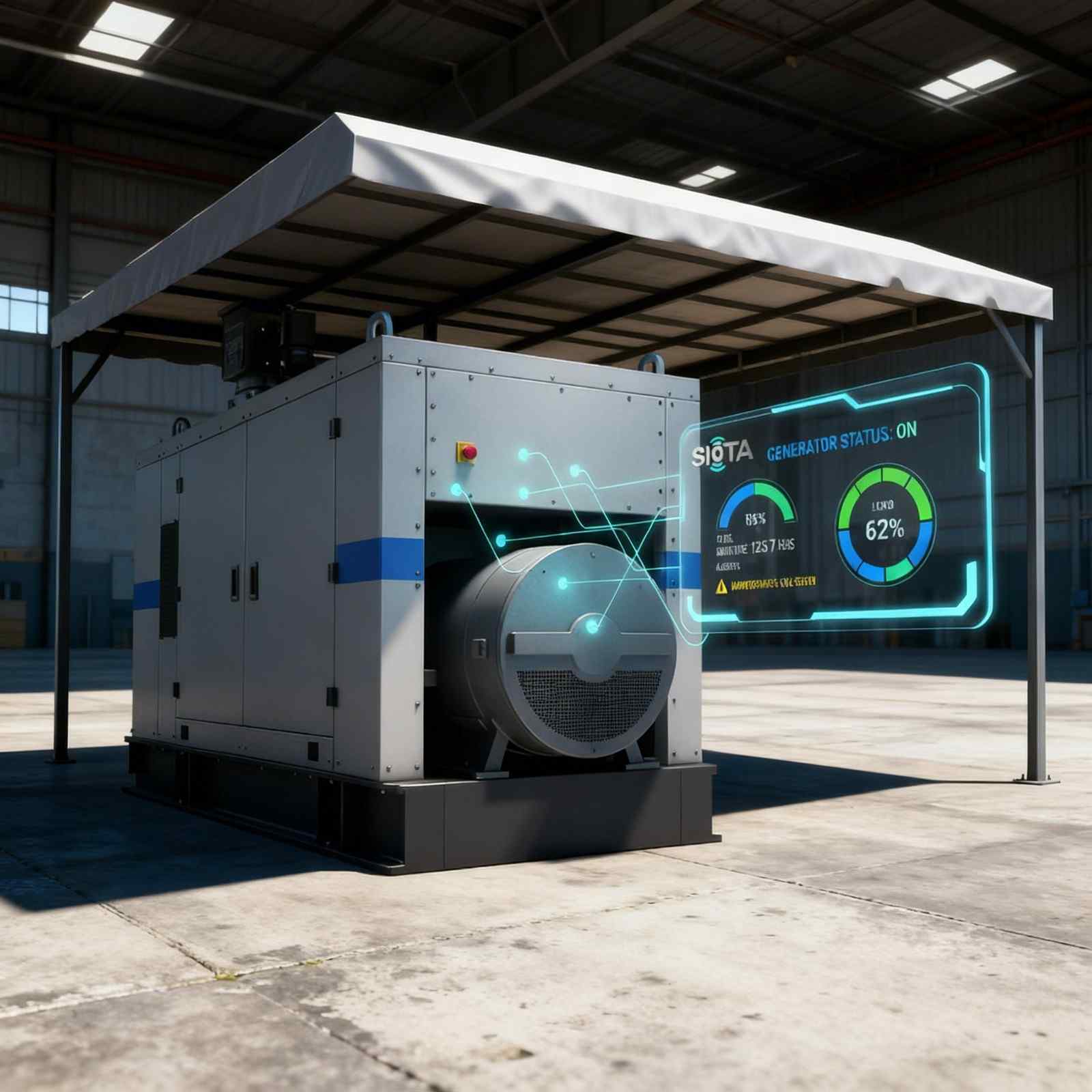
IoT-based diesel generator monitoring solutions exist specifically to prevent situations like this. They put real-time data in your hands — wherever you are, whatever time it is. Fuel levels, load readings, fault alerts, runtime logs — everything visible on one screen.
At Siota (siota.in), this is what we do. We help businesses move from guesswork to clarity when it comes to managing their power backup infrastructure.
In this article, we’ll walk you through how these systems work, what to look for when choosing one, which industries benefit most, and how the numbers actually stack up in real deployments. By the end, you’ll have a clear picture of whether this is the right move for your operations.
Why Your Current Generator Monitoring Setup Has Cracks in It
Let’s be honest about how most organizations monitor their generators today.
A technician walks to the DG room. Reads the fuel gauge. Jots something in a register. Walks away.
That’s it.
Nobody’s saying the technician is doing a bad job. The problem is the system itself. It’s built on the assumption that everything stays fine between checks. And generators don’t always cooperate with that assumption.
The Logbook Problem Nobody Talks About
Paper logs have a dirty secret: they’re often wrong.
Sometimes entries are filled in advance. Sometimes numbers are estimated rather than actually read. Sometimes the register simply doesn’t make it back to the manager’s desk for three days.
By then, a fuel theft that happened on Tuesday is only discovered on Friday—after another 200 liters have gone missing.
This isn’t a discipline problem. It’s a visibility problem. And visibility is exactly what IoT solves.
Remote Sites Make Everything Worse
For telecom towers, solar-diesel hybrid sites, or pumping stations in rural areas, manual monitoring isn’t just inconvenient. It’s nearly impossible.
Sending a technician to a remote site every day is expensive. Sending one every week means six days of zero visibility. Anything could happen in that window.
And often, it does.
Fuel gets siphoned. Generators run unnecessarily. Batteries drain. Minor faults turn into major failures. All because nobody was watching.
How IoT-Based Diesel Generator Monitoring Solutions Actually Work
People hear “IoT” and sometimes assume it’s complicated. It’s actually quite straightforward once you break it down into layers.
Layer 1 — The Sensors on the Ground
Everything starts with hardware installed on and around your generator. These are small, rugged devices that continuously measure specific parameters.
A typical installation covers:
- Fuel level sensor — sits inside the tank, measures volume in real time
- Current and voltage sensors—clamp around the output cables and measure load
- Temperature sensor — mounted near the coolant system
- Run hour counter — tracks engine-on time precisely
- Battery voltage sensor — monitors the starting battery
- GPS unit — useful for mobile generators or theft tracking
Installation is clean and non-invasive. No rewiring. No major shutdowns. Most sites are up and running within a few hours.
Layer 2 — Getting Data from Site to Cloud
Once sensors are collecting data, it needs to travel somewhere. Depending on your site, Siota’s system uses the following:
- 4G SIM for most urban and semi-urban locations
- LoRa wireless for sites where cellular coverage is weak
- Wi-Fi for generators inside factory or office premises
Data moves from sensor to cloud every few seconds. Nothing is cached and sent in batches — you’re always seeing live information.
Layer 3 — The Dashboard Where Decisions Happen
This is what you actually interact with. A clean web dashboard (and mobile app) that shows:
- Real-time fuel level with visual tank indicator
- Live load graph — current, voltage, power factor
- Engine temperature and oil pressure readings
- Alert history with timestamps
- Runtime logs by date, shift, or site
Features That Separate a Good System from a Great One
There are several IoT generator monitoring products in the market. Here’s how to separate what’s genuinely useful from what’s just a spec sheet.
Fuel Monitoring With Theft Detection Logic
Tracking fuel level is basic. The smarter move is tracking fuel consumption rate against runtime and flagging anomalies.
If your generator consumed 40 liters in 4 hours but the fuel level dropped by 65 liters, the system should catch that gap and alert you immediately. That’s not consumption. That’s theft or a leak.
Siota’s platform does exactly this. It cross-references runtime data with fuel drop to identify suspicious patterns automatically.
Alerts That Actually Reach You
An alert system is only useful if the right person gets the message at the right time.
Look for systems that support:
- SMS alerts — reaches even basic mobile phones
- Email notifications — with parameter readings attached
- WhatsApp alerts — increasingly preferred by field teams in India
- Escalation chains — if the first person doesn’t acknowledge, alert the next
Siota allows you to configure multiple recipients per site and set escalation timers. So nothing slips through.
Historical Reports That Hold Up to Scrutiny
Good reports aren’t just pretty charts. They should be detailed enough to verify against diesel purchase bills, generator service records, and electricity downtime logs.
Monthly runtime reports, fuel consumption summaries, and fault frequency analysis—these are the reports that help you negotiate better contracts, reduce wastage, and build a case for better maintenance budgets.
Multi-Site Dashboard for Fleet Managers
If you’re managing more than one site — and most enterprise clients are — you need a single view of all generators.
Color-coded site status, fleet-level fuel summary, site-wise alert count — these fleet management features save hours of manual coordination every week.
Who Should Be Using IoT Generator Monitoring Right Now
This isn’t just a large-enterprise product. If you depend on uninterrupted power and you’re losing sleep over generator reliability, this is for you.
Telecom Tower Companies
India’s telecom tower count crossed 7 lakh. A significant portion runs on diesel backup. Fuel pilferage at tower sites is an industry-wide headache.
IoT monitoring gives tower operators a live view of fuel at every site. Unauthorized generator runs get flagged immediately. Consumption data gets reconciled with refill records automatically.
One mid-sized tower company we spoke to estimated fuel savings of over ₹12 lakh per month after deploying site-level IoT monitoring across 300 towers.
Hospitals and Clinics
A generator failure in a hospital is not an operational inconvenience. It’s a patient safety issue.
Healthcare facilities need to know, at any moment, that their backup power is ready to kick in. Battery health, fuel sufficiency, load capacity — all of it must be continuously tracked and verified.
Siota has deployments in hospital infrastructure where the dashboard is monitored by the engineering team 24×7 — the same way ICU vitals are monitored by nursing staff.
Manufacturing and Industrial Plants
Production environments are intolerant of power interruptions. A 10-minute outage can mean hours of restart procedures, scrapped raw material batches, and missed delivery timelines.
Plant managers use IoT generator monitoring to ensure backup power is always primed and to understand load patterns across shifts—optimizing generator sizing over time.
Data Centers and Server Rooms
Uptime SLAs leave no room for surprises. IoT monitoring integrates with existing BMS infrastructure to provide a unified energy view—UPS, generators, and utility—in one dashboard.
Commercial Real Estate and Housing Societies
Large residential complexes and office buildings with DG sets benefit from automated runtime logging — especially for billing purposes. Accurate runtime data eliminates disputes between facility management teams and residents or tenants.
The Numbers: What Businesses Actually See After Deployment
We’ll be straightforward here. Results vary by site, usage pattern, and existing discipline. But across deployments, here’s what organizations commonly report.
Fuel Savings Between 15 and 25%
This comes primarily from two sources: catching theft early and optimizing runtime. Generators running unnecessarily during grid hours — even for short durations — add up fast.
At 10 liters per hour and ₹95 per liter, even 2 hours of unnecessary daily runtime costs ₹5,700 per month per generator. Multiply across a fleet of 20 units—that’s over ₹1.1 lakh monthly in avoidable fuel cost.
60–70% Drop in Unplanned Downtime
Early fault alerts give maintenance teams a head start. Instead of reacting to a breakdown at 3 AM, they’re scheduling a coolant system check at 10 AM because the system flagged an upward temperature trend two days earlier.
Maintenance Compliance Goes Up
When service reminders are automatic and logged, they don’t get forgotten. OEM-recommended service intervals get followed consistently. Generator lifespan improves. Warranty conditions are met.
ROI Within 6–12 Months
Fuel savings + reduced repair costs + extended asset life = a system that pays for itself faster than most people expect.
Conclusion
There’s a moment every facility manager knows. The generator fails. The calls start coming in. And somewhere in the back of your mind, you think, I should have caught this earlier.
IoT-based diesel generator monitoring solutions exist to make sure that moment never happens to you again.
They give you visibility when you’re away from the site. They alert you when something needs attention. They build a log of everything that happens—accurate, tamper-proof, and available whenever you need it.
Siota has built a platform designed specifically for how power infrastructure works in India — variable connectivity, distributed sites, stretched maintenance teams, and real cost pressures.
If you’re serious about protecting your generators, reducing fuel costs, and eliminating downtime surprises—it’s time to move past the logbook.
Visit siota.in today and speak with our team. We’ll understand your setup, walk you through what monitoring would look like for your sites, and give you a clear picture of what’s possible—with no pressure and no jargon.
Your generators work hard. Make sure you’re watching over them.
Frequently Asked Questions
Q1. What exactly does an IoT generator monitoring system track?
It tracks fuel level, engine runtime, output voltage and current, coolant temperature, oil pressure, battery voltage, load percentage, and fault events—all in real time.
Q2. How is this different from just having an AMF panel?
An AMF panel handles automatic start and stop when mains power fails. That’s its job, and it does it well. IoT monitoring does something different — it tracks everything the generator is doing, sends you alerts, builds usage history, and helps you make decisions. The two work alongside each other.
Q3. Our sites have very poor mobile networks. Will this still work?
Yes. Siota’s systems support LoRa wireless for low-connectivity environments. We’ve deployed at remote tower sites and agricultural pump stations with minimal cellular coverage.
Q4. How long does installation take?
A standard single-generator site is typically commissioned within 3–5 hours. No major civil work is needed. The generator doesn’t need to be shut down for extended periods.
Q5. Can we monitor generators across multiple states from one account?
Absolutely. The platform is built for multi-site, multi-region fleet management. You can view all sites on one map, drill into any individual generator, and pull consolidated reports across the entire fleet.
Q6. How does the system detect fuel theft?
It compares fuel drop against runtime and consumption rate. If fuel decreases faster than what the engine could have consumed—or drops when the generator isn’t running—the system flags it and sends an immediate alert.
Q7. What kind of alerts does the system send?
Alerts cover low fuel, high temperature, low oil pressure, weak battery, overcurrent, unauthorized runtime, and sudden fuel drop. They’re sent via SMS, email, and WhatsApp depending on your configuration.
Q8. We already have a SCADA system. Can Siota integrate with it?
Yes. Siota supports API-based integration with existing SCADA, BMS, and ERP platforms. Our team handles the integration during deployment.
Q9. What’s a realistic payback period?
For most clients, the system pays for itself within 6 to 12 months through fuel savings and reduced breakdown costs. Sites with significant fuel theft history often see returns within the first 3 months.
Q10. How do we get started?
Visit siota.in and get in touch. Our team will do a quick assessment of your requirements and suggest the right configuration — whether you have one generator or a fleet of hundreds.
