

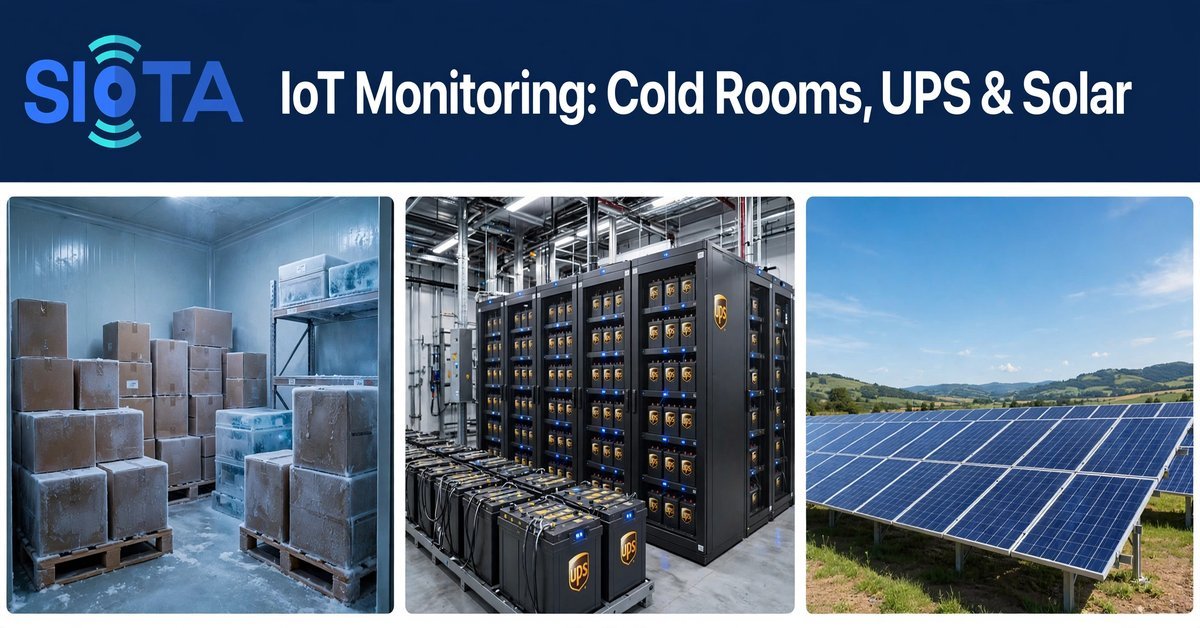
Walk through any large Indian facility — a food processing plant, a hospital, a data centre, a factory with a rooftop solar array — and you will find the same pattern. The cold room has its temperature log, the UPS room has its battery register, the solar plant has its inverter app, and none of them talk to each other. An iot based cold room temperature monitoirng setup is often where the unification starts, because a single warm night in a cold room can cost more than a year of monitoring.
While iot based cold room temperature monitoring is often the starting point, this article covers three monitoring jobs that belong together: cold rooms, UPS systems and solar plants. Each one protects something valuable — product, uptime, or generation revenue — and each one fails quietly when watched manually. We will look at what the sensors watch in each case, why Indian conditions make continuous monitoring especially worthwhile, and what a unified setup looks like on a normal working day.
Why iot based cold room temperature monitoring is worth the investment
Cold rooms are unforgiving. A pharmaceutical storage room, a dairy cold store, a frozen-food warehouse: the product inside lives in a narrow temperature band, and a few hours outside it can mean a rejected batch, a ruined consignment, or goods that look fine but are not. The loss from one incident routinely exceeds the cost of a monitoring system many times over, which makes this one of the easiest monitoring investments to justify.
Most cold rooms in India are still watched the old way: a manual log, written twice a day by whoever is on shift, which is why iot based cold room temperature monitoring usually pays for itself quickly. That log tells you nothing about the other twenty-two hours. A compressor can struggle all night, temperatures can drift upward from two to six in the morning, and the morning reading can still look acceptable because the system recovered before the logbook came out. Manual logs record the moments someone remembered to check; sensors record everything.
Continuous iot based cold room temperature monitoring changes the job from hoping to knowing. Wireless sensors log temperature and humidity around the clock, a gateway pushes the data to the cloud, and the system raises an alarm the moment readings leave the safe band — by SMS, call or whatever channel your team actually reads at 2 am. Just as valuable are the slow findings: a door left ajar every evening by the same shift, a compressor cycling harder than it used to, a defrost cycle that has started drifting.
Regulatory pressure adds another reason. Pharma, food and dairy operations increasingly need continuous temperature records for audits, and a manual logbook does not survive serious scrutiny. Digital records with timestamps and alarm histories turn audits from stressful events into routine ones. If your customers ask for temperature traceability, monitoring is the cost of staying in business.
What cold room sensors actually watch
In iot based cold room temperature monitoring, temperature is the headline measurement, but placement matters more than most people realise. One sensor in the middle of the room is not enough. Good practice puts sensors near the door, where warm air enters; near the evaporator, where the cooling happens; and at product level, where the goods actually sit. These three points tell very different stories, and the difference between them is often the first clue that something is wrong.
Humidity is the second measurement, and it matters most where frost and condensation cause damage: frozen storage, chocolate, certain pharma products. A humidity sensor catches the door-seal failure that temperature alone might miss, because moist air entering the room shows up in humidity readings before it moves the temperature. Door contact sensors complete the picture by logging exactly when the door opens and closes, which settles every argument about whether the night shift is leaving it ajar.
Power monitoring on the refrigeration unit adds the maintenance angle. A compressor drawing more current than its baseline is working harder than it should, often weeks before temperatures start drifting. That early warning is the difference between scheduling a service visit and losing product. The best cold room setups correlate all of it: power, temperature, humidity and door events on one timeline, so the cause of an excursion is usually obvious.
Sensor choice makes or breaks iot based cold room temperature monitoring in Indian conditions. Condensation, washdown routines and sub-zero temperatures kill cheap electronics. Specify sensors rated for your actual operating range with proper ingress protection, and confirm battery life at low temperatures, because cold shortens it. A sensor that dies silently in a minus-twenty room is worse than no sensor, since it creates false confidence.
Iot based ups monitoring solutions for critical power backup
Move from the cold room to the UPS room and the monitoring logic is the same, but the asset is different. Here you are protecting uptime: the servers, the process controls, the hospital equipment that cannot blink when the grid does. Continuous iot based ups monitoring solutions watch the health of the backup chain, so you discover a weak battery on a quiet Tuesday instead of during a blackout.
Batteries are the weak link in almost every UPS installation. They age, dry out, and bake through the Indian summer. One failed cell in a long string can take down the whole bank when it is needed most. Monitoring tracks per-cell voltage, temperature and resistance trends, flagging drifting cells before they fail. That turns battery replacement from a calendar guess into a condition-based decision.
Beyond the batteries, the system watches what the UPS is actually doing: input and output voltage, load percentage, operating mode, and how often it switches to battery. Frequent switching tells you the incoming power quality is poor, which is useful evidence when talking to the utility or justifying a stabilizer. Load trending tells you when the UPS is approaching capacity, so expansion gets planned instead of discovered during an outage.
The human factor matters here too. UPS rooms are checked on rounds, which means they are checked when someone remembers and has time. Alarms from a monitored system go to the right phones immediately, with escalation if nobody acknowledges. In facilities where the UPS protects revenue or safety, that difference in response time is the whole point of the investment.
Iot based solar power monitoring for rooftops and solar plants
The third piece of the puzzle sits on the roof or in the field. Whether it is a factory rooftop array or a ground-mounted plant, solar assets have a frustrating property: they degrade gracefully. A dirty string, a failing connector, a shaded panel — each one trims generation a little, and the plant keeps producing, just less than it should. Without monitoring, that shortfall hides inside the monthly generation number.
An iot based solar power monitoirng setup watches generation at the string or inverter level and compares it against what the plant should be producing given the sunlight. That expected-versus-actual comparison is the heart of solar monitoring. A string underperforming its neighbours by a clear margin is not a mystery; it is a work order: clean it, inspect the connectors, check for shading or a failed bypass diode.
Inverter health gets its own attention. Inverters log faults, temperature derating events and grid disconnections, and a monitored system collects these into a service history instead of letting them vanish when the display is cleared. For plants under maintenance contracts, this history is also your evidence in reviews: it shows whether the O&M vendor is actually keeping the plant at the promised performance ratio or just visiting on schedule.
Indian conditions shape monitoring priorities. Dust between cleanings is the everyday generation thief on rooftops, and monitoring quantifies what each cleaning recovers, settling the debate about cleaning frequency. Summer heat causes inverter derating, and the data distinguishes derating from genuine faults. Monsoon cloud cover is normal; a string that stays low after the clouds pass is not.
One dashboard for all three: why integration pays
Each of these systems justifies itself alone, but the real payoff comes from running them on one platform. The facility manager starts the day with a single screen: cold rooms green, UPS batteries healthy, solar generating as expected. Exceptions from all three land in the same alarm pipeline, with the same escalation rules, reaching the same phones. Nobody has to remember which app to check for which system.
Integration also reveals connections that siloed systems hide. The classic example: the solar plant dips every afternoon at the same time the cold room compressor works hardest, because both are responding to peak heat. Seen together, that pattern suggests pre-cooling strategies or load shifting that neither system would propose alone. Another: UPS load trending upward month after month while the IT team insists nothing changed — the data settles it.
There is a practical argument too: one vendor relationship, one support number, one training session for your team. Facilities already juggle too many AMC contracts. Running iot based ups monitoring solutions, cold room sensors and solar monitoring on a single IoT platform means your operators learn one dashboard deeply instead of three superficially, with one escalation matrix instead of three forgotten ones.
Start where the pain is sharpest — usually iot based cold room temperature monitoring, because product loss is the most vivid risk — and expand the same platform to the UPS room and the solar plant once the team trusts it. The sensors differ, the gateway and software stay the same. That phased path keeps the first investment small and lets each success fund the next expansion.
Choosing sensors and connectivity for Indian sites
Hardware selection makes or breaks these projects. For cold rooms, specify the real temperature range including defrost spikes, with proper ingress protection against condensation and washdown. UPS battery sensors must tolerate heat and fit your racks. Solar monitoring hardware must survive rooftop temperatures.
Connectivity deserves the same care. Cold rooms are often metal boxes that block wireless signals, so plan gateway placement and check signal strength during the survey, not after installation. Factory sites may have patchy Wi-Fi; cellular gateways with local data buffering handle that gracefully. Whatever the link, confirm the system stores data locally during outages and syncs afterwards, because a monitoring gap during a power cut is exactly when you need the record most.
Power for the sensors is the detail everyone forgets. Battery-powered sensors need realistic life estimates at your operating temperatures, with someone owning the replacement schedule. Mains-powered gateways need UPS-backed sockets, or they go blind exactly when the site loses power. Small decisions, but they determine whether the system works on the bad days.
Finally, insist on a proper commissioning period. Thresholds need tuning to your site’s reality: the cold room door that opens fifty times during dispatch hours is normal, the same pattern at midnight is not. The vendor should spend the first weeks learning your normal before the alarms go live in anger. A system that cries wolf in week one gets ignored in week five, and an ignored monitoring system is just decoration.
Frequently asked questions
Can one platform really monitor cold rooms, UPS and solar together?
Yes. The sensors and measurements differ, but iot based cold room temperature monitoring, UPS monitoring and solar monitoring share the same underlying plumbing: wireless gateways, cloud software, dashboards and alarm pipelines. A unified IoT platform handles temperature points from the cold room, battery and electrical points from the UPS room, and generation data from the solar inverters side by side. Your team learns one system, and exceptions from all three follow the same escalation rules to the same phones.
How fast will we get an alarm if the cold room temperature drifts?
Typically within minutes of the reading crossing your configured threshold. Most iot based cold room temperature monitoring setups deliver it by SMS, call or app notification, depending on what your team actually responds to. Just as important, the system can warn on trends before the threshold is crossed: temperatures climbing steadily over two hours trigger an early warning even while still inside the safe band. Configure escalation so an unacknowledged alarm reaches the next person automatically.
Will UPS monitoring work with our existing UPS brand?
In most cases, yes. Battery monitoring uses external sensors on the string and does not depend on the UPS make. Electrical parameters can come from the UPS communication port or from independent energy meters on its input and output. Very old units without any communication port are still monitorable through external metering.
What does solar monitoring tell us that the inverter app does not?
Inverter apps show plant-level totals and basic faults. Dedicated monitoring adds string-level comparison, expected-versus-actual modelling against sunlight data, soiling loss figures, and a service history that survives display resets. It also keeps watching when the inverter’s own connectivity drops.
Do we need internet at every monitored location?
Not at each sensor, but the gateway needs a path to the cloud: site Wi-Fi, ethernet or cellular. Sensors talk to the gateway over short-range wireless, so only the gateway needs the uplink. For remote cold stores or solar plants without reliable site internet, cellular gateways work well. And every serious system buffers data locally during connectivity outages, syncing when the link returns, so gaps in the record do not coincide with the events you most need recorded.
Who responds to alarms at night?
Whoever your escalation matrix names. The platform supports rosters, shift-based routing and automatic escalation of unacknowledged alarms. Most facilities route critical alarms to the duty engineer first, then the facility manager. Alarms only work if the receiver has the authority and means to act at 2 am, so set that up during commissioning, not after the first night incident.
Cold rooms, UPS rooms and solar plants fail quietly and cost loudly, which is exactly why they belong on continuous monitoring. If you want to start with the sharpest pain point, begin with an iot based cold room temperature monitoring setup and expand the same platform to power backup and solar from there. To see how SIOTA builds these unified monitoring setups for Indian facilities, check SIOTA’s Google business listing and book a site survey to map your cold rooms, UPS rooms and solar assets in one visit.
