

Introduction
Last year, a factory owner in Pune told me something that stuck with me.
He said, “I know we’re wasting electricity. I just don’t know where.”
His facility was spending over ₹80 lakh a year on power. His team did monthly meter readings. They had an Excel sheet. And at the end of every quarter, the bill was still higher than it should have been—with no clear explanation why.
This is not a unique story. It’s the reality for hundreds of industrial facilities across India right now.
The best IoT-based energy management system for industries exists specifically to solve this problem. Not with more dashboards or prettier graphs, but with actual answers. Which machine? Which floor? Which hour. That’s the level of detail that turns a vague energy problem into a fixable one.
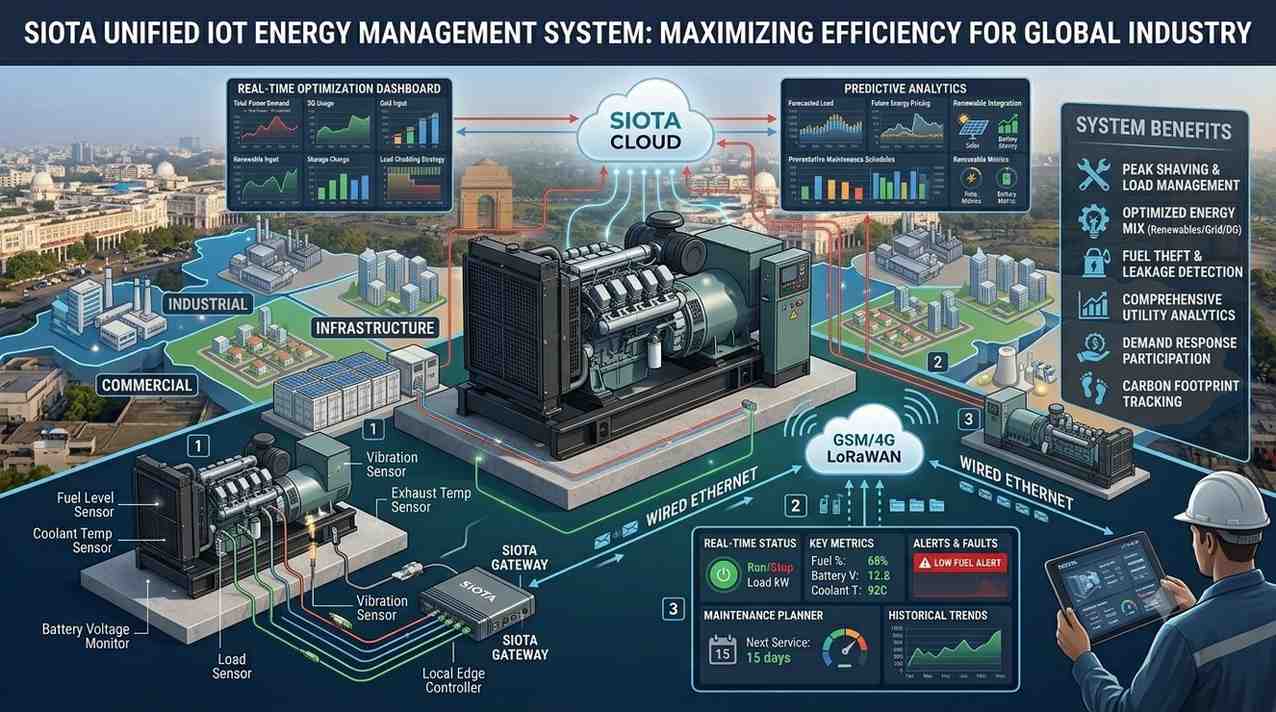
Platforms like SIOTA are built around this idea—give facility managers real-time visibility, automate the corrections where possible, and make BRSR and ESG reporting something that happens automatically instead of becoming a quarterly headache.
If your facility is still running on manual readings and reactive fixes, this article is for you.
Why Manual Energy Monitoring Is Failing Indian Industries
Here’s the honest truth about spreadsheet-based energy monitoring: it tells you what happened. It never tells you what’s happening.
By the time your team compiles last month’s meter readings and notices that Zone B consumed 40% more than usual, Zone B has already been doing that for 30 days. You’ve already paid for it.
The Numbers Nobody Talks About
Industry estimates suggest that most commercial and industrial facilities leak 15–25% of their energy budget through inefficiencies they simply can’t see. That’s not a global average pulled from a report. That’s what shows up on the ground when you actually put sensors on equipment and start looking at real consumption data.
For a facility spending ₹60 lakh annually on electricity, that’s ₹9–15 lakh that quietly disappears every single year. Not because of expensive equipment or poor procurement. Just because nobody could see it happening in real time.
What “Reactive” Actually Costs You
There’s a compounding problem with reactive energy management that doesn’t get discussed enough.
When you catch an issue late—an HVAC unit running unnecessarily through the night, a motor drawing excess current for weeks—you don’t just pay for the wasted energy. You often also pay for the equipment damage that occurred while the problem went unnoticed.
An IoT-based system catches these things when they start. Not when they’ve already cost you money and equipment life.
BRSR Made This Urgent
If your company falls under SEBI’s top 1,000 listed entities, BRSR compliance isn’t optional anymore. Energy consumption disclosure is now a hard requirement. And if you’re manually pulling data from meter readings to fill that report—you already know how painful that process is.
An IoT EMS generates those logs automatically. Every day. In formats that are actually usable for reporting.
What a Good IoT Energy Management System Actually Does
Let’s be specific here, because this category has a lot of products that look impressive in demos and disappoint in deployment.
It Monitors at the Right Level of detail.
A system that only shows you total facility consumption is not particularly useful. You already know that number — it’s on your electricity bill.
What you need is sub-meter level monitoring. Per machine, per floor, per circuit. The moment you get that granularity, patterns appear that were completely invisible before. One compressor running 18 hours a day when it should run 10. One floor’s lighting never switches off on weekends. These are real, fixable problems — but only if you can see them.
It Automates the Corrections
Monitoring alone is passive. The better platforms don’t just alert you — they act.
Occupancy-based HVAC control, for instance, isn’t a complicated concept. If no one is in the conference wing at 8 PM, the AC shouldn’t be running at full load. An IoT system with the right automation can handle that without anyone needing to remember to switch anything off.
It Connects to Everything You Already Have
Good IoT platforms don’t require you to throw out your existing infrastructure. They integrate with your meters, your HVAC controllers, your DG sets, and your BMS—using standard protocols like Modbus and BACnet.
This is actually one of the things SIOTA does well. The hardware is designed to work with existing electrical setups, which is why deployment typically goes live within 48 hours rather than weeks.
It Keeps Getting Smarter
Raw data is useful. But consumption patterns analyzed over time are genuinely powerful. The best IoT energy management systems use historical data to spot emerging inefficiencies before they become expensive—demand spikes you could shift to off-peak hours, equipment degrading slowly before it fails completely.
How SIOTA Approaches Industrial Energy Management
I want to be clear that this isn’t a product review in the traditional sense. But since this article is built around what a great IoT energy management system looks like, SIOTA is a relevant real-world example of the principles in action.
Built for Indian Facilities, Not Adapted from Elsewhere
A lot of industrial IoT software comes from Western markets and gets localized for India. The problem is that Indian facilities have specific challenges—power quality issues, DG dependency, complex tariff structures, and multi-shift operations—that platforms designed for European or American factories don’t handle naturally.
SIOTA is built around these realities from the ground up. DG monitoring is a core feature, not an add-on. Power factor optimization is standard. Multi-location management is native to the platform, not bolted on.
One Platform Across All Asset Types
Facilities that use five different tools for energy, HVAC, DG, temperature monitoring, and water management end up with five different dashboards, five different vendor contacts, and five different data silos.
SIOTA consolidates all of this. Energy monitoring, HVAC automation, DG tracking, temperature and humidity alerts, lighting control, water management — one platform, one login, one escalation path when something goes wrong.
The 48-Hour Deployment Claim — Why It Matters
Most facility managers have been burned by technology implementations that dragged on for months. A vendor promises minimal disruption. Reality turns out to be three months of integration work, six weeks of training, and a system that still has bugs six months after go-live.
The 48-hour deployment timeline at SIOTA works because the hardware is plug-and-play and doesn’t require significant infrastructure changes. That’s not a minor operational detail — it’s the difference between a system that gets deployed and one that stays in procurement discussions forever.
Industries Where This Has Been Applied
- Manufacturing — machine-level energy tracking, predictive maintenance alerts, multi-DG visibility, power factor monitoring
- Hospitals and Healthcare—temperature and humidity compliance for pharma storage, clean rooms, and labs; HVAC automation for patient zones; zero-downtime monitoring for critical systems
- Hotels — occupancy-based room conditioning, energy monitoring across multiple properties, remote DG management
- Commercial Offices — centralized HVAC control, ESG reporting, lighting automation, multi-site dashboards
Where IoT Energy Management Actually Pays Off
Theory and case studies from global brands are fine. But let’s talk about where the ROI actually shows up in Indian industrial contexts.
Maximum Demand Charges
This is one of the most underappreciated savings opportunities in industrial electricity billing. Maximum demand charges — the penalty for peak power draws — can account for 30–40% of a large facility’s electricity bill.
IoT monitoring lets you see demand spikes as they’re building, not after they’ve happened. Automated load management — shifting non-critical loads off during peak periods — directly reduces this charge. Facilities that focus here often see bill reductions that pay for the entire IoT system in the first year.
HVAC Over-Conditioning
Walk through any large commercial building at 9 PM. The AC is probably running at full capacity in empty meeting rooms, corridors, and lobby spaces.
Occupancy sensors paired with automated HVAC control fix this completely. The system doesn’t need someone to remember to switch things off — it does it based on actual occupancy data. For buildings where HVAC represents 50%+ of energy consumption, this is where significant money lives.
DG Fuel Accountability
DG fuel theft and wastage is a real operational problem for facilities that rely on backup generators. Without monitoring, there’s no reliable way to cross-check fuel consumption against runtime. Anomalies go undetected for weeks.
IoT-based DG monitoring gives you runtime logs, fuel consumption data, and alerts when something doesn’t add up. That’s cost control and fraud prevention in one.
Predictive Maintenance Savings
An unplanned production halt is almost always more expensive than the equipment repair itself. Lost production hours, emergency service calls, overtime to catch up — it adds up fast.
IoT sensors tracking vibration, temperature, and current draw on critical motors and compressors can flag degradation patterns days before failure. Maintenance happens on a schedule. Production continues uninterrupted.
What to Actually Check Before Choosing an IoT Energy Management System
This is the part most buyers skip and then regret.
Don’t Evaluate on Features Alone
Every vendor will show you an impressive demo. The questions that matter are the ones that come after the demo.
How does the system handle connectivity drops at the facility? Local data buffering, or does everything go missing? What happens when a sensor fails? Does the platform flag it or silently show stale data? What’s the actual support SLA? Is it 4 hours or 4 business days?
Verify Protocol Compatibility Before Signing
If your facility uses specific HVAC controllers, meters, or BMS systems, confirm compatibility before the contract is signed — not after. Ask for a site survey. Any serious vendor will do one before deployment.
Ask for References from Similar Facilities
A system that works beautifully in a 5,000 sq ft office may behave completely differently in a 200,000 sq ft manufacturing plant with 80 machines and three shifts. Ask for references from facilities similar to yours in size, industry, and operational complexity.
Understand the Data Ownership Terms
Your energy data is operational intelligence. Make sure the contract is clear on who owns it, how it’s stored, and what happens to it if you switch vendors down the line.
Conclusion
The best IoT-based energy management system for industries isn’t the one with the most features on a spec sheet. It’s the one that actually gets deployed, gives your team visibility they can act on, and pays for itself within a year.
For Indian facilities—dealing with DG dependency, complex tariffs, BRSR obligations, and multi-location operations—the right platform needs to be built for these realities, not adapted from somewhere else.
SIOTA is worth a serious look if you’re in this space. The 48-hour deployment, the multi-asset coverage, and the focus on Indian industrial contexts set it apart from generic IoT platforms.
But more importantly, whatever platform you choose, the time to act on this is now. Every month of manual monitoring is money you’ve already paid and can’t get back.
Frequently Asked Questions
What exactly does an IoT-based energy management system do?
At its core, it replaces manual meter readings with real-time data from sensors placed on your panels, machines, HVAC units, and other assets. The software shows you live consumption, flags anomalies, automates control actions, and generates reports — all without manual intervention.
How much can a facility realistically save?
Most Indian industrial facilities save 15–30% on energy costs in the first year. The number depends on how much inefficiency currently exists — facilities with unmonitored HVAC, untracked DG consumption, and no demand management typically save at the higher end.
How quickly can you get a system like SIOTA running?
SIOTA deploys most facilities in 48 hours. The hardware is plug-and-play and works with existing electrical infrastructure, so there’s no major retrofitting involved.
Is this only for large enterprises?
Not at all. Mid-sized manufacturers, multi-branch hospitals, hotel chains with 3–4 properties, and commercial buildings of all sizes benefit from IoT energy management. The ROI often shows up faster for mid-sized facilities because the inefficiencies are more concentrated and easier to address.
How does this help with BRSR compliance?
An IoT EMS logs energy consumption data continuously. When it’s time to prepare your BRSR disclosure, the data is already there—organized, accurate, and audit-ready. No scrambling, no manual aggregation.
What if our facility has poor internet connectivity?
Good IoT hardware includes local data buffering — it stores readings locally during connectivity drops and syncs when the connection is restored. Ask your vendor specifically about this before deployment.
Can it monitor our DG sets too?
Yes—and this is actually one of the more impactful use cases. IoT-based DG monitoring tracks runtime, fuel consumption, and alert thresholds. It’s especially useful for facilities with multiple generators across locations.
What’s the typical payback period?
For most industrial facilities, the payback period is 12–18 months. Facilities with high energy spend, significant HVAC loads, or DG dependency often see payback in under a year.
