

Let me be direct with you.
If your facility runs diesel generators and your team is still filling log books by hand, you’re not managing your DGs. You’re guessing about them.
I’ve spoken to dozens of facility managers across India—in hospitals, factories, hotel chains, and retail networks—and the story is almost always the same. The generator runs. Someone writes down the hours. Fuel gets topped up. And nobody really knows if the numbers add up. Until they don’t.
That’s exactly the gap a diesel generator monitoring system is built to close. Real-time data. Automatic alerts. Reports that are actually reliable. And a dashboard that shows you what’s happening—right now, across every DG set you operate.
This guide breaks down how it works, what it actually gives you, and what to look for when choosing one. No fluff. Just the stuff that matters.
What Is a Diesel Generator Monitoring System, Really?
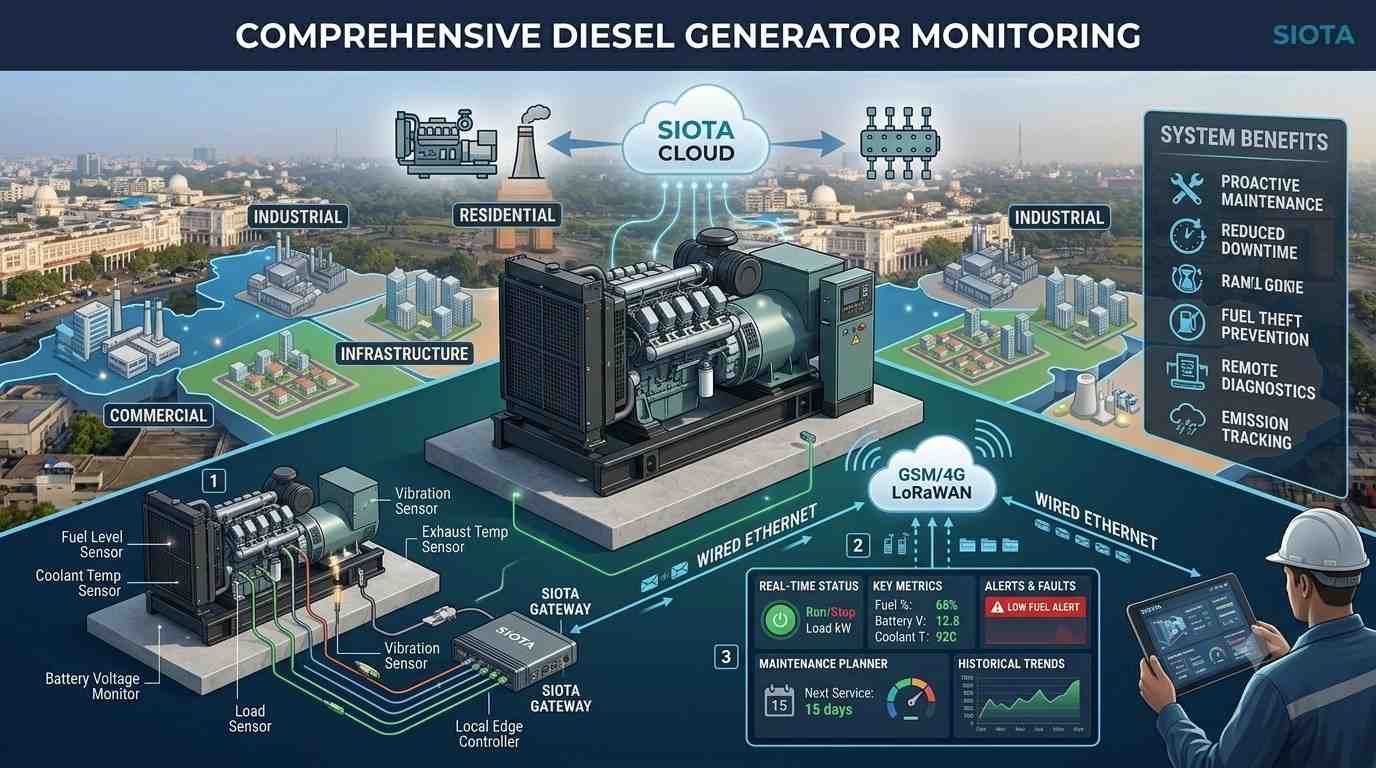
At its core, a diesel generator monitoring system is IoT hardware plus software. Sensors go on the DG set—measuring fuel level, voltage, current, temperature, runtime, and load. A gateway pushes that data to the cloud. You log into a dashboard and see everything live.
That’s the basic version.
The better version also tells you when something’s wrong before it becomes a breakdown. It flags when fuel drops faster than expected. It sends you an SMS at 2 AM if the generator overloads. It builds you a monthly report without anyone lifting a pen.
What Gets Monitored
Here’s what a decent diesel generator monitoring system tracks:
- Fuel level — in real time, not from a dipstick reading three days ago
- Runtime hours — exact, not approximated from a handwritten shift log
- Load percentage — so you know if the DG is being pushed too hard or running light
- Voltage and current — to catch electrical faults before they escalate
- Temperature—overheating is one of the top causes of DG failure
- Start/stop events — every cycle logged automatically with timestamps
The Bit People Overlook
Most people think about monitoring in terms of data. Fair enough. But the bigger value is in the alerts. Knowing that your fuel dropped 200 liters in an hour when the DG only ran for 20 minutes—that’s not a data point. That’s a red flag. And a good system catches it instantly, not when the next manual stock audit rolls around.
The Ugly Truth About Unmonitored DG Sets
I’m going to say something that most vendors won’t put in writing: unmonitored generators are one of the biggest hidden costs in Indian facilities. And they’ve been hiding in plain sight for years.
Fuel Theft Is More Common Than Anyone Admits
In multi-site operations—manufacturing clusters, hotel chains, and hospital groups—fuel theft from DG tanks is shockingly routine. It’s not always dramatic. Sometimes it’s just a few liters here and there, spread across dozens of sites and dozens of weeks.
Without a sensor on the tank, you’d never know. The generator ran, and fuel got consumed—that’s the story the log sheet tells. What the log sheet doesn’t tell you is that 40% of that fuel never went near the engine.
A diesel generator monitoring system with a fuel sensor changes that equation entirely.
Reactive Maintenance Is Expensive
When does most DG maintenance happen? After something breaks. A failed start. Smoke from the exhaust. A generator that won’t take a load during a power cut—at the worst possible time.
Condition-based monitoring flips this. When the system sees abnormal temperature trends or unusual vibration patterns, it alerts you while there’s still time to schedule a repair before anything actually fails. That’s the difference between a ₹5,000 service call and a ₹2 lakh emergency replacement.
Log Sheets Don’t Hold Up in Audits
If your facility falls under BRSR reporting requirements — or if you’re preparing for an energy audit — manually maintained DG logs are a liability. They’re inconsistent, incomplete, and frankly, often retrofitted. Auditors know it. You know it.
Automated, timestamped, tamper-proof records are a different story entirely.
The Features That Actually Matter (Versus the Ones That Sound Good)
Every vendor will hand you a feature list as long as your arm. Most of it is noise. Here’s what actually moves the needle.
Real-Time Fuel Monitoring With Tamper Alerts
This is non-negotiable if you have any fuel theft concern at all. Flow sensors or ultrasonic fuel level sensors give you a live reading. The system calculates expected fuel consumption based on runtime and load — and if actual consumption exceeds that by more than a set threshold, you get an alert.
Simple. Effective. Often pays for the entire system within a month or two.
Predictive Maintenance, Not Just Alarms
There’s a difference between an alarm (something has already gone wrong) and a predictive alert (something is trending in the wrong direction). The best diesel generator monitoring systems give you the latter.
Temperature trending upward over three weeks? Alert. Runtime hours approaching the service interval? Alert. Start failures increasing in frequency? Alert. You catch the problem at the trend stage, not the failure stage.
Multi-Site Dashboard
If you’re managing DGs across more than one location—and most serious facility operations in India are—a multi-site dashboard isn’t a nice-to-have. It’s essential.
You need to see all your generators on one screen. Compare fuel efficiency across sites. Spot which location is overworking its DG. Identify which site hasn’t done a service in four months. SIOTA’s platform is designed specifically for this kind of multi-site visibility — it’s not an afterthought bolted onto a single-site product.
Compliance-Ready Reports, Automatically
BRSR, ISO 5000 1. Internal energy audits. ESG frameworks. Whatever your reporting requirement, the system should generate it without anyone having to compile spreadsheets the night before a submission deadline.
Automated reports that pull from live, verified sensor data are a different category of evidence than anything a human puts together manually.
How Deployment Actually Works — No Jargon
People sometimes assume that installing an IoT monitoring system means weeks of downtime and a team of engineers taking over the facility. That’s not how it works.
The Honest Timeline
Day 1: A site visit. The team looks at your DG sets, confirms sensor placement, and checks communication options (GSM, Wi-Fi, or wired depending on the site).
Day 2: Hardware goes up. Sensors mount on the fuel tank, control panel, and other key points. The gateway gets configured. Nothing gets rewired. The DG keeps running throughout.
Day 2–3: Platform gets set up. Your specific parameters are entered—tank capacity, rated load, alert thresholds, and shift schedules. The dashboard is configured for your team.
Day 3: Training session for your operations team. Usually 2–3 hours. The platform is designed to be straightforward — if you can use a smartphone, you can use the dashboard.
Day 4 onwards: You have live data. And you’ll probably see something unexpected within the first week. Everyone does.
What to Ask Before You Sign Anything
Before you commit to a vendor, get clear answers on these:
- What happens if the gateway loses connectivity — does data get stored locally and sync when it reconnects?
- What’s the uptime SLA on the cloud platform?
- If a sensor fails, how fast can it be replaced?
- Can the system scale if you add more DG sets or open new sites?
- What does the support look like after installation — phone, email, on-site?
A vendor who hesitates on any of these is telling you something important.
Who Needs This Most? (Industry Breakdown)
Every industry that uses diesel generators benefits from monitoring. But some have more to lose than others.
Hospitals and Healthcare Facilities
Power failure in a hospital is not an inconvenience. It’s a patient safety event. Healthcare facilities need their backup power systems to work every single time, without question.
Diesel generator monitoring gives hospital facility managers certainty. They know the DG is healthy. They know the fuel is there. They know it started cleanly during the last test run. And they know if anything changes.
Manufacturing and Factory Operations
Production lines don’t care why the power cut happened. Every minute of downtime has a cost—in output lost, in labor wasted, in deadlines missed. Factories with unmonitored DG sets are one unexpected breakdown away from a very bad day.
Predictive alerts and runtime analytics give plant managers time to act before the situation becomes a crisis.
Hotels and Hospitality Groups
Guest experience is everything in hospitality. A generator that fails during a wedding or a board-level conference is remembered. For hotel chains managing multiple properties, centralized DG monitoring means the operations team catches issues at Property B without needing to physically be there.
Cold Storage and Warehousing
If a DG fails in a cold storage unit and nobody notices for four hours, the losses can be catastrophic. Temperature monitoring combined with DG monitoring—which SIOTA’s platform integrates natively—creates an automatic early warning chain that protects inventory before damage occurs.
Retail Chains and Multi-Location Networks
Retail chains with 50, 100, or 200 stores across India cannot afford to manage DG assets site by site. Centralized monitoring standardizes the operation, surfaces anomalies fast, and gives leadership real data instead of hand-collated reports from store managers.
Choosing a Vendor: What Separates Good From Mediocre
The Indian market has no shortage of IoT vendors claiming to offer DG monitoring. Most of them are repackaging generic hardware with a basic dashboard. Here’s how to tell the difference.
Look for Industry Depth, Not Just Product Specs
A vendor who has deployed in hospitals understands alarm sensitivity requirements. A vendor who has worked with manufacturing understands shift-based reporting. Generic IoT companies often don’t have this context—and it shows in the implementation.
Ask: Have you deployed in my industry specifically? Can I speak to a customer in a similar operation?
Integration Matters More Than You Might Think
A diesel generator monitoring system that sits in isolation is useful. A system that integrates with your broader energy management stack—HVAC, sub-metering, temperature monitoring, and lighting—is transformational.
When all your energy assets talk to each other on one platform, you get a picture of your facility’s total energy posture, not just a window into one piece of it. SIOTA builds exactly this kind of unified platform — DG monitoring sits alongside HVAC automation, energy sub-metering, and temperature monitoring, all on one dashboard.
After-Sales Support Is Where Most Vendors Fall Short
The IoT hardware market has a graveyard full of “solutions” that worked fine on day one and nobody could get support for by month six. Before you commit, understand the support model clearly. Is there a dedicated account manager? Is support 24/7 or business hours only? What’s the escalation path if the platform goes down?
Conclusion: Stop Guessing About Your Generators
Here’s the thing about diesel generator monitoring — it’s not a complex decision once you see what you’re currently missing.
Most facilities that install a monitoring system are surprised. Not because the technology is impressive (it is), but because of what the data reveals in the first few weeks. A site where fuel was disappearing. A DG that was running six hours longer per week than anyone realized. A generator that had been starting with partial load failures for a month, invisible to everyone on the ground.
You can’t fix what you can’t see. And right now, if you’re relying on manual logs, you can’t really see your generators.
A diesel generator monitoring system gives you that visibility — in real time, across all your sites, with the kind of data that holds up in audits and actually helps you make decisions.
If you want to see what this looks like for your specific facility, SIOTA offers a free demo. No obligation. Just a live walkthrough of what your DG data would look like on a real dashboard. Most people who take the demo don’t need much convincing after that.
Frequently Asked Questions
What exactly does a diesel generator monitoring system do?
It puts sensors on your generator—fuel tank, control panel, exhaust, and body—and streams live data to a cloud dashboard. You see fuel levels, runtime, load, temperature, and fault conditions in real time. If anything goes wrong or crosses a threshold, you get an alert on your phone immediately.
How does it actually prevent fuel theft?
The system calculates how much fuel should have been consumed based on how long the generator ran and at what load. If the actual fuel drop is significantly higher than that calculation, it flags the discrepancy instantly — usually within minutes. Without this, fuel theft can go undetected for months.
We have generators at 12 different locations. Can one system cover all of them?
Yes, that’s actually where these systems shine most. A cloud-based platform like SIOTA’s shows all your sites on one dashboard. You can compare fuel efficiency across locations, see which sites are overworking their DGs, and get alerts from any site on one phone—without visiting each one.
How disruptive is the installation?
Genuinely not disruptive. The sensors mount externally, and the generator keeps running throughout. A standard single-site installation takes 48–72 hours from start to finish. Most facilities don’t even notice it happening.
We’re a mid-sized facility with just two DG sets. Is this overkill?
Two unmonitored DGs can still cost you significantly in fuel theft or an unplanned breakdown at the wrong time. The system scales down as well as up—you don’t need to be running 50 generators to get real value from monitoring.
Will this help with BRSR or ESG reporting?
Yes. The system generates timestamped, tamper-proof logs of DG runtime, fuel consumption, and load data. These can be exported in formats suitable for BRSR reporting, ISO 50001 audits, and internal ESG submissions — no manual compilation needed.
What if the internet goes down at a site?
Most professional systems (including SIOTA’s) have local data buffering on the gateway. Data is stored on the device and synced to the cloud automatically when connectivity is restored. You don’t lose data during connectivity gaps.
How long before we see a return on the investment?
It genuinely depends on your situation. Facilities with significant fuel theft issues often see payback within 6–8 weeks. For facilities where the primary value is predictive maintenance and compliance, it typically ranges from 3–6 months. SIOTA can give you a rough estimate based on your site parameters before you commit to anything.
