

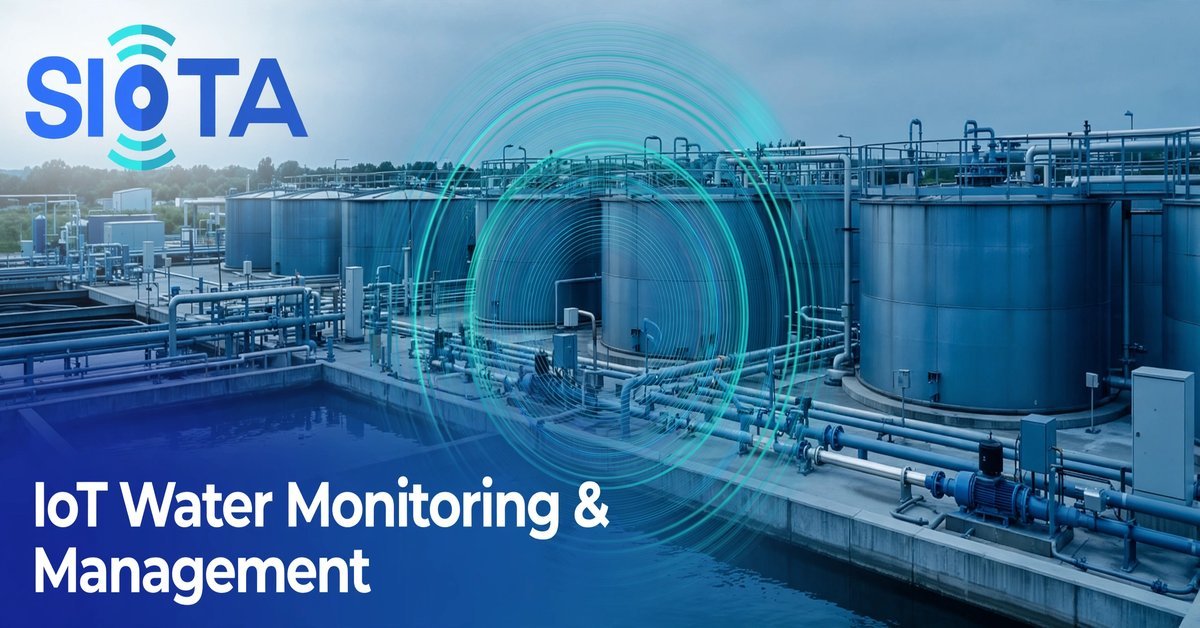
Ask a facility manager about his most frustrating invisible cost and many will not say electricity. They will say water — the tanker that showed up twice this week, the underground tank nobody can see into, the terrace tank that overflowed all night because the float valve gave up quietly. An iot based Water monitoring company in india exists for exactly this frustration: it puts level sensors on your tanks, flow meters on your lines, and the whole picture on a phone screen, so water stops being a monthly surprise and starts behaving like a managed utility.
This guide is written for the people who actually run buildings and plants — facility heads, admin managers, plant engineers. It explains what an IoT based water monitoring company in India really does on your site, where water typically disappears, what the hardware looks like, and what changes in the first few months. No jargon, no miracle promises. Just the practical shape of a water monitoring project, drawn from how these systems get used on real Indian sites.
Working with an iot based Water monitoring company in india: what actually happens
The engagement usually starts with a walkthrough, not a sales presentation. Someone visits your site, looks at your tanks, pumps, borewell, and the lines feeding your building or plant, and figures out what is worth measuring. An IoT based water monitoring company in India does not meter every tap; it picks the points that explain your water story — how much comes in, how much each major consumer takes, and how much the tanks hold at any given hour. That short list of measuring points is the whole project in miniature.
Then comes the installation, which is smaller than most people expect. Level sensors get mounted on top of tanks — usually ultrasonic, no cutting, no civil work. Flow meters go on the main lines, often the clamp-on type that straps around the outside of the pipe. A small gateway box collects the readings and sends them to a cloud dashboard over mobile data or your site’s internet. Your team gets logins, the important alerts land on phones as messages, and a weekly or monthly report lands in the facility head’s inbox.
What an IoT based water monitoring company in India will not do is equally worth knowing. It does not fix your plumbing, replace your plumber, or argue with your tanker supplier on your behalf. What it gives you is proof — timestamped levels, metered flows, pump run-hours — so those conversations stop being arguments and start being arithmetic. Most facility teams say the reports paid for themselves the first time a tanker bill or a leak dispute got settled with data instead of shouting.
Where the water quietly goes missing
The biggest losses are the ones nobody sees. Underground sumps and buried lines can leak for months, showing up only as a damp patch in the soil or a municipal bill that keeps climbing for no visible reason. A level sensor on the sump tells the truth within days: if the tank never quite fills, or drains faster than your consumption can explain, something underground is drinking your water. Finding that early is the difference between a small repair and a dug-up driveway.
Then there is the classic Indian sight — the terrace tank overflowing at midnight, water streaming down the side of the building while everyone sleeps. Float valves fail quietly, and the night watchman has better things to do than stare at a tank. This is the single most visible win of monitoring: the sensor watches the level round the clock, the pump cuts off at the right mark, and the overflow that used to run for hours simply stops happening. Site staff notice this change within the first week.
The rest of the losses hide in plain sight, and they are worth listing because every site recognises at least three of them:
- Tankers billed for a full load with no reliable record of what was actually unloaded.
- Borewell pumps running far longer than anyone authorised, with no log of run-hours.
- RO plant reject water going straight to the drain instead of to flushing or gardening.
- Cooling tower bleed and drift that nobody measures, because nobody was asked to.
- Garden hoses and cleaning lines left running, metered by nobody.
- Multiple buildings on one campus sharing a single municipal connection with no split measurement.
None of these is dramatic on its own. Together, on a large site, they are the gap between the water you paid for and the water you actually used — and until you measure, that gap has no name and no owner. An IoT based water monitoring company in India usually finds at least two or three of these on the very first site survey.
The hardware: level sensors, flow meters and one dashboard
The level sensor is the workhorse. Mounted above the water surface inside the tank, it measures the distance to the water and converts it into a level reading every few minutes. Ultrasonic sensors handle most tanks; where there is foam, vapour, or tight space, other sensor types take over. The point is the same: you always know how much water you have, in every tank, without climbing a ladder or sending someone to the terrace with a stick.
Flow meters answer the second question — where did it go? Installed on the main inlet lines and the big consumption branches, they record how much water passes through, hour by hour. The revealing number is the balance: inflow minus the sum of measured outflows. When that balance drifts, you have a leak, an unmetered branch, or a meter that needs attention. An iot based water monitoring system turns this balance into a daily figure your team can actually read, instead of a calculation nobody ever does.
All of it lands on one dashboard — tank levels as simple bar graphics, flow trends as charts, pump run-hours as a log, and alerts as plain-language messages: “Terrace tank 2 reached full level, pump stopped,” or “Sump level falling faster than normal, possible leak.” Nobody needs training to read it. The facility head checks it over morning tea, the operator gets the alerts that need action, and the monthly report gives management the summary in two pages.
Tank automation: the small upgrade everyone feels first
Monitoring tells you the level; automation acts on it. A basic controller wired to the level sensor starts the pump when the tank runs low and stops it at the full mark, with dry-run protection so the pump never burns out sucking air. The 2 am trip to the terrace ends. The operator stops guessing. For most sites this is the first piece of automation they ever install, and it is the one the site staff appreciate most, because it removes a daily chore rather than adding a dashboard.
There is a specifically Indian wrinkle here: the supply window. Municipal water often arrives in a fixed morning slot, and if your tanks are not ready to receive it, that day’s quota is simply lost. An iot based Water management company in india will typically set your system around this reality — tanks kept at receiving level before the supply window, borewell scheduled for the hours it is actually needed, and everything logged so the “the pump was on all night” argument finally has an answer. The technology bends to the local water routine, not the other way round.
Tanker accounting: knowing what you actually received
On sites that depend on tankers, the most quietly disputed number in the whole operation is the volume unloaded. The bill says one figure; the tank tells another story, or rather, it used to tell no story at all. With level sensing, every tanker visit leaves a signature — the level jumps the moment unloading starts and settles when it stops. Compare that jump against the billed quantity, visit after visit, and you have an honest record. Suppliers who know they are being measured tend to become remarkably accurate.
The same logic applies to your own borewell. A pump’s run-hours, logged automatically against the water level it produced, tell you whether the bore is yielding what it used to, and whether the pump is running when nobody asked it to. Many sites discover their borewell runs far more than the official schedule admits — sometimes because of a stuck contactor, sometimes because someone “just topped up the tank.” Either way, the log ends the mystery, and the electricity the pump was quietly consuming gets noticed too.
The first ninety days: what changes and in what order
The first month is the baseline, and it is almost always worse than assumed. The dashboard starts showing the real numbers — the night overflows, the sump that never fills, the tanker shortfalls — and the initial reaction is usually disbelief, followed by a walkaround that confirms every bit of it. Resist the urge to fix everything at once. An iot based water monitoring system is most valuable in this phase as a witness: it records the truth while your team decides what to tackle first.
The second month is when the visible wins land. The first leak gets found and fixed because the balance sheet pointed at it. Tank automation stops the overflows. A tanker dispute gets settled in one meeting with the level charts on the table. Your IoT based water monitoring company in India should be reviewing these numbers with you — the good vendors treat the monthly review as part of the job, not an extra, because that is where the system earns its keep.
By the third month, the routines have settled. The operator trusts the alerts. The facility head has a water report that goes to management alongside the electricity one. Somebody specific owns the numbers. That last point matters more than any sensor: measured water with no owner drifts back to unmeasured water within a year. The sites that keep saving are the ones where water became somebody’s job, with a dashboard to prove how the job is going.
Frequently asked questions
Do you need to break walls or shut down operations for installation?
No. Level sensors mount on top of tanks without cutting anything, and clamp-on flow meters strap around the outside of existing pipes. Most sites are instrumented without stopping any operation — the work happens tank by tank, line by line, usually within a day or two per site. If a vendor tells you they need civil work and a shutdown for basic water monitoring, get a second opinion.
Will the system keep working during power cuts?
The critical parts should. Good systems put the gateway and key sensors on battery backup, and the gateway stores readings locally when the internet drops, then backfills them when connectivity returns. Ask this question explicitly before you sign — a monitoring system that goes blind every time the power trips is not designed for Indian site conditions.
Can it also check water quality, not just quantity?
Yes, where it matters. TDS and pH sensors can be added on drinking water lines, RO outlets, or STP outputs, with alerts when readings cross your limits. Most commercial sites start with quantity — levels and flows — and add quality sensing on the lines where compliance or health is at stake. It is the same dashboard; just more tiles.
Our main tanks are underground and hard to reach. Does that rule us out?
Not at all — underground sumps are actually one of the strongest cases for monitoring, because they are the tanks nobody can see into. Sensors mount at the sump’s access opening, and where even that is difficult, the system can infer sump behaviour from pump run-hours and inflow metering. If anything, the less visible your storage, the more you need the visibility.
Who is supposed to look at the dashboard every day?
Your IoT based water monitoring company in India should help you answer this on day one: the operator watches the alerts, the facility head scans the daily summary, and management sees the monthly report. Monitoring without an owner is decoration. Name the person who acts on a leak alert at 11 pm, write it down, and the system will actually get used.
How is this different from just putting an automatic float switch on the tank?
A float switch controls one tank; a monitoring system explains your whole site. The switch stops the overflow, which is good, but it cannot tell you about the underground leak, the tanker shortfall, or which building consumes the most. Automation without measurement fixes one symptom. Measurement plus automation fixes the system.
If any of this sounds familiar — the mystery bills, the night overflows, the tanker arguments nobody can resolve — talk to people who do this every day. A site survey and a look at your last few water bills shows where the losses are, and an iot based Water management company in india will tell you honestly whether your site is a good fit. To speak with the SIOTA team or see what other facility managers say, find SIOTA on Google here — the best water projects start with an honest look at where your water actually goes.
