

Introduction
Most facilities in India are bleeding money and don’t know it.
Not because anyone’s careless. It’s just hard to fix a problem you can’t see. The electricity bill lands at the end of the month, everyone winces, and then it happens again next month — with no real idea why it’s high or which machine is the culprit.
That’s the gap an energy management company in India is built to close. Instead of waiting for the bill, you get sensors and software watching your equipment as it runs, telling you exactly where the waste is happening.
If you’re managing a hospital, a factory floor, a hotel, or a stack of office buildings, an energy management company in india can genuinely change how you run the place — lower bills, fewer surprise breakdowns, and ESG reports that don’t take three weeks to compile. That’s what this piece is about: how it works, why it matters right now, and what to actually look for before you hire someone.
Quick number to anchor things: the Bureau of Energy Efficiency (BEE) points to India’s commercial and industrial sectors as the country’s biggest electricity users, and the Alliance for an Energy Efficient Economy (AEEE) has found that most facilities can shave 15–25% off consumption just by monitoring and automating better — no major operational overhaul required.
What an Energy Management Company Actually Does
Strip away the jargon and it’s pretty simple: they help you see your energy use in real time, then help you act on it.
Sensors go on your panels, meters, HVAC units, generators — whatever’s drawing power. That data flows somewhere you can actually look at it. And ideally, some of it gets acted on automatically, without a person having to babysit a dashboard all day.
Watching It Happen, Not After the Fact
The old way is a monthly bill. The new way is a live feed. That difference matters more than it sounds — a live feed catches a spike the moment it starts, not thirty days later when it’s already cost you.
It also helps separate the boring, expected stuff (hot April, more AC use) from actual waste (a compressor running all night for no reason).
Letting the System Handle the Boring Parts
Seeing the data is step one. Doing something about it is where the real savings show up — lights that switch off in empty rooms, HVAC that adjusts itself, an alert the moment something starts drawing more power than it should.
Automation isn’t about replacing your facilities team. It’s about not needing someone to stare at a screen for eight hours.
Reports That Don’t Eat Your Week
If your company falls under SEBI’s BRSR requirements — and that list of companies keeps growing — you already know how painful it is to chase down meter readings from five different sites. A decent energy platform just builds that reporting in, so it’s a few clicks instead of a few days.
Why This Matters in India Right Now
Two things are happening at once: electricity demand keeps climbing, and so do tariffs. Neither trend is reversing anytime soon.
The Bills Keep Going Up
Commercial power rates aren’t the same everywhere in India, but the direction has been pretty consistently upward for years — worse if you’re a hotel, factory, or hospital running heavy loads around the clock. Without granular data, you’re basically guessing which part of your operation is driving that number.
Compliance Isn’t Optional Anymore
SEBI’s BRSR rules already apply to India’s largest listed companies by market cap, and that circle is expected to widen. Spreadsheets and manual site visits don’t scale well once you’re managing this across multiple locations every quarter.
Breakdowns Cost More Than the Repair Bill
A machine failing mid-shift doesn’t just cost the part and the labor. It stops a production line, delays patient care, annoys a hotel guest who just wanted the AC to work. Predictive alerts — the kind that flag a compressor drawing more power each week — buy you time to fix things on your own schedule instead of theirs.
The Tech Stack Behind Modern Energy Management
Not every vendor in this space is running the same setup. Here’s roughly what’s under the hood with the better ones.
Wireless Sensors, Not Rewiring Projects
Most modern IoT sensors just clip onto what you already have — no rewiring, no civil work, no month-long installation window. That’s a big deal if you can’t afford downtime.
One Screen for Everything
All that sensor data lands in a cloud dashboard, so a manager overseeing five branches doesn’t need five separate logins to know what’s going on. Energy, water, HVAC, generators — one screen.
AI That Actually Catches Things Early
This is where it gets genuinely useful: AI models spotting a slow drift in power draw weeks before a compressor actually fails. Humans miss that pattern. Machines don’t, if they’re trained to look for it.
What to Actually Check Before You Sign With a Vendor
There’s more competition in this space than there used to be, which is good for you — but it also means you need to ask better questions.
Will It Work With What You Already Own?
Don’t let anyone talk you into ripping out perfectly good HVAC systems or meters. Ask directly: does this connect to what I already have installed, or am I buying new hardware too?
How Fast Can They Actually Get Live?
Some providers can get a site fully monitored within 48 hours using wireless sensors. Others want weeks of planning meetings before anything’s installed. That gap matters — every week of delay is a week of savings you didn’t capture.
Have They Actually Worked in Your Industry?
A cold storage warehouse and a five-star hotel have almost nothing in common operationally. Ask for real examples in your specific space, not a generic case study deck.
What Happens When Something Breaks?
Installing sensors is the easy part. Ask who answers when an alert fires at 2am, and how fast they actually respond.
SIOTA: One Example of This in Practice
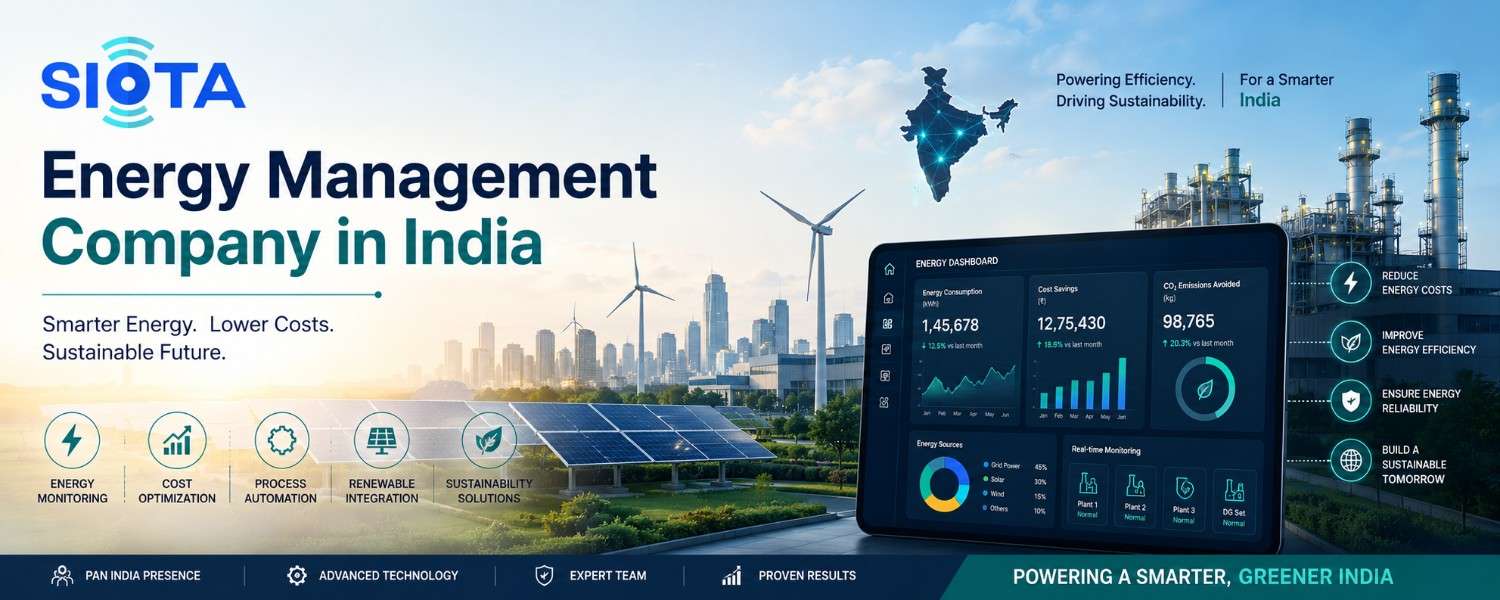
SIOTA is an energy management company in India built around exactly this idea — real-time energy monitoring, HVAC automation, DG monitoring, water tracking, and predictive maintenance, all in one platform.
It’s designed to connect to whatever HVAC setup you already have — split, cassette, duct, VRF — plus your existing meters and generators, without forcing a hardware swap. Sites reportedly go live within 48 hours using wireless sensors.
The platform also auto-generates ESG and BRSR-ready reports, so someone isn’t manually pulling meter readings from six sites every quarter.
SIOTA works across hospitals, factories, hotels, office buildings, retail chains, cold storage, and server rooms — the kind of places where a single equipment failure or a month of unnoticed waste actually costs real money.
Curious what your own facility’s data would even show? You can schedule a demo with SIOTA and find out.
Wrapping Up
Picking the right energy management company in india isn’t just a nice-to-have anymore — it’s the difference between guessing at your utility bill and actually controlling it. The technology’s matured enough that this isn’t experimental territory: sensors, dashboards, and AI now genuinely work together to show you where the money’s going.
You don’t need to wait for another brutal electricity bill to act on this.
Want to see your own facility’s energy data, live? Schedule a free demo with SIOTA and see exactly where the waste is hiding.
Frequently Asked Questions
What does an energy management company actually do? It installs sensors and software that track how much power your building or facility is using in real time, then helps automate the response — cutting waste without someone manually watching a dashboard all day.
How much can a business realistically save? It varies by site, but a lot of Indian commercial and industrial facilities see 15–20% off their utility bills after switching to real-time monitoring and automation. That’s a range reported across the industry, not a guarantee for every building.
Is this only useful for big factories? No — hospitals, hotels, offices, retail chains, and multi-location businesses all use these systems, usually for the same two reasons: lower bills and fewer surprise breakdowns.
How long does installation actually take? With modern wireless IoT setups, a lot of vendors can get a site live within 48 hours. No rewiring, no weeks of civil work.
Does this help with ESG or BRSR compliance? Yes. If the platform logs energy, water, and carbon data automatically, putting together a BRSR or ESG report stops being a multi-day scramble. That matters more each year as SEBI’s requirements apply to more listed companies.
How do I actually pick a good vendor? Check compatibility with your existing equipment, how fast they can get you live, whether they’ve actually worked in your industry before, and what their support looks like once something goes wrong at 2am.
