

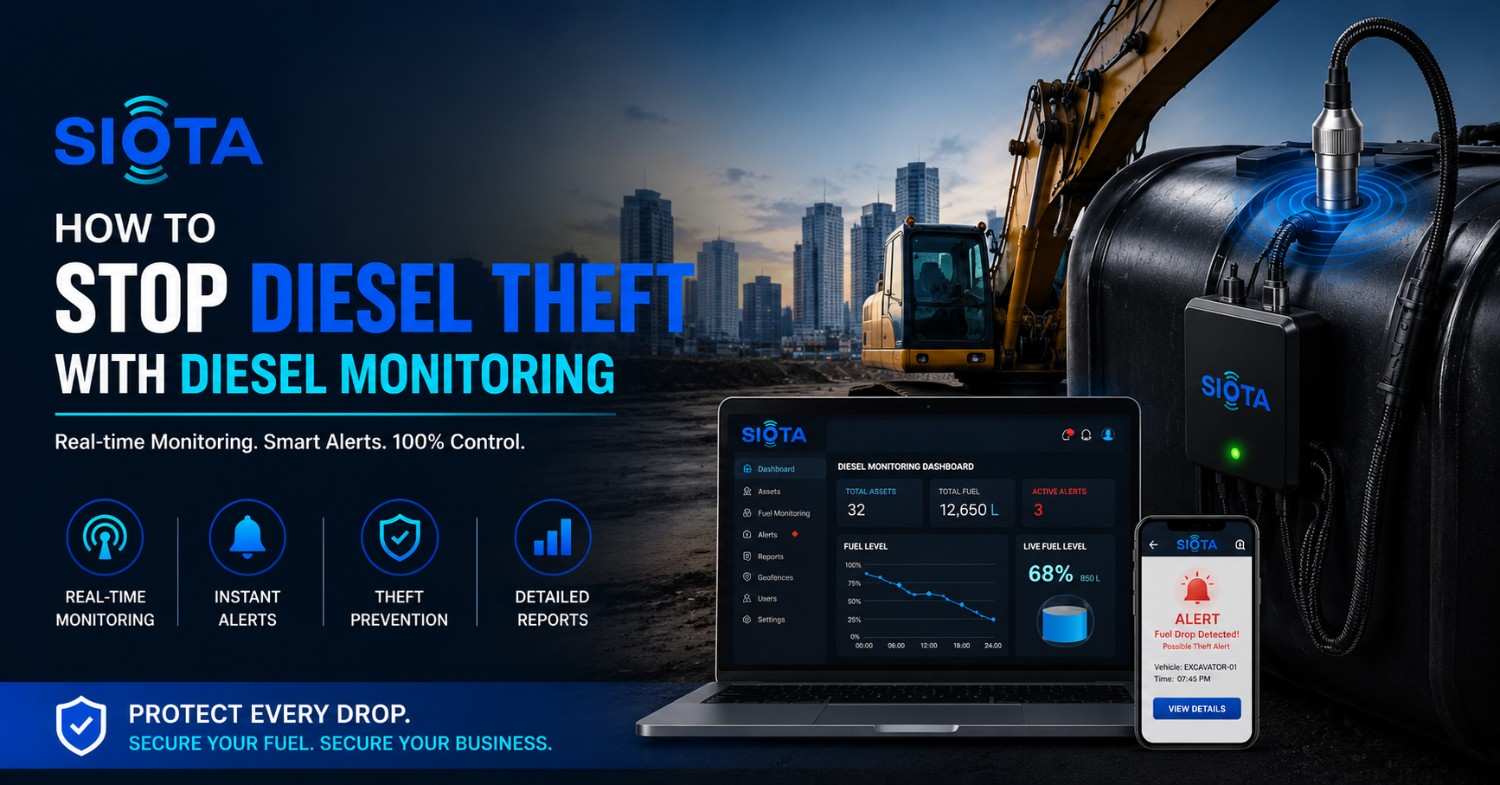
Introduction
I’ve sat across the table from more than one fleet owner who found out, almost by accident, that they’d been losing lakhs of rupees a year to diesel theft. Nobody flags it on day one. It’s usually a finance manager comparing fuel bills to mileage logs, scratching their head over numbers that just don’t add up. If that sounds familiar, you’re in the right place. This guide is about how to stop diesel theft from diesel monitoring — not in theory, but with the actual sensors, alerts, and habits that work on Indian roads and job sites.
Fuel theft rarely looks dramatic. It’s a driver siphoning a few liters after dark. A fuel attendant who “forgets” to fill the tank all the way. A logbook entry that’s just a little off, week after week, until it becomes a pattern nobody caught. Left unchecked, these small leaks turn into a real hole in your budget.
This is written for people who actually run fleets, generators, or job sites — not for people who write about them from a distance. So we’ll skip the fluff and get into what genuinely works, including where diesel monitoring fits and where it doesn’t. There’s an FAQ at the end too, for the questions that always come up in these conversations.
Why Diesel Theft Happens So Easily
Theft thrives where nobody’s watching, and fuel is one of the easiest things in a business to lose track of. It’s liquid, it’s hard to measure precisely by eye, and once it’s gone, there’s no paper trail unless you built one in advance.
Common Theft Methods You Should Know
Siphoning is still the classic move — a hose, a jerry can, and a few quiet minutes at night. It happens more often than most owners want to admit. Some drivers get creative and mess with fuel gauges so the dashboard shows a full tank even when it isn’t. Others aren’t working alone; they team up with fuel station staff who under-fill the tank while billing for the full amount.
Then there’s the paperwork side of things. A driver logs 300 km for a trip that was really 250. That “extra” 50 km becomes the excuse for missing fuel. Without GPS data to cross-check against what’s actually in the tank, this kind of thing can run for months before anyone notices.
The Real Cost of Ignoring It
Ten liters a day doesn’t sound like much. But do the math over a year, across a fleet of even 30 or 40 vehicles, and you’re looking at a genuinely painful number. Most companies don’t catch it early — they catch it when someone finally sits down and reconciles the annual fuel spend against distance traveled, and the gap is too big to explain away.
It’s not just the fuel cost either. A truck that’s quietly running low breaks down more often, which means missed deliveries and frustrated customers. Insurance and maintenance records get messy too, because nobody trusts the fuel numbers on file. And there’s a quieter cost — when theft goes unaddressed, honest drivers start feeling like they’re under suspicion right alongside the ones actually stealing. That’s bad for morale, and it’s avoidable.
Why Manual Checks Don’t Work
A lot of businesses still lean on logbooks and dipstick checks. I get why — it feels tangible. But it’s slow, and it’s far too easy to round a number in your favor when nobody’s cross-checking it. Paper gets lost. Entries get “adjusted.” There’s no timestamp, no GPS location, nothing to prove an entry is genuine. That gap is exactly why more fleet owners are moving to automated diesel monitoring instead of trusting a notebook.
How Diesel Monitoring Systems Actually Detect Theft
This is the part that changes everything, honestly. Modern diesel monitoring combines sensors, GPS, and cloud software so you’re not relying on anyone’s word — you’re relying on data that updates itself.
Real-Time Fuel Level Sensors
Ultrasonic and capacitive sensors sit inside the tank and track fuel level continuously, not just when someone happens to check. If the level drops suddenly while a vehicle is parked for the night, the system catches it immediately — no waiting for someone to notice at the next fill-up.
These sensors typically run within a 1-2% margin of error. That kind of precision matters more than people expect. The small inconsistencies that used to hide theft simply don’t survive that level of accuracy anymore. Fleet managers get a live view of every tank, all in one dashboard.
GPS and Geofencing Integration
Pairing GPS with fuel sensors adds context that fuel data alone can’t give you. If a vehicle stops somewhere it shouldn’t and the tank level drops at the same time, that’s worth a second look. Geofencing lets you mark approved fuel stations and depots, and anything outside those zones triggers an alert on its own.
Location plus fuel level is a strong combination. It removes the guesswork. You know when the fuel dropped, where the vehicle was, and how much went missing — all without asking anyone to explain themselves first.
Cloud Dashboards for Fleet-Wide Visibility
Sensors on individual vehicles are useful, sure, but the real payoff is a single dashboard pulling everything together. You can compare fuel use across your whole fleet in a few clicks, spot which vehicle or generator is behaving oddly, and look at trends over weeks instead of guessing from memory. It turns a scattered problem into something you can actually manage from your phone.
Setting Up Alerts That Actually Get Acted On
Catching theft in the data is one thing. Making sure someone actually sees the alert and does something about it is a different problem — and it’s where a lot of setups quietly fail.
SMS and App-Based Notifications
A decent monitoring platform sends alerts the moment something looks wrong — SMS, email, or a push notification, whatever gets read fastest by your team. Say fuel drops by more than 10 liters in five minutes; that triggers a notification right away, not a note buried in a weekly report.
Speed matters here more than people think. A same-day conversation with a driver about a fuel drop lands very differently than one three weeks later. And once your team knows theft gets flagged in real time, a lot of the temptation just disappears on its own.
Setting the Right Thresholds
Not every dip in fuel level is theft — engine load, temperature swings, even the vehicle tilting on a slope can cause small fluctuations. A good system filters that noise out and only flags genuine, sudden drops.
This part takes a bit of calibration. Every vehicle and tank size behaves a little differently, so it’s worth working with your provider to get the thresholds right rather than accepting default settings. Siota’s platform, for what it’s worth, auto-adjusts based on each vehicle’s own usage history, so false alarms drop off pretty quickly.
Using Data Reports to Catch Repeat Offenders
Real-time alerts stop theft as it’s happening. But it’s the longer-term data — weeks and months of it — that exposes patterns nobody would spot from a single incident.
Fuel Consumption Analytics
Dashboards break down fuel use by vehicle, driver, and route. If one truck consistently burns more fuel than others running near-identical routes, that’s a flag worth chasing. Comparing actual mileage against what the fuel usage should support tends to expose the inconsistencies fast — usually faster than most owners expect.
Driver Behavior Scoring
Some platforms score drivers on fuel efficiency, idling, and how closely they stick to assigned routes. The drivers with repeated anomalies tend to stand out on their own, without anyone needing to point fingers. That’s actually a relief for a lot of managers — the data does the uncomfortable part of the conversation for you.
Automated Audit Trails
Every transaction gets logged with a timestamp, location, and amount attached automatically. If a dispute comes up later, you’re not relying on someone’s memory of what happened — you’ve got a record that’s genuinely hard to argue with.
Best Practices for a Theft-Free Fleet
Technology gets you most of the way there, but it’s not the whole answer. The fleets that see the biggest drop in theft usually pair the tech with a few sensible habits.
Train Your Team on the System
Make sure everyone — drivers, depot staff, whoever handles fuel — knows the monitoring is active and understands roughly how it works. This isn’t about creating a culture of suspicion. It’s about being upfront, which tends to cut down on temptation before it starts.
Regular Maintenance of Sensors
Sensors drift over time. Dust, moisture, general wear — all of it can throw off readings if nobody’s checking. A quarterly calibration check with your vendor keeps the hardware honest, and honest hardware is the whole point.
Combine with CCTV at Depots
Pairing fuel sensors with cameras at fueling points closes the loop. Sensor data tells you something happened; footage tells you exactly what and who. Together, there’s not much room left for anyone to argue their way out of it.
Set Clear Policies and Consequences
None of this works well without a clear policy behind it. Spell out what counts as a violation and what happens next, and make sure every driver hears it during onboarding, not after an incident. Clear rules, consistently applied, tend to stop most problems before they start.
Review Reports on a Fixed Schedule
Don’t let the reports pile up unread — that’s the most common way these systems quietly stop working. Pick a day each week, assign someone to actually look at the dashboard, and follow up on anything odd. It doesn’t take long, but skipping it is how good systems turn into expensive software nobody checks.
Conclusion
Diesel theft isn’t some unsolvable problem — it just hides well when nobody’s watching closely. With the right diesel monitoring setup, you get real-time visibility, alerts that reach the right person fast, and data trails that hold up when it matters. None of it requires guesswork or accusations. The numbers do the talking.
If you’re ready to see where your fuel is actually going, Siota builds diesel monitoring systems for Indian fleets, generators, and industrial sites — sensors, GPS integration, and alerts that are built for how businesses here actually operate. Visit siota.in to book a free demo and see what’s really happening with your fuel.
Frequently Asked Questions
Q1: What is diesel monitoring, and how does it work? It’s a system of fuel sensors placed inside a vehicle or generator tank that track levels in real time and send that data to a cloud dashboard. From there, managers can see consumption patterns, catch sudden drops, and get alerted the moment something looks off.
Q2: How accurate are diesel fuel sensors? Good ultrasonic and capacitive sensors stay within about 1-2% accuracy. That’s precise enough to catch even fairly small theft attempts — the kind older mechanical gauges would’ve missed entirely.
Q3: Can diesel monitoring work for generators too? Yes, and it’s often just as valuable there. The same sensor and alert setup works across vehicles, construction equipment, and stationary generator tanks — anywhere diesel sits still long enough to be a target.
Q4: How much does diesel monitoring cost for a small fleet? It depends on fleet size and the type of sensor, but most providers, Siota included, offer plans that scale down to a handful of vehicles. In practice, the fuel savings usually cover the cost within the first few months.
Q5: Does diesel monitoring stop all types of fuel theft? Nothing stops it completely, but it makes a huge dent. Businesses that combine monitoring with driver training and depot cameras typically see fuel losses drop somewhere between 60-80% within the first few months.
