

Introduction
Let me tell you something most HVAC vendors in India will never admit.
A large chunk of the “smart HVAC” projects that get sold to Indian businesses every year do not deliver what was promised. The system gets installed. There is a dashboard. Someone gets trained on it for half a day. And then — three months later — the facility manager is back to manually overriding everything because the automation just isn’t working the way they need it to.
This is frustratingly common. And it’s one of the main reasons businesses searching for a genuine HVAC automation company in India end up spending months doing due diligence before committing to anyone.
Siota (siota.in) was built specifically to fix this problem. As an IoT-first HVAC automation company in India, Siota doesn’t sell generic hardware and walk away. It engineers end-to-end climate control systems that are designed around how Indian facilities actually operate — power fluctuations, monsoon humidity, legacy chiller infrastructure and all.
This article covers everything you need to understand about HVAC automation in the Indian context — why it matters right now, how it actually works, who needs it most, and why the company you choose makes an enormous difference in outcomes.
The Real Problem with HVAC in Indian Facilities
Here’s something worth sitting with for a moment.
The Bureau of Energy Efficiency (BEE) has documented that HVAC systems account for anywhere between 40% and 60% of a commercial building’s total electricity consumption in India. That’s not a rounding error. That’s the single biggest line item on your energy bill, and in most facilities, it’s being managed with the same logic that was used twenty years ago.
Fixed schedules. Manual thermostat adjustments. Reactive maintenance — meaning someone calls a technician only after something breaks.
Why “Set It and Forget It” Doesn’t Work in India
The problem isn’t that facility managers are careless. It’s that traditional HVAC systems simply don’t have the intelligence to respond to what’s actually happening inside a building.
Think about a manufacturing floor in a city like Ludhiana or Coimbatore. The heat load changes dramatically depending on how many machines are running, what shift is operating, and what the ambient temperature outside looks like that day. A fixed schedule doesn’t account for any of that. So either the system over-cools (wasting energy) or under-cools (making conditions uncomfortable or even unsafe for workers).
Neither outcome is acceptable. But without automation, that’s the trade-off most facilities live with every single day.
The Maintenance Problem Nobody Talks About
There’s another issue that doesn’t get enough attention — deferred maintenance.
In India, HVAC maintenance is often reactive rather than scheduled. Equipment runs until it shows obvious signs of strain, and then someone calls for service. By that point, you’re usually looking at significant wear, possible part replacements, and downtime that disrupts operations.
In industries like pharmaceutical manufacturing or food processing, that downtime isn’t just inconvenient. It can mean batch failures, compliance violations, and real financial damage.
What HVAC Automation Actually Does — Beyond the Buzzwords
The term “HVAC automation” gets thrown around a lot these days, so let’s be specific about what it actually means in practice when a company like Siota deploys it.
At its core, HVAC automation means replacing manual and timer-based control with intelligent, sensor-driven decision-making. The system monitors real conditions, processes that data, and adjusts equipment output accordingly — continuously, without human intervention.
But good automation goes deeper than that.
Sensor Networks That Give You Real Visibility
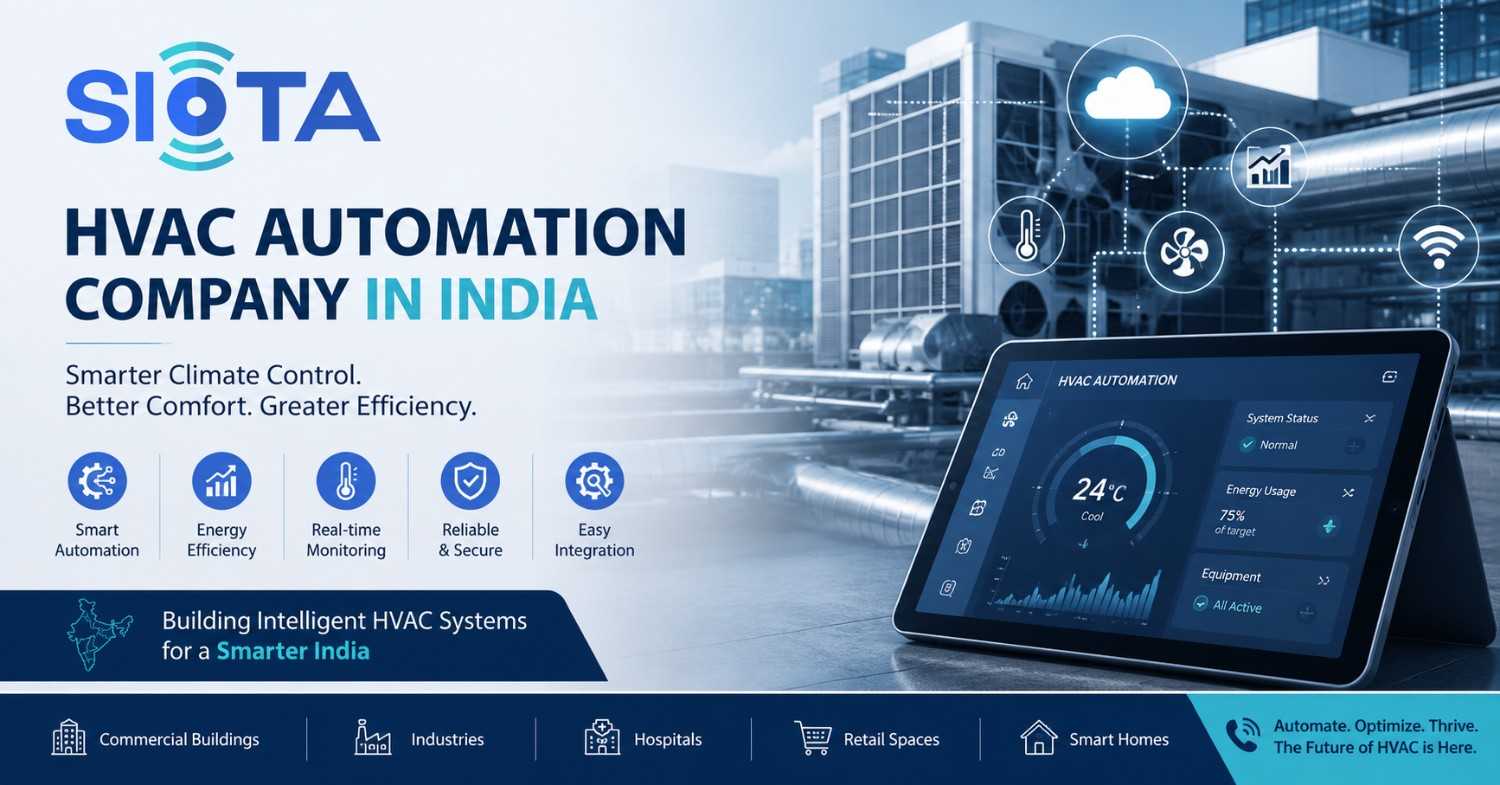
The foundation of any Siota deployment is a network of IoT sensors placed strategically throughout your facility. These aren’t just temperature sensors. Depending on the application, Siota’s installations monitor:
- Zone-by-zone temperature and humidity
- CO₂ concentration and air quality levels
- Equipment energy draw in real time
- Refrigerant pressure in chiller systems
- Occupancy patterns across different areas
This data is collected continuously and streamed to a cloud platform. For the first time, you get a genuinely clear picture of what your HVAC infrastructure is actually doing — not what you assume it’s doing.
A Dashboard That Makes Sense
One of the most common complaints about industrial IoT projects in India is that the dashboards are overly complex. Facility managers end up ignoring them because they can’t extract useful information quickly.
Siota’s platform is designed around how people actually make decisions. The interface surfaces the things that matter — which zones are outside parameters, which equipment is drawing unusual amounts of power, what your energy consumption looks like compared to last week — without burying you in data you don’t know what to do with.
You can access it from your phone, your laptop, or a fixed control station on-site.
Predictive Maintenance That Actually Prevents Problems
This is the part that tends to surprise clients most.
Once Siota’s system has collected enough operational data from your equipment, it starts identifying patterns that precede failures. A compressor that’s working harder than usual for its current load. A cooling coil that’s showing early signs of fouling. A variable frequency drive that’s behaving inconsistently.
The system flags these anomalies before they become failures. Your maintenance team gets an alert. They investigate and address the issue during planned downtime — not during a production run when everything is at stake.
For large facilities, this predictive capability alone can justify the entire investment.
Industries Where Siota Has Made the Biggest Impact
Siota has deployed HVAC automation solutions across a range of Indian industries, and the results vary somewhat by sector — not because the technology is different, but because the specific pain points differ.
Here’s an honest look at where the impact tends to be most significant.
Pharmaceutical Manufacturing
This is probably the sector where getting HVAC wrong has the most severe consequences. Temperature and humidity deviations in a pharma facility aren’t just operational problems — they’re regulatory ones. CDSCO and WHO-GMP guidelines mandate specific environmental conditions for different production areas, and every deviation needs to be documented and explained.
Siota provides continuous environmental monitoring with automated data logging for pharma clients. Every reading is timestamped and stored. During audits, compliance teams can pull complete environmental history for any zone, any time period, without any manual data compilation.
More importantly — when a deviation happens, the system responds automatically and alerts the right people within seconds, not the next morning when someone checks a paper chart.
Data Centres
If you’ve ever walked into a poorly cooled server room in Indian summer, you understand the urgency. Servers generate enormous heat loads, and even brief temperature excursions can cause hardware damage or unexpected shutdowns.
Data centres need precision cooling that responds dynamically to changing server loads. Siota’s automation adjusts cooling capacity in real time based on actual thermal load — not on a fixed schedule — which both protects the equipment and significantly reduces energy waste during low-load periods.
Cold Chain and Logistics
The cold chain sector in India has grown rapidly, partly driven by pharmaceutical distribution requirements and partly by organised retail and e-commerce expansion. Maintaining precise storage temperatures across large warehouses and distribution hubs is genuinely challenging.
Siota’s HVAC automation provides zone-level temperature control with instant deviation alerts sent to operations managers via SMS and app notifications. For clients handling temperature-sensitive pharmaceuticals, this is often a contractual requirement from their customers.
Large Commercial Buildings
Office complexes, malls, and hospitality properties in India frequently suffer from the same inefficiency — massive HVAC systems running at full capacity whether the building is at 100% occupancy or 30%.
Siota integrates occupancy sensing with HVAC control, so cooling and ventilation adjust dynamically based on where people actually are. The energy savings in commercial applications typically run between 25% and 35% annually.
How to Evaluate an HVAC Automation Company in India — Honestly
Since the market has become crowded, it’s worth talking about what actually separates a genuine specialist from a vendor who’s repackaging generic hardware with a smart label.
Here’s what to look for.
Do They Start with a Site Audit — or a Brochure?
Any serious HVAC automation company in India should be unwilling to quote you a solution before understanding your facility. The variables that determine the right system — ceiling height, equipment age, load profiles, electrical infrastructure, zone configuration — are different for every client.
If a vendor gives you a package price without walking your site first, that’s a red flag.
Siota always begins with a detailed site assessment. The engineering team maps your current setup, identifies inefficiencies, and models the automation solution before proposing anything.
Local Engineering vs. Imported Boxes
This matters more than most buyers realise. International HVAC automation products are designed for stable power grids, consistent ambient conditions, and relatively new building infrastructure. India is none of those things in many locations.
Siota’s systems are engineered specifically for Indian field conditions — they handle voltage fluctuations, operate reliably through high-humidity monsoon periods, and integrate with the mix of old and new equipment that most Indian facilities actually have.
Post-Installation Support Is Non-Negotiable
Installation is the easy part. The real value of an HVAC automation system comes from how well it runs over months and years — and how quickly someone responds when something doesn’t look right.
Ask any vendor you’re evaluating about their support SLA. Ask how many engineers they have in your region. Ask what happens to your system if the vendor goes quiet.
Siota provides structured AMC support with defined response times and a remote monitoring capability that catches most issues before clients even notice them.
The Business Case: What HVAC Automation Actually Saves You
Let’s be concrete about this, because the numbers are what ultimately drive the decision for most businesses.
The typical energy saving from a well-implemented HVAC automation project in India runs between 20% and 40% of current HVAC energy consumption. For a facility spending ₹15–20 lakhs per year on HVAC-related electricity, that’s ₹3–8 lakhs saved annually.
Most Siota clients see full payback within 18 to 30 months. After that, the savings are pure margin improvement.
But energy cost reduction is only part of the financial story.
Extended equipment life matters too. When HVAC systems run in tightly controlled parameters rather than cycling unnecessarily or operating at excessive loads, compressors, chillers, and air handling units last significantly longer. Deferring a major capital replacement by even two or three years is a substantial financial benefit.
And then there’s the compliance angle. For pharmaceutical, food, and healthcare clients, avoiding a single serious regulatory deviation — one that might require batch destruction or trigger an audit — can save more than the entire automation project cost.
Frequently Asked Questions
Q: How is Siota different from a regular BMS (Building Management System) provider?
A Building Management System typically provides monitoring and basic scheduling across multiple building systems. Siota’s focus is specifically on HVAC automation with deep IoT integration — meaning more granular sensor data, more intelligent control logic, and predictive analytics that most standard BMS platforms don’t offer. Siota’s systems can also integrate with existing BMS infrastructure where that’s in place.
Q: We have older HVAC equipment. Can automation still work for us?
Almost always, yes. Siota engineers frequently work with legacy chiller systems, older AHUs, and mixed-vintage infrastructure. The automation layer is added on top — retrofitting sensors and control interfaces without necessarily replacing the underlying equipment. You get modern intelligence on existing assets.
Q: What’s the minimum facility size where HVAC automation makes financial sense?
There’s no hard rule, but as a general guide, facilities spending more than ₹3–4 lakhs annually on HVAC energy tend to see strong ROI from automation. Siota has implemented solutions for facilities ranging from small cold storage units to large multi-building campuses.
Q: How disruptive is the installation process?
Less disruptive than most clients expect. Sensor installation and control system integration can typically be done without shutting down HVAC operations. Siota’s project team plans installations around operational schedules to minimise impact.
Q: Does the system require a dedicated IT team to manage?
No. The Siota platform is designed to be used by facility managers and operations teams, not IT specialists. The interface is intuitive, alerts are automatically generated, and Siota’s support team handles any technical issues on the backend.
Q: Can Siota manage multiple sites from a single dashboard?
Yes. Multi-site management is a core capability. Enterprise clients with facilities across multiple cities can view all locations from a single dashboard with customisable role-based access for regional managers, maintenance teams, and senior leadership.
Q: What protocols does Siota’s system support for integration?
Siota supports standard industrial protocols including BACnet, Modbus, and MQTT, as well as REST API integration for connecting to ERP and other enterprise platforms.
Q: How do I get started?
The best starting point is a free site assessment. Visit siota.in, fill in your facility details, and Siota’s engineering team will get in touch to schedule a walkthrough. You’ll come away with a clear understanding of what’s possible and what the likely ROI looks like for your specific setup.
Conclusion
Here’s the honest bottom line.
HVAC automation is not a complicated idea — but getting it right in the Indian industrial context is genuinely hard. It requires people who understand both the technology and the realities of operating in India. Power quality issues. Monsoon conditions. Aging infrastructure. Tight maintenance budgets. Regulatory pressures that vary by sector.
The HVAC automation company in India that’s right for your facility isn’t necessarily the biggest name or the one with the flashiest brochure. It’s the one that walks your site, asks the right questions, engineers a solution around your specific constraints, and is still reachable a year after installation when you have questions.
That’s what Siota does.
If you’re ready to take HVAC energy waste seriously — and start running your facility the way modern industrial operations should run — the conversation starts at siota.in.
Get your free site assessment. Find out what’s actually possible. The numbers usually speak for themselves.
