

Introduction
Here’s a scenario most facility managers know too well: an AC unit dies on the hottest day of the year, tenants are calling, and nobody saw it coming.
That’s the problem a smart facility management system solves. It’s not magic — it’s sensors, data, and automation working together so you catch issues before they turn into emergencies.
We’ve talked to enough building operators to know the pain points are usually the same: rising energy bills, reactive maintenance, and too much time spent chasing paperwork instead of running the building. A good smart facility management system fixes all three.
This guide walks through what these systems actually do, what features matter (and which ones are just marketing fluff), and how to avoid the mistakes most teams make when they switch. If you’re evaluating options like Siota or comparing platforms in general, this should give you a real starting point.
Let’s get into it.
What a Smart Facility Management System Actually Is
Strip away the buzzwords, and it’s pretty simple: software that connects your building’s sensors and systems into one place, so you can see what’s happening and act on it.
No more walking floor to floor with a clipboard. No more finding out the HVAC filter needed changing three weeks ago.
The Moving Parts
Most platforms are built around a few core pieces:
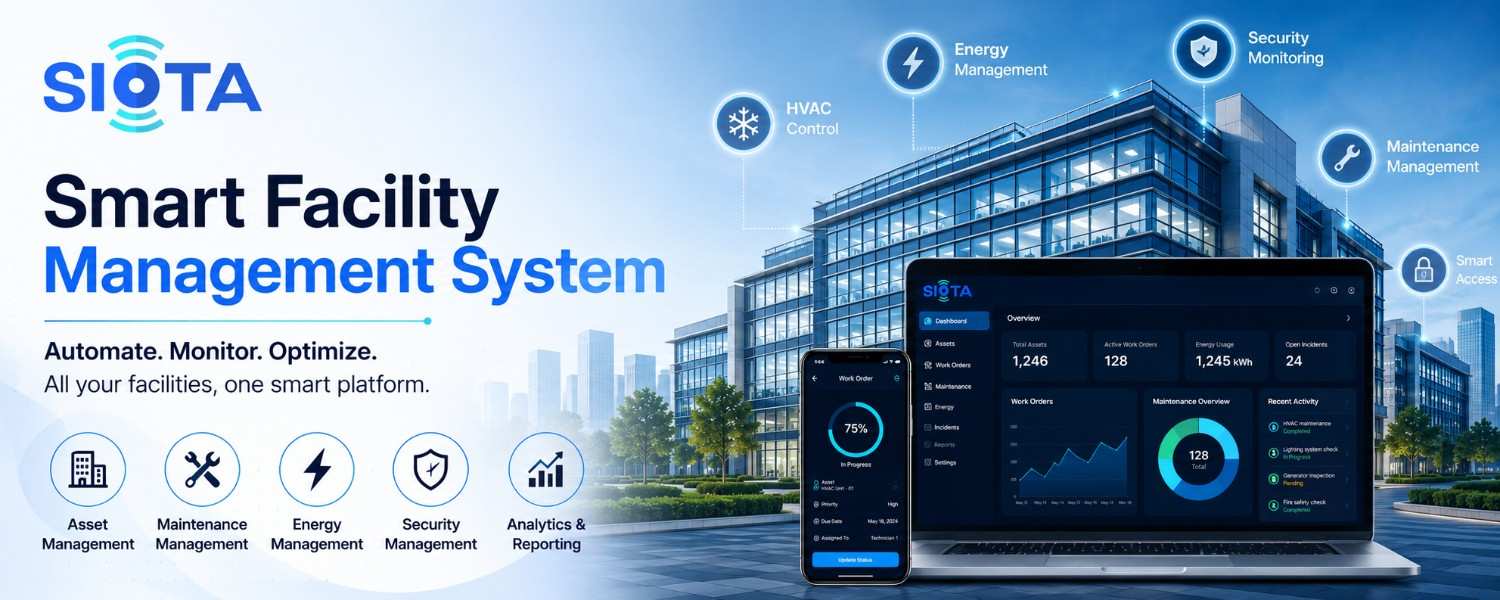
- Sensors on equipment, doors, and rooms that track temperature, occupancy, and status
- A dashboard where all that data lands in one view
- Alerts that fire off automatically when something needs attention
- Reports you can hand to auditors or leadership without building them from scratch
The value isn’t any one piece — it’s how they talk to each other. A sensor flags a problem, the system creates a work order, your tech gets a notification. That whole chain used to take a phone call and a delay. Now it happens in seconds.
Why “Smart” Isn’t Just a Buzzword
Old-school facility management is reactive by nature. Something breaks, you fix it, you move on.
A smart system flips that. It watches for early warning signs — a compressor running hotter than usual, a motor drawing more power than it should — and tells you before the failure happens, not after.
That’s the actual shift. Not “smarter” in some abstract sense. Just earlier.
What You Actually Get Out of It
I’ll be honest — a lot of facility management pitches oversell the benefits. Here’s what tends to hold up in practice.
Lower Energy Bills
Energy is usually the biggest line item you can actually control. Smart systems show you where it’s going in real time, not at the end of the month when the bill arrives.
Lights and HVAC that adjust based on who’s actually in the room, instead of running on a fixed schedule, add up faster than people expect.
Fewer Emergency Repairs
Nobody likes calling a technician in on a Sunday for something that could’ve been caught on Tuesday. Predictive alerts let you schedule fixes on your terms, not the equipment’s.
Knowing What Space You’re Actually Using
Occupancy data tends to surprise people. Buildings often run at far lower usage than assumed, especially with hybrid work now normal. That data is useful when you’re deciding whether to renew a lease or reconfigure a floor.
Audits That Don’t Eat Your Week
When fire safety checks, air quality logs, and maintenance history are already recorded automatically, an audit becomes a report you pull up, not a scramble.
Features Worth Paying For (And What’s Just Noise)
Not every platform is built the same, and some “smart” features barely move the needle. Here’s what’s actually worth prioritizing.
Real-Time Data, Not Yesterday’s Data
If the dashboard updates once a day, you’re still reacting late. Real-time visibility is the whole point — don’t compromise on this one.
Predictive Maintenance That’s Actually Predictive
Some platforms call basic scheduling “predictive maintenance.” Real predictive maintenance uses equipment behavior patterns to flag problems before symptoms are obvious. Ask vendors to show you an example, not just describe it.
A Mobile App People Will Actually Use
Facility techs are on their feet, not at a desk. If the mobile experience is clunky, your team will find workarounds — and you’ll lose the whole benefit of instant alerts.
Integration With What You Already Have
If it can’t talk to your existing HVAC controls or security system, you’re building a second silo, not solving the first one.
Room to Grow
What works for one building should scale to five without a total system overhaul. Ask specifically how pricing and setup change as you add locations.
Picking the Right One (Without Getting Talked Into the Wrong One)
This is a multi-year decision, so it’s worth slowing down here.
Start With Your Actual Problems
Not the industry’s problems — yours. Is it the energy bill? Constant emergency repairs? A compliance headache that eats a week every quarter? Your top three issues should drive the whole evaluation.
Get a Demo Using Your Own Data
Generic demos look great and tell you nothing. Ask the vendor to run through a scenario from your actual building. If they hesitate, that’s worth noting.
Ask About Support Before You Need It
Something will go sideways during setup — it usually does. Find out now whether support means a real person or a ticket queue that takes three days.
Look at the Full Cost, Not Just the Subscription
Installation, sensor hardware, training time — these add up. A platform that looks cheaper on paper isn’t always cheaper once it’s running.
Ask for Examples, Not Testimonials
A glowing quote on a website means very little. A case study with a similar building type and real numbers means a lot more.
Mistakes I See Teams Make (So You Don’t Have To)
Skipping Training Because “It’s Intuitive”
Every platform claims to be intuitive. Most still need real onboarding. Skip this step and adoption stalls within weeks.
Not Asking About Data Security Until Later
Facility systems touch a lot of operational data. Ask about encryption and access controls during evaluation, not after a contract is signed.
Choosing on Price Alone
The cheapest option is rarely the cheapest option once you factor in poor support and missing integrations six months in.
No Clear Definition of Success
If you don’t decide up front what “this is working” looks like, you’ll never know whether it actually did.
Where This Leaves You
A smart facility management system isn’t a nice-to-have anymore — it’s becoming the baseline for buildings that don’t want to bleed money on avoidable repairs and wasted energy.
The upside is real, but only if you pick a platform that fits how your building actually runs, not just what looks good in a sales deck.
If you’re at the point of comparing options, Siota’s platform is worth a look — request a demo and see how it handles your specific building before committing to anything.
Frequently Asked Questions
What does a smart facility management system actually do, day to day? It tracks your building’s systems in real time — HVAC, lighting, occupancy, equipment health — and automates the maintenance and reporting work that used to be manual.
Is this expensive to set up? It depends heavily on building size and what infrastructure you already have. Most vendors let you start with one system or floor and expand from there, so it doesn’t have to be an all-or-nothing cost.
How long does it take to get running? Simpler setups can be live in a few weeks. Larger portfolios with multiple buildings usually take a few months, mostly due to integration work.
Will it work with the systems I already have? Most platforms today integrate with common HVAC and security setups, but always confirm compatibility with your specific equipment before signing anything.
What kinds of buildings see the biggest payoff? Offices, hospitals, schools, manufacturing sites, and retail chains — especially anywhere with multiple locations or high energy use.
Do we really need to train staff on this? Yes. Even a well-designed system needs a proper walkthrough, or your team ends up ignoring alerts and reverting to old habits.
